

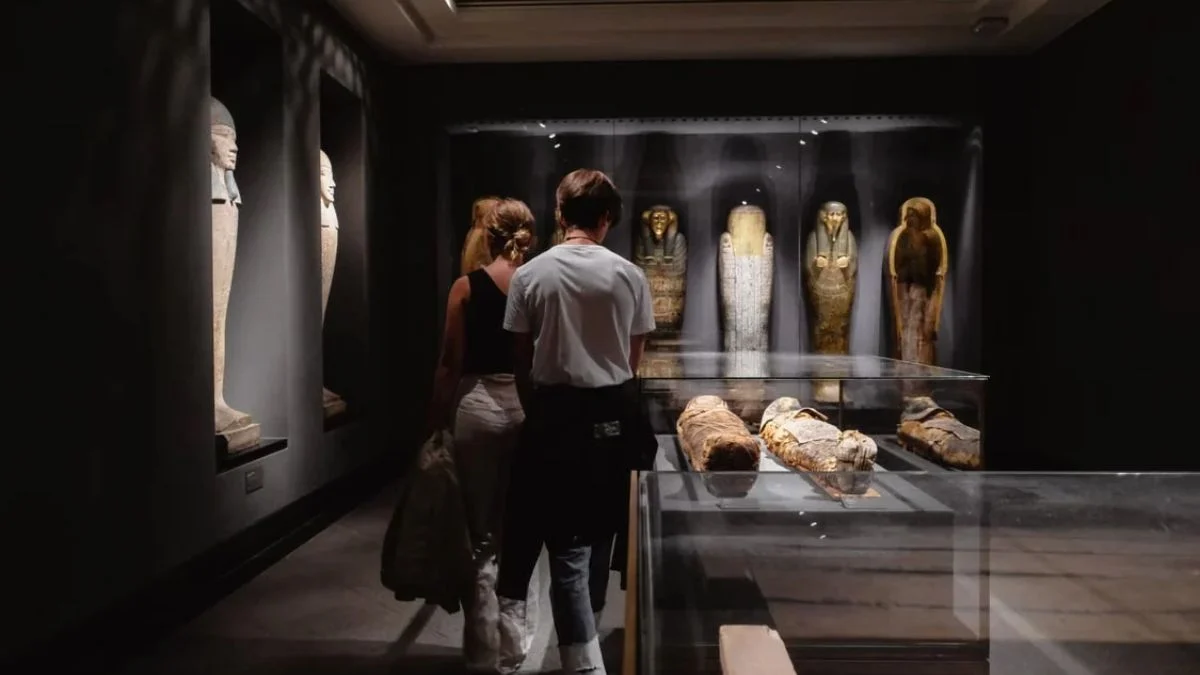
Two museums in Glasgow are rethinking how ancient Egyptian human remains should be presented to the public, raising fresh questions about history, cultural heritage and the dignity of the dead. The changes have renewed debate over whether displaying mummified people is an essential part of understanding ancient civilisations or a practice that museums should reconsider when the wishes of the deceased cannot be established.
The decisions reflect a wider shift in museum ethics, but they have not produced a single approach across Scotland. Behind the changes are individual museum policies, expert consultations and an international debate about consent, descendant communities and what respectful treatment of human remains should look like today.
Why Are Glasgow Museums Removing Ancient Egyptian Human Remains?
The debate has become particularly visible at Kelvingrove Art Gallery and Museum and the University of Glasgow’s Hunterian Museum. Both institutions have reconsidered how Egyptian human remains are presented, but their responses differ.
Kelvingrove, operated by Glasgow Life, has removed several ancient Egyptian human remains from public view. Meanwhile, the Hunterian has retained an ornate Egyptian sarcophagus associated with Lady Shep-En-Hor but covered the mummified person inside it.
Neither decision amounts to a blanket rejection of ancient Egyptian history. Instead, the museums are distinguishing between displaying archaeological objects and exposing human remains to public view.
| Museum | What has changed? | Stated approach |
| Kelvingrove Art Gallery and Museum | Several Egyptian human remains have been removed from public displays. | Glasgow Life is developing its approach to respectful treatment and display, including the role of documented consent. |
| Hunterian Museum | Lady Shep-En-Hor’s sarcophagus remains visible, but the mummified person inside is covered. | The museum has decided that human remains from outside the UK should no longer be placed on open display. |
| St Mungo Museum of Religious Life and Art | A coffin and mummified human remains are in the process of being removed from public display. | The changes form part of Glasgow Life’s wider review of archaeological human remains. |
The distinction matters because the museums have not announced that all Egyptian artefacts will disappear from their galleries. Their decisions concern the public presentation of human remains, while historical objects and archaeological interpretation can continue to be accessible.
Curious About Ancient Egypt?
Ancient Egyptian burial practices continue to prompt questions about funerary traditions, archaeological discoveries and the treatment of the dead. Explore our Egyptian skulls and Abydos human sacrifice report for a related look at reported findings from Egypt.
Which Egyptian Remains Have Been Removed From Kelvingrove?
Kelvingrove has removed several items from public view, including a painted coffin containing the remains of an ancient Egyptian priest named Nekht, a mummified male head, a mummified right foot and a mummified right hand recovered from the Valley of the Kings at Luxor, Egypt.
Visitors have instead encountered a notice explaining the change:
“We have removed human remains from this display as a mark of respect.”
Glasgow Life said the decision “reflects contemporary museum practice” and forms part of its developing approach to the treatment and display of human remains.
The organisation’s draft Human Remains Policy proposes that remains should only be displayed where there is documented and informed consent from the deceased individual or, in appropriate circumstances, their descendants. Where such consent is absent, Glasgow Life considers removing ancient Egyptian remains from public display to be more respectful.
Importantly, Glasgow Life has not claimed that an international museum organisation ordered the removals. The decision was made by the organisation itself within its developing policy framework.
Who Was Nekht, the Ancient Egyptian Priest?
Nekht is identified as an ancient Egyptian priest whose remains were excavated at Beni Hasan in Middle Egypt during archaeological work carried out in the early 20th century.
He is thought to have lived between approximately 1985 and 1797 BC. His remains were subsequently donated to the city of Glasgow in 1923 and became part of the city’s museum collections.
The current decision does not mean that Nekht’s remains have disappeared from the collections altogether. Removing human remains from public view is different from destroying them, disposing of them or returning them to their place of origin.
Glasgow Life is also continuing work to review and remove other archaeological human remains from its displays, including material in the History Discovery Centre and the Scotland’s Early People gallery at Kelvingrove. A coffin and mummified human remains at St Mungo Museum of Religious Life and Art are also being removed from public display.
The Hunterian Covers Lady Shep-En-Hor While Keeping Her Sarcophagus on Display
The Hunterian has taken a different approach to the presentation of Lady Shep-En-Hor.
Rather than removing the entire exhibit, the University of Glasgow museum has kept her ornate sarcophagus on public display while covering the mummified person inside. Visitors can still see the sarcophagus as an archaeological and artistic object, but the human remains are no longer visible.
The museum explained its decision:
“The Hunterian is also re-assessing what will be on display to the general public and as part of its duty for the respectful care of these collections, it has decided to no longer put human remains from outside the UK on open display.”
It continued:
“After in-depth consideration and consultation with experts, including Egyptologists, the Hunterian has decided to continue to display Lady Shep-En-Hor’s sarcophagus as a fine work of Late Period Ancient Egyptian funerary art, but to cover the mummified person, so she can no longer be viewed.”
The museum also stated:
“The Hunterian takes the view that the Lady Shep-En-Hor deserves privacy in death, while retaining its commitment to providing visitors, students and staff with an accessible introduction to the importance of Ancient Egyptian culture for an understanding of the world’s history.”
The sarcophagus has been on near-continuous display since 1820, making it one of the Hunterian’s longstanding Egyptian exhibits. Covering the body therefore changes a presentation that visitors have encountered for generations, without removing the funerary object itself.
Questions About Lady Shep-En-Hor’s Identity
The remains inside the sarcophagus have also been the subject of historical uncertainty. The Hunterian has noted that questions were raised decades ago about whether the person inside the coffin was actually Lady Shep-En-Hor.
Nineteenth-century excavators sometimes moved human remains between coffins. In some circumstances, better-preserved remains could be placed inside more intact or ornate sarcophagi.
According to current reporting, the remains associated with Lady Shep-En-Hor have also undergone X-rays and CT scans during the past 50 years.
These historical and scientific questions form part of the context surrounding the exhibit. However, they should not be confused with the ethical reasoning the Hunterian has given for preventing public viewing of the body.
The museum undertook detailed consideration and consulted experts, including Egyptologists, before reaching its decision. Its current policy states that human remains from outside the UK should no longer be placed on open display, while associated archaeological objects may remain accessible where appropriate.
How the Revised ICOM Code of Ethics Influenced the Debate
The International Council of Museums (ICOM) adopted its revised Code of Ethics in June 2026, following a multi-year revision process.
ICOM UK said the revised code was approved by 85.90% of members at the organisation’s 41st Ordinary General Assembly.
One principle particularly relevant to the Glasgow decisions concerns the dignity of human remains. The revised code states that museums should:
“uphold the inherent dignity of human remains and promote respect for their significance.”
It also calls for decisions concerning human remains to take account of descendants or communities from which the remains originate, where those communities are known.
However, the code does not require every museum to remove all human remains from public display. Instead, it establishes shared ethical principles while recognising that institutions operate within different legal, cultural and professional circumstances.
Prof Steph Scholten, who sits on ICOM’s ethics committee, emphasised that the code supports careful consideration rather than one mandatory outcome.
He said:
“What the code of ethics puts forward is that these topics need careful consideration and decision making, they do not suggest one fixed outcome.”
He also said:
“Kelvingrove and The Hunterian have come to slightly different outcomes about our displays.”
Clarifying the position further, he stated:
“The code of ethics does not prescribe that all human remains should be taken of display.”
The Glasgow decisions should therefore be understood as individual institutional responses to evolving ethical standards, rather than removals ordered by ICOM.
The Hunterian’s Decision Has Its Own Timeline
Although October 2026 reporting places the Hunterian’s decision within the same wider reassessment of museum practice, it should not simply be described as a direct consequence of the June 2026 code.
The Hunterian’s approach followed its own review and consultation process, including consideration of whether the remains should be removed from display, repatriated or retained in storage while the sarcophagus remained visible.
The museum’s dedicated Human Remains Policy covers the care and management of human remains in its collections, with the collection being reviewed and documented as work progresses.
Why Consent and Cultural Heritage Are Central to the Decision
Glasgow Life has also cited the 2025 report Laying Ancestors to Rest by the All-Party Parliamentary Group for Afrikan Reparations.
The report raised concerns about the public display of ancient Egyptian human remains and the possible disregard of the wishes of ancestors and the communities that originally buried them. It argued for significant changes to how ancestral human remains are treated by UK institutions.
The report is an advocacy and parliamentary-group publication, not a law that automatically requires Scottish museums to remove Egyptian remains. Glasgow Life cited it as part of the ethical context informing its developing policy.
Consent is particularly complicated when dealing with people who died thousands of years ago. Direct, informed consent from the deceased cannot realistically be obtained, and the available information may not establish what they would have wanted.
Glasgow Life’s position is that the absence of documented consent is an important consideration when deciding whether the remains should remain on public display. This does not establish what ancient Egyptians would have wanted in these particular cases. Rather, the lack of a way to establish informed consent is being treated as an ethical reason to restrict public viewing.
The wider discussion includes the dignity and privacy of deceased people, religious and cultural beliefs, the wishes of descendant communities, the provenance of museum collections, research access and the educational value of displaying human remains.
Why Some Critics Oppose Removing Egyptian Mummies From Museums
The decisions have also attracted criticism from politicians and commentators who argue that displaying human remains can have educational value and that removing them limits what visitors can learn about ancient civilisations.
Scottish Conservative culture spokesman Murdo Fraser criticised the Kelvingrove decision, describing it as “woke madness”.
He said:
“People visit museums to learn about ancient civilisations, not to see history hidden away because it fails to meet today’s ideological standards.”
He added:
“Glasgow’s museums should be showcasing our history, not quietly removing it to appease the latest trend in political correctness.”
These comments represent political criticism of the museum’s decision, rather than an established finding about the ethics of displaying human remains.
The central disagreement is about how museums should balance the educational and scientific value of their collections against the ethical treatment of the people whose remains are displayed.
The Glasgow decisions also do not represent a universal policy across Scotland. National Museums Scotland has said it is not considering changes to the display of human remains in its collections. Its holdings include Scottish archaeological human remains as well as mummified people from Egypt and Peru.
Some museums may continue displaying human remains when they consider the presentation respectful and appropriate for education or research. Others may choose covering, removal or alternative interpretation.
Could the Egyptian Remains Be Returned to Egypt?
Repatriation is another part of the wider debate over human remains and cultural material.
Both Glasgow institutions have indicated that they would consider repatriation if an appropriate approach were made by a country or institution. However, there is no current reporting establishing that Egypt has made a formal request for the specific Glasgow remains discussed in this story.
Removing remains from public display is not the same as repatriating them. A museum can continue to care for remains in its collections while keeping them out of public view. Repatriation involves a separate process concerning the return of material to an appropriate country, institution, community or claimant.
The Glasgow developments therefore do not establish that the Egyptian remains are currently being returned to Egypt.
What Happens Next for Glasgow’s Museums?
The reviews are continuing beyond the two most prominent exhibits.
At Kelvingrove, work is under way to remove archaeological human remains from additional displays, including material in the History Discovery Centre and the Scotland’s Early People gallery. Glasgow Life has also said that a coffin and mummified human remains at St Mungo Museum are being removed from public view.
The Hunterian is continuing its broader review of human remains in its collections, guided by its Human Remains Policy and ongoing documentation.
There is currently no evidence of a blanket Scottish ban on displaying Egyptian mummies. The museums’ different responses show how institutions can apply broader ethical principles in different ways, depending on their policies, collections, consultations and circumstances.
For the Science-Curious
Unusual natural formations can attract speculation when their appearance resembles familiar structures. Read our Antarctica Pyramid Mountain formation explainer for a science-focused look at the feature.
Conclusion: A Changing Approach to Ancient Egyptian Human Remains
Glasgow’s museum decisions highlight an evolving debate about how ancient Egyptian human remains should be treated and presented. Kelvingrove has removed several remains from public view, while the Hunterian has covered the mummified person associated with Lady Shep-En-Hor but retained her sarcophagus as an example of Late Period Egyptian funerary art.
The revised ICOM Code of Ethics has strengthened the international emphasis on dignity and respect, but it does not demand the removal of every human remain from public display. The debate instead centres on how museums can preserve historical knowledge and support education while considering consent, cultural significance and the respectful treatment of the dead.
For Glasgow’s museums, the process is continuing. Their decisions illustrate a broader reassessment of museum practice, in which ancient history can remain accessible even when the human remains themselves are no longer visible.
Source and Research Disclaimer: This article has been prepared based on thorough research of the sources provided, including reporting from BBC Scotland and STV News, the University of Glasgow Hunterian Human Remains Policy, ICOM UK’s announcement and the International Council of Museums’ Code of Ethics. It reflects the information available from those sources as presented in the supplied material and does not imply independent verification beyond that material. Museum policies, display arrangements and repatriation discussions may change as reviews and consultations continue.
Sources
- BBC Scotland report on the Glasgow museums’ decisions
- University of Glasgow Hunterian Human Remains Policy
- STV News: Egyptian mummies removed from Kelvingrove
- STV News: Hunterian removes Egyptian mummified remains from public view
- ICOM UK: Revised Code of Ethics officially adopted
- International Council of Museums: Code of Ethics
Featured Image Credit: Shvets Anna / Pexels


Leave a Reply