

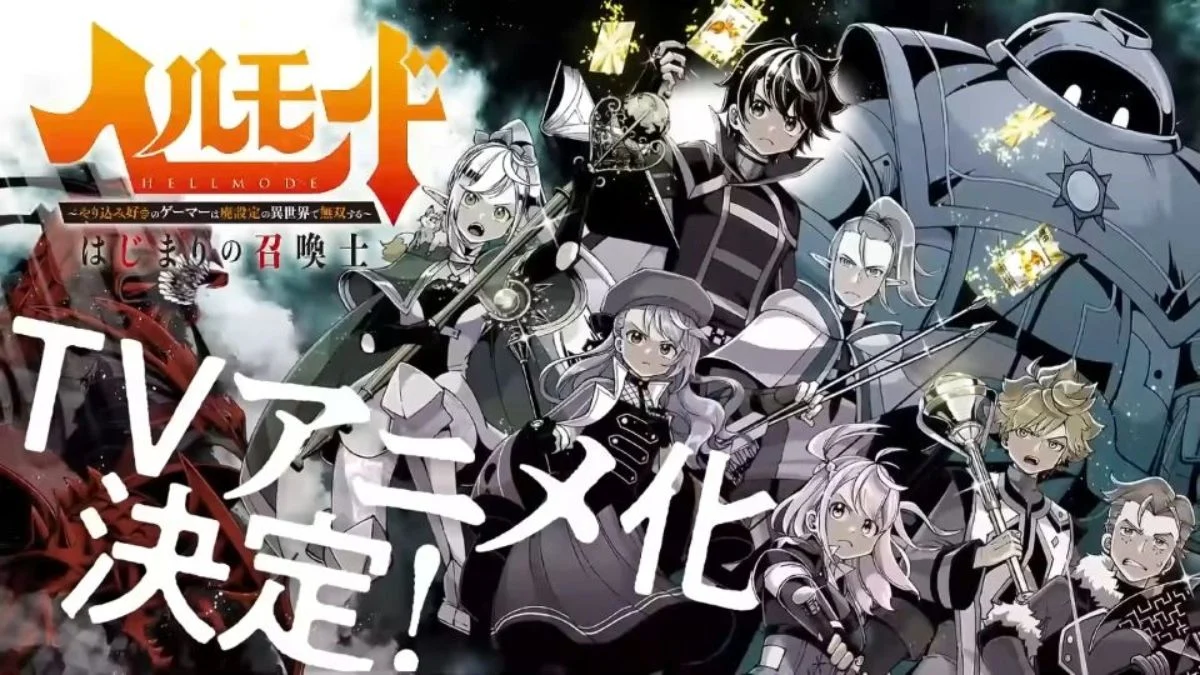
Hell Mode: The Hardcore Gamer Dominates in Another World with Garbage Balancing stands out in the crowded isekai space by turning difficulty itself into the story’s core conflict. The anime officially released on January 9, 2026, and is currently streaming on Prime Video in multiple regions, alongside its Japanese broadcast and streaming rollout. Unlike many power-fantasy adaptations, Hell Mode builds its narrative around persistence, analysis, and earned growth rather than instant dominance.

Premise: A Gamer’s Choice Defines a Life
The story begins with Kenichi Yamada, a 35-year-old hardcore gamer who feels alienated by modern games that reward passive play and shallow progression. When he encounters a mysterious invitation to an endless game, he chooses the hardest possible setting without hesitation. That decision reincarnates him into another world as Allen, a child born into a poor serf family with no visible talent.
This choice defines everything that follows. Hell Mode multiplies experience requirements and strips away conveniences, forcing Allen to survive and grow in a world that offers no guidance, no tutorials, and no safety nets. Every gain comes from deliberate effort, testing limits, and learning through failure.
Reincarnated in an Unforgiving World
Allen’s new world operates on rigid class systems, social hierarchies, and visible power rankings. On paper, he appears talentless, which places him at the lowest rung of society. In practice, his hidden Summoner class and Hell Mode mechanics allow growth at an unprecedented scale, provided he endures the grind.
Instead of dramatic power spikes, the anime focuses on incremental progression. Allen studies enemy behavior, experiments with skills, and treats every encounter as data. This approach creates tension rooted in preparation and strategy rather than spectacle alone. The result feels closer to a long-term campaign than a highlight reel of victories.
Manga and Light Novel Background
The Hell Mode franchise began as a web novel written by Hamuo, later published as a light novel series with illustrations by Mo. Its popularity led to a manga adaptation illustrated by Enji Tetta, which further expanded the audience through detailed visual storytelling.
The manga delves deeper into Allen’s internal logic, system experimentation, and long-term planning. It spends significant time on early hardship, making later successes feel justified rather than inevitable. English releases of both the light novels and manga are available through J-Novel Club, helping the series gain a strong international following well before the anime aired.
While the anime streamlines some internal monologue, it remains faithful to the manga’s emphasis on effort-driven progression and mechanical depth.
Anime Production and Cast Details
The anime adaptation features a strong voice cast led by Mutsumi Tamura as Allen, with Mayu Iizuka as Krena, Tasuku Hatanaka as Dogora, and Sayaka Senbongi as Cecil. Direction comes from Masato Tamagawa, with series composition by Daishiro Tanimura. Character designs by Kei Tsushima translate the source material’s grounded aesthetic into animation that prioritizes clarity over excess.
The pacing reflects the story’s philosophy. Training, preparation, and consequence receive as much attention as combat, reinforcing the sense that progress must be earned.
What Are Isekai Anime?
Isekai anime revolve around characters who get transported, reincarnated, or trapped in another world, often one with fantasy or game-like rules. The genre typically explores how modern knowledge, values, or skills interact with unfamiliar worlds. Many isekai series lean into power fantasy, where protagonists gain overwhelming abilities early on.
Hell Mode takes a different approach. It uses isekai mechanics to examine endurance, discipline, and long-term strategy. Instead of asking how fast a character can become powerful, it asks how much effort that power truly demands.

Releasing Soon: The Eminence in Shadow Sets the Spotlight for March 29
Why Hell Mode Feels Different

What sets Hell Mode apart is its respect for process. The story treats preparation as meaningful drama and frames growth as something you build over time, not something you receive. For viewers tired of effortless protagonists, this creates a more grounded and rewarding experience.
If you enjoy isekai anime and prefer stories that emphasize on character growth, strategic thinking, and earned strength, Hell Mode offers a refreshing and thoughtful take on the genre. It is well worth watching if you appreciate challenge-driven narratives.


Leave a Reply