

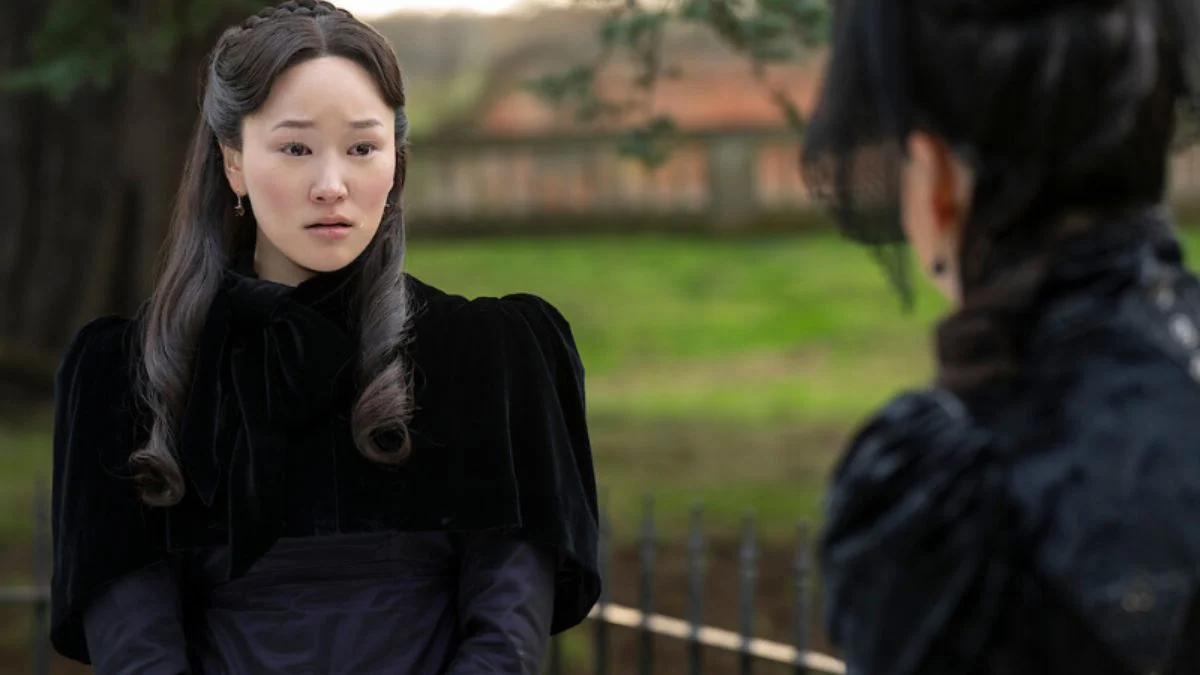

Netflix’s Bridgerton has always thrived on the tension between glittering romance and rigid Regency-era social rules. In Bridgerton Season 4, one seemingly simple word—“ward”—becomes the emotional and narrative backbone of Sophie Baek’s story. While casual viewers may gloss over the term, its historical meaning carries deep implications that shape Sophie’s identity, her suffering, and her forbidden romance with Benedict Bridgerton.
This article unpacks what “ward” means in Bridgerton, why it mattered in Regency society, and how the term quietly exposes secrets about class, legitimacy, and power—setting the stage for one of the show’s most dramatic love stories yet.
In This Post:
Understanding the Regency-Era Meaning of “Ward”
In historical terms, particularly during the Regency period, a ward referred to a person—most often a child or minor—placed under the legal protection and guardianship of another individual, a court, or an institution. According to standard dictionary definitions and historical records, wards were commonly:
- Orphans
- Children without direct family support
- Illegitimate children whose parentage needed to remain discreet
Guardians were responsible for a ward’s education, financial support, upbringing, and social protection. Among the aristocracy, this arrangement often concealed inconvenient truths while maintaining social respectability.
In short, being called a ward offered protection without acknowledgment—a crucial distinction in a society obsessed with lineage and reputation.

The First Use of “Ward” in Bridgerton Season 4
The term takes on narrative weight in Episode 2 of Season 4, titled “Time Transfixed.” During a flashback to Sophie Baek’s childhood, Lord Penwood introduces her to his new wife, Lady Araminta Gun, with a carefully chosen phrase:
“This is my ward.”
On the surface, the statement appears polite and proper. Yet Araminta’s immediate coldness and visible disdain signal that she understands the coded implication. In Regency society, calling a child a ward—rather than a niece, cousin, or dependent—often hinted at scandalous origins.
Her reaction reveals that the word is doing far more work than it appears.
Sophie Baek’s True Identity: The Secret Behind the Label
As Bridgerton Season 4 gradually reveals, Sophie Baek is not an orphaned child of a family friend, as Lord Penwood claims. She is, in fact, his illegitimate daughter, born from an affair.
Acknowledging Sophie openly would have endangered Lord Penwood’s social standing and his marriage. By calling her his ward, he creates a socially acceptable fiction—one that allows him to provide for her upbringing without publicly admitting paternity.
This euphemism protects his reputation while quietly condemning Sophie to a life of uncertain status—never fully family, never fully servant.
Why Illegitimacy Was So Dangerous in Regency Society
To understand the weight of Sophie’s position, it’s essential to grasp how illegitimacy functioned in Regency England. Children born outside marriage were often:
- Excluded from inheritance
- Barred from respectable marriages
- Socially marginalized regardless of upbringing
Even when financially supported, illegitimate children existed on the fringes of polite society. The term ward allowed aristocrats to care for such children discreetly, but it offered no protection against long-term vulnerability.
This social reality explains why Araminta Gun immediately views Sophie as a threat—not emotionally, but economically and socially.
Araminta Gun’s Cruelty Begins with One Word
Lady Araminta Gun, played by Katie Leung, understands exactly what “ward” implies. Her resentment is instant and enduring. While Sophie initially lives in relative comfort under Lord Penwood’s protection, her position is never secure.
After Lord Penwood’s death, the fragile shield provided by the word ward collapses.
Araminta demotes Sophie to a household servant, stripping her of education, status, and dignity. Her daughters, Rosamund and Posy, follow suit—Rosamund with cruelty, Posy with quiet discomfort.
This dynamic closely mirrors Cinderella, but Bridgerton grounds the fairy tale in harsh social realism.
“Ward” as a Symbol of Class and Power in Bridgerton
In Bridgerton Season 4, “ward” becomes more than a legal term—it becomes a symbol of enforced silence. Sophie’s inability to speak openly about her birth traps her in a social limbo:
- Too refined to be a servant
- Too illegitimate to be a lady
Her romance with Benedict Bridgerton is shaped entirely by this tension. While Benedict is drawn to Sophie’s intelligence and strength, society sees only her status. The barriers between them are not emotional—but institutional.
Fans on Reddit and other platforms have noted that Araminta’s hostility stems from recognizing Sophie as “coded illegitimacy”, a truth everyone understands but no one names.
From Julia Quinn’s Novel to Netflix’s Adaptation
The storyline draws directly from Julia Quinn’s novel An Offer from a Gentleman, which serves as the basis for Season 4. In the book, Sophie’s status as a ward is central to:
- Her lack of inheritance
- Her vulnerability to abuse
- The impossibility of her marrying Benedict without scandal
Netflix’s adaptation modernizes the presentation but preserves the theme: love constrained by class and legitimacy.

Bridgerton Season 4 Cast: Characters Shaping Sophie’s Story
Season 4 introduces new faces while bringing back beloved favorites, all contributing to Sophie’s journey.
Lead Characters
- Luke Thompson as Benedict Bridgerton – A bohemian artist grappling with identity and love
- Yerin Ha as Sophie Baek – A resilient maid with a hidden past as a ward
Key Supporting Roles
- Katie Leung as Lady Araminta Gun – Sophie’s cruel stepmother
- Michelle Mao as Rosamund Li – Araminta’s favored daughter
- Isabella Wei as Posy Li – The kinder stepsister
Returning Bridgertons include Anthony, Kate, Eloise, Francesca, Violet, and Queen Charlotte, whose societal influence continues to loom large over Sophie’s fate.
| Category | Actor/Actress | Character | Role Details |
| Leads | Luke Thompson | Benedict Bridgerton | The bohemian second son; central to the season’s romance, exploring art, identity, and love. |
| Yerin Ha | Sophie Baek | Benedict’s love interest; a resourceful maid with a secret past as a “ward”; newcomer bringing vulnerability and strength. | |
| Returning Bridgertons | Jonathan Bailey | Anthony Bridgerton | Eldest brother; provides guidance and comic relief with his wife Kate. |
| Simone Ashley | Kate Bridgerton (née Sharma) | Anthony’s wife; continues her role as a supportive viscountess. | |
| Claudia Jessie | Eloise Bridgerton | Benedict’s sister; aids in his quest to find the “Lady in Silver”; explores her own independence. | |
| Hannah Dodd | Francesca Bridgerton | Younger sister; deals with her own marriage subplot. | |
| Ruth Gemmell | Violet Bridgerton | Matriarch; hosts the masquerade ball; pursues her own romance with Lord Marcus Anderson. | |
| Florence Hunt | Hyacinth Bridgerton | Youngest sister; adds family levity. | |
| Will Tilston | Gregory Bridgerton | Youngest brother; minor role in family scenes. | |
| Returning Ton Members | Nicola Coughlan | Penelope Bridgerton (née Featherington) | Former Lady Whistledown; supports the family as Colin’s wife. |
| Luke Newton | Colin Bridgerton | Benedict’s brother; focuses on his marriage and writing. | |
| Adjoa Andoh | Lady Agatha Danbury | Wise advisor; involved in subplots with Violet. | |
| Golda Rosheuvel | Queen Charlotte | Oversees the season’s “diamond”; adds royal intrigue. | |
| Polly Walker | Portia Featherington | Penelope’s mother; schemes for her family’s status. | |
| Martins Imhangbe | Will Mondrich | Baron; navigates inheritance and society issues. | |
| Emma Naomi | Alice Mondrich | Will’s wife; deals with family tensions. | |
| Hugh Sachs | Brimsley | Queen’s loyal secretary. | |
| Lorraine Ashbourne | Mrs. Varley | Featherington household staff; recurring support. | |
| New Additions | Katie Leung | Lady Araminta Gun | Sophie’s cruel stepmother; twice-widowed social climber with debutante daughters. |
| Michelle Mao | Rosamund Li | Araminta’s favored daughter; competitive debutante. | |
| Isabella Wei | Posy Li | Araminta’s overlooked daughter; kinder stepsister to Sophie. | |
| Victor Alli | Lord John Stirling | Francesca’s husband; recurring from Season 3. | |
| Masali Baduza | Michaela Stirling | John’s cousin; new dynamic for Francesca’s arc. | |
| Sophie Lamont | Celia | Recurring guest; minor ton member. | |
| David Moorst | Alfie | New character; involved in side plots. |
The Masquerade Ball and the “Lady in Silver”
The season’s emotional catalyst arrives at Violet Bridgerton’s masquerade ball, where Benedict meets the mysterious “Lady in Silver.” Their connection is instant and intense—yet fleeting.
Unbeknownst to Benedict, the woman who captivates him is the same maid he later encounters in everyday life.
The irony is devastating: when Benedict later asks Sophie to become his mistress, he unknowingly reenacts the very power imbalance her status as a ward created. Sophie’s refusal marks a turning point—one driven by dignity, not romance.

How “Ward” Shapes the Season’s Central Themes
By the time Season 4 unfolds fully, “ward” has come to represent:
- The cost of secrecy
- The cruelty of rigid class systems
- The emotional toll of social invisibility
Sophie’s journey from silenced dependent to self-possessed woman mirrors Bridgerton’s broader critique of aristocratic privilege.
Release Schedule and What Lies Ahead
Bridgerton Season 4 premiered on Netflix in two parts:
- Part 1: January 29, 2026
- Part 2: February 26, 2026
With eight episodes total, the season builds deliberately—favoring emotional tension over immediate payoff. As Part 2 approaches, viewers can expect revelations about Sophie’s identity, Benedict’s reckoning with privilege, and resolutions that challenge Regency norms.
Why the Word “Ward” Matters So Much
In Bridgerton, a single word can define a life.
“Ward” protects Sophie as a child—but abandons her as a woman. It conceals love, enables cruelty, and exposes the hypocrisy of a society obsessed with appearances. By centering an entire season around this fragile status, Bridgerton Season 4 transforms historical nuance into emotional drama.
And in doing so, it reminds viewers that sometimes the most powerful secrets are hidden in plain sight—spoken softly, but understood by everyone who hears them.


Leave a Reply