

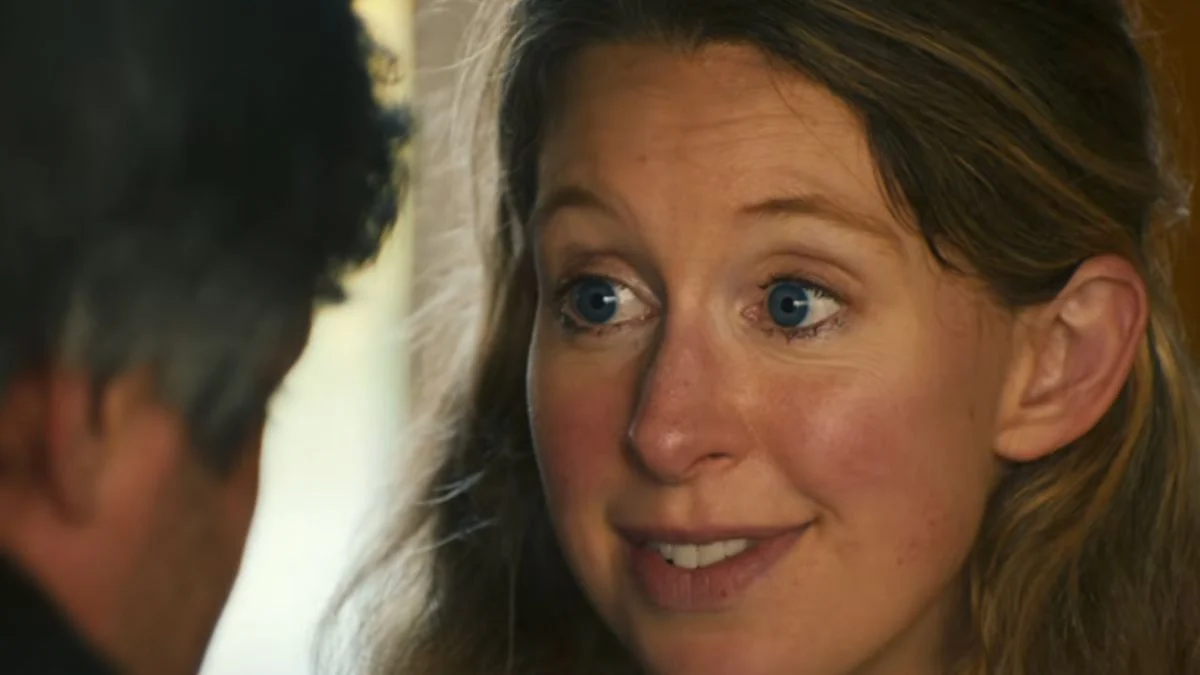
Nathan Fielder has taken one of Silicon Valley’s most infamous scandals and made it even stranger. You Can See Everything, his secret Elizabeth Holmes documentary co-directed with Lance Oppenheim, suddenly appeared at the Telluride Film Festival on September 6, 2026, after being kept almost completely under wraps for years. A24 has now confirmed the 174-minute film will hit cinemas in October.
But this is not simply another retelling of the Theranos scandal. Fielder and Oppenheim spent nearly three years following Holmes, beginning just 34 days before she was due to enter federal prison, creating an unusually intimate and surreal portrait of the convicted Theranos founder — and of the way she continues to understand what happened.
Blindsided By The Truth: Another 2025 documentary shocked audiences by exposing a story darker than anyone expected. For more, read our story on The Perfect Neighbor (2025) Netflix Documentary: The True Crime Film That Won 5 Critics Choice Awards and Shocked America.
Nathan Fielder’s secret Elizabeth Holmes documentary shocked Telluride
The first twist came before the film even started.
Telluride audiences were invited into a screening without being told which movie they were about to watch. The mystery surrounding the screening was so intense that festival organisers required recording-capable electronic devices to be placed inside sealed pouches to prevent details from escaping.
Then the filmmakers walked out.
The mystery film was revealed to be You Can See Everything, the previously secret documentary from Nathan Fielder and Lance Oppenheim.
Fielder, whose work includes the reality-bending comedy series Nathan for You, The Rehearsal and The Curse, appeared with Oppenheim before the screening.
He immediately acknowledged the unusual reveal with a joke:
“For those of you who don’t know who we are and are disappointed, I apologize. But hopefully by the end of the film, you’ll be slightly less disappointed,” Fielder told the audience.
By the time the screening ended, the film had become one of Telluride’s biggest talking points.
Early critical reaction described it as an unusually strange collision of observational filmmaking, performance and reality — a combination that makes considerably more sense once you understand exactly how Fielder approached Holmes.
A Warmer Kind of Tribute: Prime Video’s own documentary offers an emotional look back at a comedy icon’s life and legacy. For more, check out our piece on John Candy: I Like Me – A Touching Prime Video Documentary Honoring a Comedy Legend.
What is Nathan Fielder’s ‘You Can See Everything’ documentary about?
At its core, You Can See Everything follows Elizabeth Holmes during the period surrounding the beginning of her federal prison sentence.
But the project is much bigger than that initial premise.
Holmes invited Fielder and Oppenheim to document her life 34 days before she was sent to prison. What began as access to an extraordinarily consequential moment in her life eventually became a three-year filmmaking project.
The filmmakers were not simply interested in sitting Holmes down for conventional interviews.
They spent extended periods around her, observing her home life, conversations, interactions and preparations for prison. Holmes was living with her partner, William “Billy” Evans, and their children as she prepared for the separation created by her sentence.
That access changes the entire perspective of the Theranos story.
Instead of reconstructing Holmes exclusively through journalists, former employees, investors and courtroom testimony, You Can See Everything allows audiences to spend extended time with Holmes herself.
And that is where things get considerably more uncomfortable.
Counting Down To Confinement: Another Netflix feature explores survival and resilience in the shadow of a life-altering ordeal. For more, our full breakdown is here: Kidnapped: Elizabeth Smart (2026) — A Powerful Netflix Documentary on Survival, Trauma, and Resilience.
Elizabeth Holmes still insists she was telling the truth
The most striking part of the documentary may not be a new revelation about Theranos at all.
It is Holmes’ apparent conviction in her own version of events.
The film does not present her criminal case as some unresolved legal mystery. Holmes was convicted of defrauding investors, and You Can See Everything does not overturn or challenge that finding.
Instead, Fielder investigates something far more unusual: how Holmes understands herself after Theranos collapsed and after she was convicted.
Holmes continues to describe herself as someone who has been truthful, even though the evidence presented during her trial established that investors were misled about important aspects of Theranos’ technology, business relationships and financial condition.
That creates the documentary’s central tension.
Fielder is openly sceptical.
Holmes continues to present herself as sincere.
And the longer the filmmakers remain with her, the more complicated that gap becomes.
The question gradually stops being simply What happened at Theranos?
Instead, the documentary asks:
How does Elizabeth Holmes continue to understand what happened at Theranos?
When Charm Hides The Truth: This chilling documentary unpacks how a killer’s likability fooled everyone around him. For more, our full breakdown awaits: Handsome Devil: Charming Killer (2026) — Full Breakdown of the True-Crime Documentary That Shocked Viewers Worldwide.
The A24 teaser reveals the strange dynamic between Fielder and Holmes
After the surprise Telluride premiere, A24 released the first teaser for You Can See Everything and confirmed its October theatrical release.
The studio’s official synopsis sets up the story with a remarkably specific starting point:
“Thirty-four days before she’s sent to prison, notorious Silicon Valley founder Elizabeth Holmes invites a skeptical film crew to document her every move.”
A24 describes the resulting project as a “mind-bending three-year journey into the abyss.”
The teaser immediately establishes the unusual relationship between Fielder and Holmes.
The two sit extremely close together while Fielder questions Holmes about whether she is being truthful with him.
Holmes tells him:
“I don’t have anything to deceive you on. Of course I’m not deceiving you. … Why would I deceive you? There’s no reason for me to do that.”
Fielder responds:
“Okay. All right. Okay, good chat.”
Holmes then says:
“I’m always being real.”
It is a tiny exchange, but it essentially establishes the entire documentary’s central conflict.
Fielder is questioning.
Holmes is insisting.
And neither side appears willing to completely occupy the other’s version of reality.
When The Story Becomes The Payday: A closer look at how one high-profile documentary and memoir deal translated into millions. For more, our report is here: Melania Trump Earned Over $17.2 Million in 2025: Inside the Documentary Deal, NFT Boom and Memoir That Fueled Her Income.
Why the exact Elizabeth Holmes conviction matters to this documentary
Because the Theranos story has been told so many times, it is easy for the legal details to become blurred.
One particularly important distinction is sometimes missed: Elizabeth Holmes was not convicted of defrauding patients.
A federal jury convicted Holmes in January 2022 on one count of conspiracy to commit wire fraud against Theranos investors and three counts of wire fraud against investors.
She was acquitted of the conspiracy charge involving patients and three substantive patient-fraud counts.
The jury also failed to reach unanimous verdicts on three additional investor-related counts.
Holmes was sentenced in November 2022 to 135 months — 11 years and three months — in federal prison, followed by three years of supervised release.
She began serving her sentence in 2023.
Those distinctions matter because You Can See Everything is deeply interested in Holmes’ legacy and self-understanding, while the criminal conviction itself specifically concerned fraud against investors.
Loyalty Over Everything: A new documentary puts a rapper’s allegiances and legacy on full display. For more, our story is right here: The Game Releases ‘The Documentary III’ and Puts Drake Loyalty Front and Center: “When You’re From the Westside You Ain’t Gotta Pick Sides”.
Elizabeth Holmes legal timeline
| Date / Period | Event | Official detail |
| 2003 | Theranos founded | Elizabeth Holmes founded the company |
| January 2022 | Federal conviction | One investor-fraud conspiracy count and three investor wire-fraud counts |
| January 2022 | Acquittals | Holmes was acquitted of the patient-related conspiracy charge and three substantive patient-fraud counts |
| November 2022 | Sentencing | 135 months, or 11 years and three months, in federal prison |
| 2023 | Prison sentence begins | Holmes began serving her sentence |
| 2023 | Documentary filming begins | Holmes invited the filmmakers to document her life 34 days before prison |
| September 6, 2026 | World premiere | You Can See Everything surprise-premiered at Telluride |
| October 2026 | Theatrical release | A24 has confirmed a theatrical release, with the specific date not yet announced as of September 7, 2026 |
What Theranos promised — and why the company became a scandal
To understand why Fielder’s documentary carries such weight, it helps to go back to the original Theranos pitch.
Holmes founded Theranos in 2003 and promoted it as a revolutionary healthcare technology company.
The company’s central promise was enormous: blood testing could supposedly be performed using extremely small quantities of blood, including samples collected through a finger prick, rather than traditional blood draws.
The idea attracted massive attention.
Theranos eventually secured hundreds of millions of dollars from investors and reached a valuation of roughly $9 billion at its peak.
Holmes became one of the most recognisable young entrepreneurs in the technology industry. She was frequently presented as a visionary capable of transforming healthcare.
But the technology did not perform as publicly represented.
The Ninth Circuit’s review of the case described the promised technological breakthrough as a “mirage” and concluded that the company’s blood-testing system did not deliver the faster and more accurate results Holmes and Ramesh “Sunny” Balwani had promoted.
The court also reviewed evidence concerning Theranos’ use of conventional third-party laboratory equipment while investors were allegedly led to believe that testing was being performed using Theranos’ proprietary technology.
That history ultimately became central to the federal criminal case.
How the Theranos scandal destroyed Elizabeth Holmes’ public image
Theranos’ collapse accelerated in 2015 after investigative reporting exposed serious questions about the company’s technology and testing practices.
What followed was a rapidly expanding crisis involving regulatory scrutiny, lawsuits and criminal investigations.
Holmes’ trial ultimately established that investors had been misled about significant aspects of Theranos’ business and technology.
The resulting federal case ended with her conviction and prison sentence.
Ramesh “Sunny” Balwani, Holmes’ former romantic partner and Theranos executive, was separately convicted and sentenced to 155 months in prison.
The Ninth Circuit later upheld the convictions.
Yet You Can See Everything deliberately refuses to structure itself as another straightforward rise-and-fall account.
The legal record already exists.
The scandal has already been investigated.
The question Fielder is interested in is what happens when the person at the centre of that scandal is given the opportunity to tell her own story — at length, and on camera.
Rivalries Boiling Over: A long-running mining series takes a darker turn as old partnerships fracture on camera. For more, our recap is here: ‘Gold Rush’ Season 17 Takes a Dark Turn: Parker Schnabel Targets Tony Beets While Rick Ness Faces a Life-Altering Crisis.
Why Nathan Fielder is the perfect — and strangest — filmmaker for this story
Fielder’s fascination with human behaviour has always been at the centre of his work.
From Nathan for You to The Rehearsal and The Curse, his projects repeatedly blur the boundaries between genuine interaction and constructed situations.
That makes You Can See Everything particularly intriguing.
Holmes is not an ordinary documentary subject.
Her entire public history has been shaped by questions of presentation, perception, credibility and extraordinary claims.
Fielder’s approach puts those same questions directly inside the filmmaking process.
He becomes part of the story.
His reactions are visible.
His scepticism is visible.
His questions are visible.
And Holmes’ answers remain at the centre of the encounter.
The documentary therefore becomes about two things simultaneously: Elizabeth Holmes and the experience of trying to understand Elizabeth Holmes.
That distinction is what separates the film from a conventional investigative documentary.
Amanda Seyfried returns to the Elizabeth Holmes story in a very unexpected way
Then comes another layer.
Amanda Seyfried, who famously portrayed Holmes in Hulu’s 2022 limited series The Dropout, also becomes part of You Can See Everything.
Seyfried won an Emmy for her performance as Holmes.
Here, however, she is not simply appearing to discuss the role.
Her involvement becomes part of Fielder’s unusual attempt to examine Holmes through performance.
The documentary reportedly uses Holmes’ recorded words and other material to allow Seyfried to recreate aspects of Holmes.
That creates an unusual triangle:
- The real Elizabeth Holmes
- Amanda Seyfried’s fictionalised portrayal of Holmes
- Nathan Fielder examining both
The result is deliberately self-aware.
Audiences are watching the real Holmes while simultaneously watching an actress who previously played her and a filmmaker examining the difference between the real woman and the media character audiences have already come to recognise.
Reality and performance start feeding into one another.
And that is exactly where Fielder’s filmmaking becomes especially strange.
A Sudden Fall From Grace: A beloved TV voice finds himself pulled from the spotlight amid an active investigation. For more, our report is here: Jim Thornton Suspended from ‘Wheel of Fortune’ as Sony Investigates Allegations Tied to Airline Incident.
What happens to the documentary after Elizabeth Holmes goes to prison?
Holmes entering prison does not bring the documentary to an end.
Instead, it changes the structure of the project.
Once Holmes begins serving her sentence, direct access becomes more limited. Fielder and Oppenheim continue exploring her story through recorded material, conversations and people around her.
Billy Evans becomes an important presence.
The documentary examines the people closest to Holmes and the way her public image continues to be managed even when she is physically absent.
That absence becomes part of the story.
Rather than turning into a conventional prison documentary, You Can See Everything uses Holmes’ separation from the outside world as another way of examining her continuing presence in the public consciousness.
The person may be behind bars.
The story is not.
‘You Can See Everything’ deliberately blurs reality, documentary and performance
This is arguably the film’s most unusual creative choice.
Holmes’ real conversations appear alongside Fielder’s reactions.
Seyfried’s involvement introduces performance.
The filmmakers are documenting reality while also examining how reality changes when people know they are being watched.
That creates a strange loop:
Reality becomes performance, and performance becomes part of the reality being examined.
It is a concept that fits Fielder’s broader body of work almost perfectly.
His projects frequently ask how much of human behaviour is spontaneous and how much changes when people know a camera is present.
With Holmes, that question becomes even more loaded.
Her entire public history has involved questions about perception, presentation and credibility.
So the camera is not simply observing her.
The camera becomes part of the experiment.
Nathan Fielder admits he is still struggling to understand the experience
Perhaps the most revealing comment about the documentary came from Fielder himself after the Telluride screening.
Rather than presenting himself as someone who had completely decoded Holmes, the filmmaker admitted that the experience remained difficult for him to process.
“I really am struggling to this day to understand exactly what I experienced,” Fielder said during the post-screening discussion.
That comment may be the clearest explanation of what makes You Can See Everything different.
Fielder and Oppenheim spent years with one of the most extensively documented corporate scandal figures of the modern era.
They had access.
They had time.
They had conversations.
And yet the result apparently did not produce a simple answer.
Instead, it left Fielder questioning what he had actually witnessed.
New Season, New Contenders: A ballroom competition returns with a stacked celebrity lineup ready to compete. For more, our cast breakdown is here: ‘Dancing With the Stars’ Season 35 Cast Revealed: Jenna Dewan, Julia Stiles, Harry Shum Jr. Lead 16 Couples in High-Stakes Ballroom Return.
How ‘You Can See Everything’ differs from previous Elizabeth Holmes documentaries
Elizabeth Holmes’ story has already appeared across documentaries, books, podcasts, news investigations and dramatizations.
HBO’s The Inventor: Out for Blood in Silicon Valley examined the Theranos scandal through interviews and archival material.
Hulu’s The Dropout, starring Amanda Seyfried, dramatized Holmes’ rise and downfall.
You Can See Everything takes a fundamentally different route.
Rather than simply reconstructing the Theranos scandal, it gives Holmes direct participation in the filmmaking process and documents her life immediately before imprisonment.
That means its biggest contribution may not be a brand-new explanation of what happened at Theranos.
The basic facts are already established.
Instead, the documentary offers something much stranger: an extended portrait of a convicted fraudster who continues to view herself through a very different lens.
And that is where the film’s real tension lives.
When does ‘You Can See Everything’ release in cinemas?
A24 has confirmed that You Can See Everything will receive a theatrical release in October 2026.
As of September 7, 2026, the studio has not announced the specific October release date.
The documentary is directed by Nathan Fielder and Lance Oppenheim and has a reported running time of 174 minutes.
Official film details
| Detail | Information |
| Title | You Can See Everything |
| Directors | Nathan Fielder, Lance Oppenheim |
| World premiere | September 6, 2026, Telluride Film Festival |
| Distributor | A24 |
| Theatrical release | October 2026 |
| Specific release date | Not announced as of September 7, 2026 |
| Runtime | 174 minutes |
| Main figures featured | Nathan Fielder, Elizabeth Holmes, Billy Evans, Amanda Seyfried |
| Producers | Nathan Fielder, Lance Oppenheim, Tatiana Bears, Maggie Ambrose, Jack Davis |
| Executive producer | Emily Osborne |
| Cinematographer | David Bolen |
| Editor | Adam Locke-Norton |
| Composer | Ari Balouzian |
Life After The Villa: Contestants reveal what’s actually changed in their relationships since the show ended. For more, our reunion recap is here: Love Island USA Season 8 Reunion Unveils Post-Villa Truths: “Very Much in Love,” Taking It Slow, and Two Broken Couples.
Why Nathan Fielder’s Elizabeth Holmes documentary is getting so much attention
The reaction to You Can See Everything is partly about the sheer oddness of its central pairing.
Nathan Fielder is known for turning ordinary interactions into elaborate experiments in human behaviour.
Elizabeth Holmes is a convicted fraudster whose public persona was built around extraordinary claims about transforming healthcare.
Putting those two people together creates an unusual cinematic confrontation.
And the timing could hardly be more revealing.
Audiences have already watched documentaries, dramas and investigations about Theranos. They know the basic story. They know the company collapsed. They know Holmes was convicted of defrauding investors. They know she went to prison.
So Fielder does not appear to be asking audiences to reconsider whether Theranos worked.
The legal record has already answered that.
Instead, he is asking something much more unsettling.
What happens when someone remains completely convinced of their own version of reality even after the world around them has rejected it?
That question gives You Can See Everything its strange power.
Holmes is not simply being investigated.
She is being observed.
Fielder is not simply interviewing her.
He is trying to understand the experience of being around her.
And the audience is left somewhere in the middle, watching the distance between Holmes’ self-understanding and the established legal record grow increasingly difficult to ignore.
For a story that has already been told countless times, that may be the most unexpected direction the Theranos saga could have taken.
The bottom line on ‘You Can See Everything’
You Can See Everything is not another conventional Theranos documentary, and that appears to be exactly the point.
The scandal itself is no longer the mystery. The conviction, the investor fraud, the collapse of Theranos and the company’s failed technological promises have been extensively documented.
Fielder and Oppenheim are chasing something more personal and considerably stranger.
They began filming Holmes 34 days before she entered prison and stayed with the story for nearly three years. Along the way, the documentary brings together Holmes, Fielder, Billy Evans and Amanda Seyfried, while deliberately mixing observation, recorded material and performance.
The result is an unsettling portrait of a woman whose public identity has already been dissected from almost every possible angle — yet who still appears to understand her own story very differently.
And perhaps that explains why Fielder is still trying to understand what he experienced.
The Theranos story has an established ending.
Elizabeth Holmes’ story clearly doesn’t.
Stepping Into The Spotlight: A surprise host steps in while a longtime judge recovers away from the desk. For more, our story is here: Simon Cowell’s ‘America’s Got Talent’ Seat Gets a Surprise Replacement as Kenan Thompson Steps In During Back-Surgery Recovery.
Disclaimer
This article is based on thorough research of the verified information and sources provided, including official film information, legal records and published reporting available as of September 7, 2026. The article’s descriptions of You Can See Everything, its scenes, performances, themes and critical reaction are based on information from the film’s Telluride premiere and published reviews. Characterisations or interpretations of Elizabeth Holmes’ behaviour are presented strictly as observations about the documentary and its critical reception and should not be interpreted as medical or psychological diagnoses.
Sources
- A24 — Official *You Can See Everything* information and teaser
- U.S. Department of Justice — Theranos / Elizabeth Holmes case information
- U.S. Department of Justice — Holmes sentenced to 135 months
- U.S. Court of Appeals for the Ninth Circuit — *United States v. Holmes*
- Variety — *You Can See Everything* Telluride review
- Los Angeles Times — Inside Telluride’s secret Elizabeth Holmes screening
- The Washington Post — *You Can See Everything* premiere and A24 teaser
- ABC News — Nathan Fielder’s Elizabeth Holmes documentary
- Vanity Fair — Secret Telluride screening and Fielder interview
- TheWrap — A24’s October theatrical release announcement
Featured Image Credit: A24 Pictures


Leave a Reply