

Introduction: A Quiet Exit for a Cult Film Legend
When Bud Cort first appeared on screen as the eccentric Harold Chasen in Harold and Maude (1971), few could have predicted that the role would echo through generations of film lovers. Over five decades, Cort became a symbol of cinematic counterculture—an actor who embodied vulnerability, oddball charm, and existential humor in a way few performers ever could.
On Wednesday, February 11, 2026, the beloved actor passed away at 77 years old in Norwalk, Connecticut, at an assisted-living facility following complications from pneumonia after a long illness. The news was confirmed by longtime friend and television personality Dorian (Doran) Hannaway, who described Cort as a “passionate theatregoer” who had been struggling with health issues for some time.
His death marks the end of a remarkable 50-year career that spanned more than 80 films, television shows, theater productions, and voice roles, yet his legacy remains forever tied to one unforgettable character.
Key Facts About Bud Cort’s Death

| Detail | Information |
| Full Name | Walter Edward Cox |
| Stage Name | Bud Cort |
| Date of Birth | March 29, 1948 |
| Place of Birth | Rye, New York (some sources cite New Rochelle, New York) |
| Date of Death | February 11, 2026 |
| Age at Death | 77 |
| Place of Death | Norwalk, Connecticut |
| Cause of Death | Complications from pneumonia after a long illness |
| Confirmed By | Dorian (Doran) Hannaway |
Early Life: A Theater-Loving Teen With Big Dreams
Born Walter Edward Cox on March 29, 1948, Cort grew up in New York alongside siblings Joseph, Kerry, Tracy, and Shelly. From an early age, he displayed an intense fascination with theater. As a teenager, he would sneak into Manhattan to watch Broadway shows, often waiting outside backstage doors in hopes of catching stars such as Barbra Streisand after performances of Funny Girl.
His love for acting felt almost instinctual. In a 1996 Los Angeles Times interview, Cort once reflected, “I don’t know if I believe in past lives or not… But whatever my past was, I was an actor.”
In the 1960s, he moved to Los Angeles to pursue acting full-time, adopting the stage name Bud Cort. He began performing in television roles and nightclub comedy acts, gradually developing the quirky persona that would define his career.

The Robert Altman Discovery and Early Film Breakthrough
Cort’s big break came when legendary director Robert Altman discovered him during a comedy performance. Altman cast him in the 1970 hit film MASH* as Private Lorenzo Boone, giving Cort his film debut.
That same year, Altman cast him in Brewster McCloud, a surreal fantasy film about a reclusive young man obsessed with flying. Though commercially unsuccessful, the film became an Altman favorite and marked Cort’s first starring role, earning him a Golden Laurel Award nomination and introducing actress Shelley Duvall to wider audiences.
‘Harold and Maude’: The Role That Defined a Generation
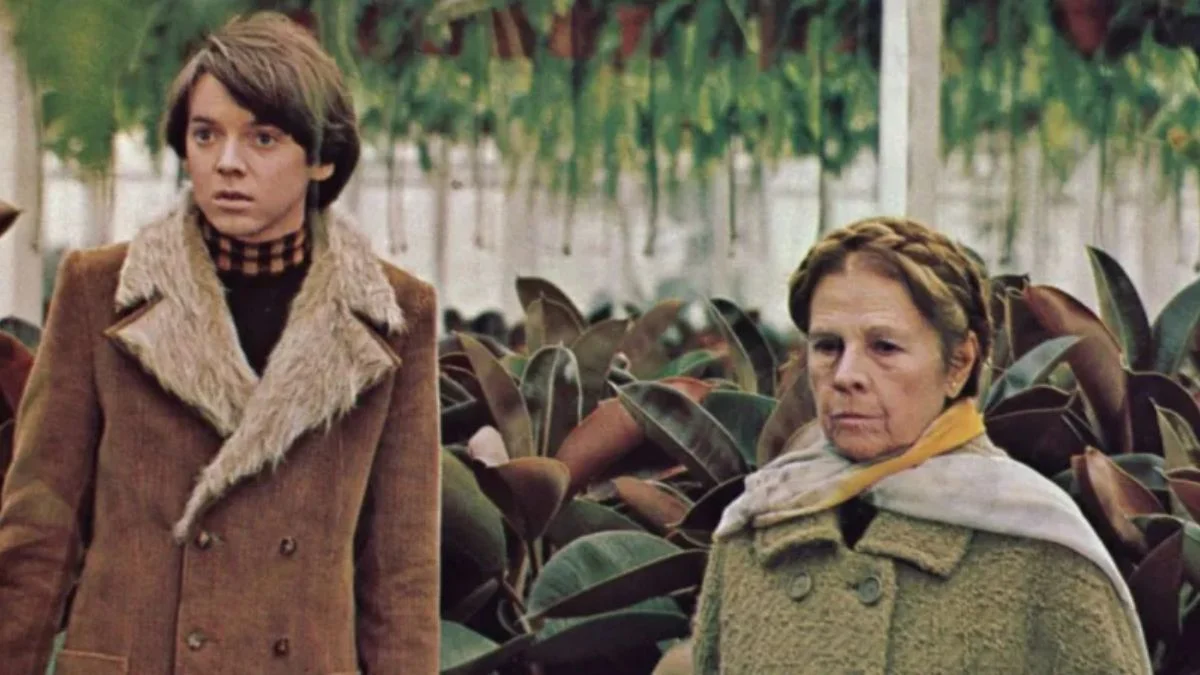
In 1971, Cort delivered the performance that would forever define his legacy: Harold Parker Chasen in Hal Ashby’s Harold and Maude.
Harold is a wealthy teenager obsessed with death, staging elaborate fake suicides until he meets Maude, a spirited 79-year-old woman played by Ruth Gordon. Their unlikely romance and existential journey struck a deep emotional chord.
Despite featuring a Cat Stevens soundtrack and a unique story, the film initially flopped. Critics were harsh—Variety famously described it as having “all the fun and gaiety of a burning orphanage.”
But something unexpected happened.
The film gained a cult following, especially among college students and counterculture audiences in the 1970s. It became a midnight-movie staple and an enduring touchstone for themes of love, mortality, and individuality.
Cameron Crowe later summarized its brilliance:
“A young man obsessed with death falls in love with an old woman obsessed with life… that movie holds up—to this minute.”
Cort’s performance earned him Golden Globe and BAFTA nominations and cemented him as an icon of unconventional cinema.

The Curse of Typecasting and Career Challenges
Ironically, Harold and Maude became both Cort’s greatest triumph and his biggest professional obstacle.
He later admitted:
“I was typecast to the point where I didn’t make a film for five years after ‘Harold and Maude.’ It closed a lot of doors… but on the other hand, it gave me the cachet to walk in a lot more doors.”
He even turned down a role in One Flew Over the Cuckoo’s Nest (1975) to avoid being pigeonholed—a decision he later regretted.
Instead, Cort turned to theater, where he felt less constrained by Hollywood stereotypes.
The 1979 Accident That Changed His Life
In 1979, Cort suffered a devastating car accident on the Hollywood Freeway. He sustained severe injuries, including fractures and facial trauma that required multiple plastic surgeries.
The accident halted his career for years, but he eventually returned to acting with a renewed presence—this time as a distinctive character actor.
Later Career: A Cult Favorite Character Actor
Throughout the 1980s, 1990s, and 2000s, Cort built a respected career in supporting roles:
Notable Film Roles
- Electric Dreams (1984) – voiced a sentient computer
- Invaders from Mars (1986)
- Heat (1995) – played an exploitative diner manager
- Dogma (1999) – portrayed a homeless man revealed to be God
- Pollock (2000) – played art patron Howard Putzel
- Coyote Ugly (2000)
- The Life Aquatic with Steve Zissou (2004)
- The Little Prince (2015) – voice of the Snake
Television and Voice Work
Cort appeared in shows such as:
- Arrested Development
- Ugly Betty
- Criminal Minds
- And the Band Played On
He also voiced Toyman in multiple DC animated projects.
Ted & Venus and His Work Behind the Camera
In 1991, Cort directed, co-wrote, and starred in Ted & Venus, a low-budget romance about a Venice Beach poet. Though modest in scale, the film showcased his passion for storytelling beyond acting.
His last credited role came in 2016, though he remained connected to the industry until declining health limited his activity.

Personal Life and Family
Bud Cort never married and had no children, but he remained close to his family. He is survived by:
- Brother Joseph Cox and sister-in-law Vickie, with nieces Meave, Brytnn, and Jesse
- Sister Kerry Cox
- Sister Tracy Cox Berkman and brother-in-law Edward Berkman, with sons Daniel and Peter
- Sister Shelly Cox Dufour and brother-in-law Robert Dufour, with nieces Madeline and Lucie
All reside in New York.
Tributes From Hollywood and Fans
Following his death, tributes poured in from filmmakers and actors.
Director Edgar Wright called Cort a “welcome and magnetic presence in every film lucky enough to have him,” praising his performance in Harold and Maude and highlighting “one of the greatest looks to camera in film.”
Jamie Lee Curtis, daughter of Harold and Maude producer Tony Curtis, also expressed her condolences.
Fans across generations celebrated him as the embodiment of youthful alienation, quirky humor, and emotional authenticity.
Bud Cort’s Enduring Legacy
Bud Cort’s career may have been shaped by one cult classic, but his impact goes far beyond a single film.
Harold and Maude continues to inspire filmmakers, musicians, and audiences with its themes of love, mortality, rebellion, and individuality. Cort’s portrayal of Harold remains one of the most iconic performances in alternative cinema history.
In a career spanning over five decades, he proved that unconventional actors can leave permanent marks on Hollywood—sometimes more profound than mainstream stars.

Conclusion: A Cult Hero Who Taught Us How to Live
Bud Cort once played a young man obsessed with death who learned how to embrace life. In a poetic twist, that performance became the very reason audiences continue celebrating life through cinema.
As the film world says goodbye, Cort leaves behind a legacy of eccentric brilliance, countercultural spirit, and timeless storytelling—a reminder that sometimes the strangest roles create the most enduring legends.


Leave a Reply