

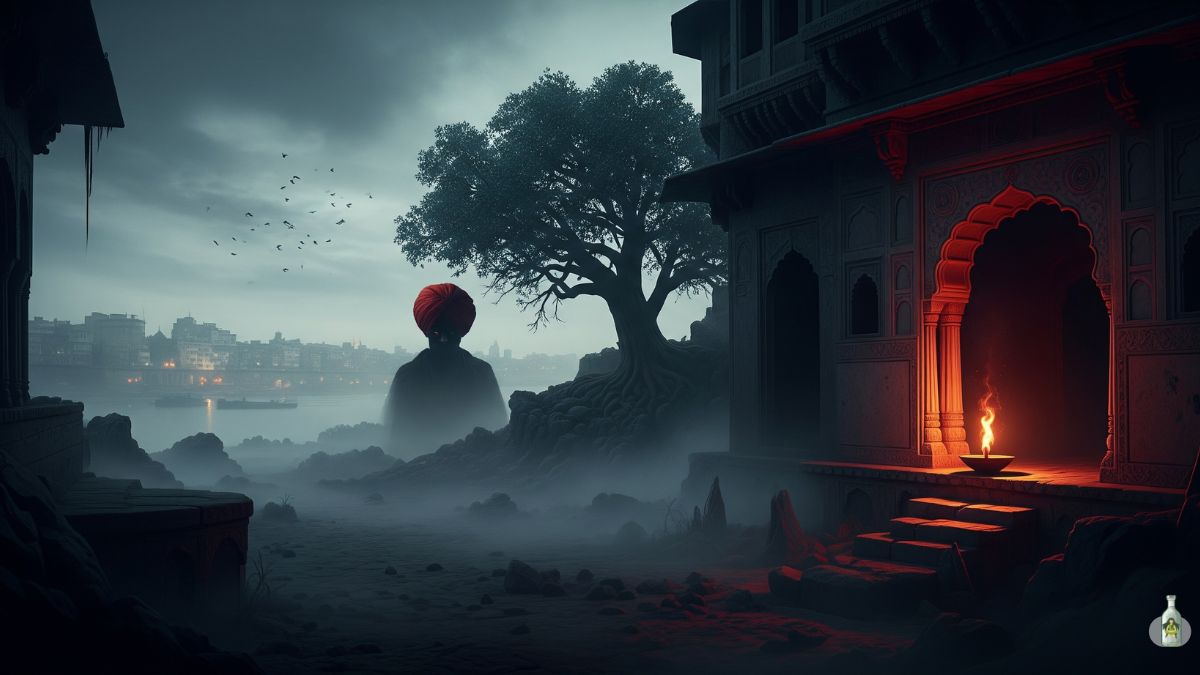
हिंदी में पढ़ें: भारत की काली छायाएं: डरावनी कहानियां जो आज भी डराती हैं
We all have enjoyed those holidays with our grandparents, listening to their age-old stories passed down through generations. These scary stories India has preserved through time carry profound cultural significance. Now, when I think about those stories, my mind wanders about the origin and depth those stories carry to this day.
Have you ever wondered how, though these stories are ancient, they remain so powerful that they still send shivers down our spines? From the cursed villages of Rajasthan to the haunted forts in India that stand sentinel against time, India’s urban legends are woven into the very fabric of its cultural consciousness, and many carry more truth than comfort would allow.
8 Indian Urban Legends That Will Make Your Skin Crawl
These mysterious legends of Indian forts and creepy folk tales from rural India continue to fascinate travelers seeking ghost tourism in India.
1. The Midnight Caller: Nale Ba — The Ghost Story of Karnataka

In the shadowy lanes of Karnataka, when the clock strikes the witching hour, a chilling presence begins its nightly rounds. The legend of Nale Ba (meaning “Come Tomorrow” in Kannada) tells of a malevolent spirit that prowls through villages, its voice a perfect mimicry of loved ones calling from beyond the door.
Picture this: You’re alone in your home, the family asleep, when suddenly you hear your mother’s voice calling your name from outside. But your mother is right there, sleeping peacefully in the next room. The voice pleads, cajoles, demands entry—but seasoned villagers know better. They’ve scrawled “Nale Ba” on their doors, a supernatural postponement that sends the spirit away until tomorrow… and tomorrow… and tomorrow.
What does Nale Ba mean in Karnataka? The genius of this legend lies in its psychological terror. In rural Karnataka, where this tale originated, families began reporting actual incidents of mysterious knockings and voices in the night. Whether supernatural or the product of shared hysteria, the phenomenon became so widespread that entire villages adopted the “Nale Ba” tradition as protection. This ghost story represents one of the most enduring supernatural beliefs in Indian culture.
2. Kuldhara Village: The Haunted Village That Vanished in Rajasthan

Kuldhara Village was established around the 13th century by the Paliwal Brahmins, a prosperous community of farmers and traders, but by the 19th century, something went terribly wrong. Located about 17 kilometres west of Jaisalmer, this haunted village is now a protected monument under the government authority, frozen in time like a photograph of abandonment.
What is the story of Kuldhara village? The legend speaks of Salim Singh, the notorious Diwan of Jaisalmer, whose eyes fell upon the village chief’s daughter. The story begins almost 200 years ago. The Kuldhara village people were frightened of only one person- the Diwan (Minister) of Jaisalmer. When he demanded the girl’s hand in marriage, threatening to destroy the village if refused, the Paliwal Brahmins made a decision that has echoed through the centuries.
In a single night, over 1,500 residents of Kuldhara and 83 surrounding villages simply vanished. Not a soul remained. Before departing, they cursed the land, declaring that no one would ever be able to settle there again. Rich Paliwal Brahmins departed the vacant hamlet in the early 1800s. Local traditions say the residents fled when a regional monarch wanted to take over but was rejected, cursing the hamlet.
Today, Kuldhara stands as a testament to their curse and ranks among the most haunted villages in Rajasthan. The Archaeological Survey of India protects the ruins, but locals refuse to spend nights there. Visitors report strange sounds, unexplained shadows, and an overwhelming sense of being watched by invisible eyes. The main feature of the Kuldhara village is the temple dedicated to the mother goddess. This temple serves as the center of this ghostly settlement, where prayers once offered for protection now seem to guard only the memory of the vanished. This cursed village in India has become one of the real haunted places to visit in India.
3. Bhangarh Fort: Why This Haunted Fort is India’s Most Terrifying

Bhangarh Fort is renowned as one of the most haunted places in India, and perhaps the greatest unsolved mystery. The Bhangarh Fort haunted reputation extends far beyond India’s borders. This 16th-century fort built in the state of Rajasthan, India, was established during the rule of Bhagwant Das as the residence of his second son, Madho Singh.
Is Bhangarh Fort really haunted? Two legends shroud this place in supernatural dread. The first one mentions the city of Bhangarh to have been cursed by a religious man called Baba Balak Nath. He permitted the fort’s construction but made a condition to not cast a shadow over his home. When the fort’s shadow eventually fell upon the ascetic’s dwelling, his curse transformed the thriving city into a desolate ruin.
Why is Bhangarh Fort haunted? The second legend speaks of Singhia, a tantrik (black magic practitioner) who fell obsessively in love with Princess Ratnavati. When she spurned his advances, he cursed the fort, prophesying its destruction. The entire army was decimated, and the people of Bhangarh suffered brutal slaughter. While the fate of the princess remains unknown, rumors suggest she was sentenced to wander the Bhangarh precincts, lost in time.
What makes Bhangarh truly terrifying are the contemporary accounts. The middle-aged guard came out from his slumber and told us that, yes, there are ghosts in Bhangarh Fort. He said he rarely goes inside the fort and leaves before nightfall. The Archaeological Survey of India has officially prohibited entry after sunset—a restriction rarely imposed on historical monuments. It is believed that the worst of misfortune befalls those who venture to stay in Bhangarh Fort at night, and the local population will happily narrate the story of three daredevils who spent the night inside the fort. This makes it one of the premier dark tourism destinations India has to offer.
4. The Churel Spirit: India’s Most Vengeful Ghost Legend

In the moonless nights of rural India, when mist clings to the ground like ghostly fingers, she appears. The Churel—a vengeful female spirit draped in white, her long hair flowing like dark water, her feet turned backwards to confuse those who might track her path. She is the embodiment of injustice, the spirit of women who died in childbirth or were wronged in life, now seeking retribution.
Who is the Churel in Indian folklore? The Churel preys upon young men, her beauty a fatal lure. She appears at crossroads, in empty fields, or outside lonely homes, her backwards feet the only clue to her supernatural nature. Those who fall under her spell are found days later, aged decades in mere hours, their life force drained by her insatiable hunger for revenge.
What makes the Churel legend particularly haunting is its roots in social commentary. In a society where women’s deaths in childbirth were tragically common and often attributed to neglect or abuse, the Churel became a supernatural expression of justice denied—a spirit that could not rest until her grievances were acknowledged. This paranormal story represents one of the most enduring folklore and myths of India.

Read in Detail: The Churel: When the Dead Refuse to Rest
5. Ban Jhakri: The Mysterious Shaman of the Himalayan Forests

High in the Himalayas, where ancient forests whisper secrets older than memory, the Ban Jhakri roams. This powerful shaman of the mountains is said to kidnap young boys, taking them deep into the wilderness to train them in the mystical arts. Some return years later as accomplished shamans themselves, speaking of otherworldly teachers and supernatural lessons. Others are never seen again.
The tale endures as it sheds light on the mysteries—why certain children have an uncanny understanding of medicinal plants and spiritual rituals, while others mysteriously disappear in the perilous mountain landscape. In societies where shamanic traditions are held in high regard, the Ban Jhakri embodies both the supreme mentor and the greatest fear. These legends of Indian shamans form part of the mysterious Himalayan stories that continue to intrigue researchers and travelers alike.

More Himalayan Urban Legends for you: The Most Haunted Stories of the Himalayas: When Mountains Whisper
6. The Monkey Man & Muhnochwa: India’s Modern Urban Legends

India’s urban legends have evolved with its cities, creating real urban legends from modern Indian cities. The Monkey Man of Delhi terrorized the capital in 2001, described as a creature with simian features that attacked sleeping residents. What is the Monkey Man of Delhi? What started as isolated incidents snowballed into mass hysteria, with hundreds of reported sightings and several deaths caused by panicked people jumping from buildings.
The Muhnochwa (face-scratcher) haunted Uttar Pradesh, described as a flying creature that would attack people at night, leaving distinctive scratch marks on their faces. These legends demonstrate how urban anxieties manifest as supernatural threats, giving form to the faceless fears of modern life. These true ghost stories from India show how ancient paranormal stories India has preserved continue to evolve in contemporary settings.
7. Shaniwar Wada Fort: The Haunted Palace with a Prince’s Eternal Cry

In Pune’s historic Shaniwar Wada fort, visitors report hearing a young voice crying “Kaka mala vachva!” (Uncle, save me!) every full moon night. Why is Shaniwar Wada haunted? The legend tells of 13-year-old Peshwa Narayanrao, who was brutally murdered within these walls by his own relatives in 1773. His dying plea for help is said to echo through the centuries, a ghostly reminder of ambition’s deadly price.
The fort’s tragic history lends credence to the supernatural claims. Built by the Peshwa rulers, it was largely destroyed by fire in 1828, leaving only the massive walls standing. Local guards and night watchmen consistently report paranormal activities, making Shaniwar Wada one of Pune’s most feared locations after dark and a popular destination for ghost hunting in India.
8. Himalayan Yeti: India’s Enduring Abominable Snowman Legend
The Abominable Snowman of the Himalayas represents India’s connection to one of the world’s most enduring cryptozoological mysteries. Himalayan Yeti sightings India have been reported by mountaineers and local guides who describe massive footprints in the snow, glimpses of towering, hair-covered figures, and an overwhelming sense of being watched in the high altitudes.
Is Yeti real in India? The Indian Yeti legends are especially fascinating due to their connection with local Buddhist and Hindu customs. Murals in monasteries illustrate Yeti-like beings, while ancient writings mention enigmatic entities residing in the tallest mountains. Whether these stories reflect a collective memory of long-gone megafauna or genuine interactions with undiscovered species, the Yeti continues to be one of India’s most enduring mythical figures and represents some of the scariest urban legends in India.
The Psychology of Fear: Why India’s Urban Legends Never Die
These urban legends and myths of India persist because they serve multiple psychological and social functions. They provide explanations for the unexplained, create community bonds through shared fear and protective rituals, and often carry moral lessons about respecting traditions, protecting the innocent, and understanding the consequences of actions.
What are the scariest urban legends in India? The power of Indian urban legends lies not just in their ability to frighten, but in their reflection of deeper cultural anxieties. They speak to fears about social change, the clash between modernity and tradition, the vulnerability of the innocent, and the persistence of injustice. In a land where the spiritual and material worlds are intimately connected, these legends serve as bridges between the seen and unseen, the known and unknowable.
For those interested in experiencing these legends firsthand, many wonder can you visit haunted places in India? The answer is yes – several of these locations, including haunted forts and palaces in Rajasthan, welcome visitors during daylight hours, though overnight stays are often prohibited or strongly discouraged.
The Eternal Echo
As you conclude this account and perhaps nervously eye your door, remember that these scary stories grandparents told in India are far more than just stories. They serve as the shared memory of a civilization, the quiet warnings that have been passed down through the years, recognizing that some mysteries are simply too deep for logical reasoning.
In India, where every stone has a story and every shadow might hide a secret, these urban legends continue to thrive. They serve as a reminder that as we hasten into modernity, we must always keep in mind the age-old wisdom that certain doors ought to stay closed, some locations should remain untouched, and some voices echoing in the night should go unanswered.
For those seeking paranormal places you can visit in India, these locations offer a glimpse into the country’s supernatural heritage. Whether you’re interested in haunted places near Delhi or venturing into the real haunted places to visit in India, these sites provide an unforgettable experience that bridges the gap between history and mystery.
For ultimately, the most frightening tales are not the ones that can be easily disregarded, but rather those that hold the unsettling potential of being true.
References
- Holidify. (2023, June 13). “Known As The Most Haunted Place In India, Bhangarh Fort Is Not Just Another Place To Visit.” Retrieved from https://www.holidify.com/pages/bhangarh-fort-most-haunted-place-in-india-1322.html
- TripBeam. (2023, October 30). “7 Intriguing Facts About Bhangarh Fort, India’s Most Haunted Place.” Retrieved from https://www.tripbeam.ca/blog/7-intriguing-facts-about-bhangarh-fort-indias-most-haunted-place/amp/
- Wikipedia. “Bhangarh Fort.” Retrieved from https://en.wikipedia.org/wiki/Bhangarh_Fort
- Rajasthan Tourism. “Kuldhara Village History: A Haunted Village near Jaisalmer.” Retrieved from https://www.tourism.rajasthan.gov.in/content/rajasthan-tourism/en/tourist-destinations/kuldhara.html
- Queen of Thar. (2024, July 4). “Kuldhara: The Abandoned Village of Thar Desert.” Retrieved from https://queenofthar.com/2024/07/04/kuldhara-the-abandoned-village-of-thar-desert/
- Historic Mysteries. (2022, September 19). “India’s Haunted Village: Why was Kuldhara Abandoned?” Retrieved from https://www.historicmysteries.com/unexplained-mysteries/kuldhara-abandoned/23149/
- Indian Holiday. (2020, November 30). “10 Creepy Urban Legends of India to Keep You Up At Night.” Retrieved from https://www.indianholiday.com/blog/urban-legends-of-india-to-thrill-you/
- My Simple Sojourn. (2020, February 19). “Bhangarh Fort’s ghost stories and my experience.” Retrieved from https://mysimplesojourn.com/bhangarh-fort-indias-most-haunted-place/
- Veena World. (2021, April 22). “What Makes the Bhangarh Fort of Rajasthan the Most Haunted Place of India?” Retrieved from https://www.veenaworld.com/blog/what-makes-the-bhangarh-fort-of-rajasthan-the-most-haunted-place-of-india
- Mocomi Kids. (2020, February 25). “Story of Kuldhara – Haunted Village in Rajasthan.” Retrieved from https://mocomi.com/kuldhara-village/
- Why Do ARMY Call Jungkook “Nochu”? The Hilarious Rap Moment That Started It All

- Wordle 1754 Hints and Tips for April 8th 2026

- What Does BTS SUGA’s Stage Name Really Mean? The Truth Is Finally Out

- Nintendo Switch 2 + Super Mario Galaxy 1 & 2 Gets $20 Off in Limited-Time Deal

- Samson: A Tyndalston Story — Release Date, Platforms, Price, and Everything We Know


Leave a Reply