

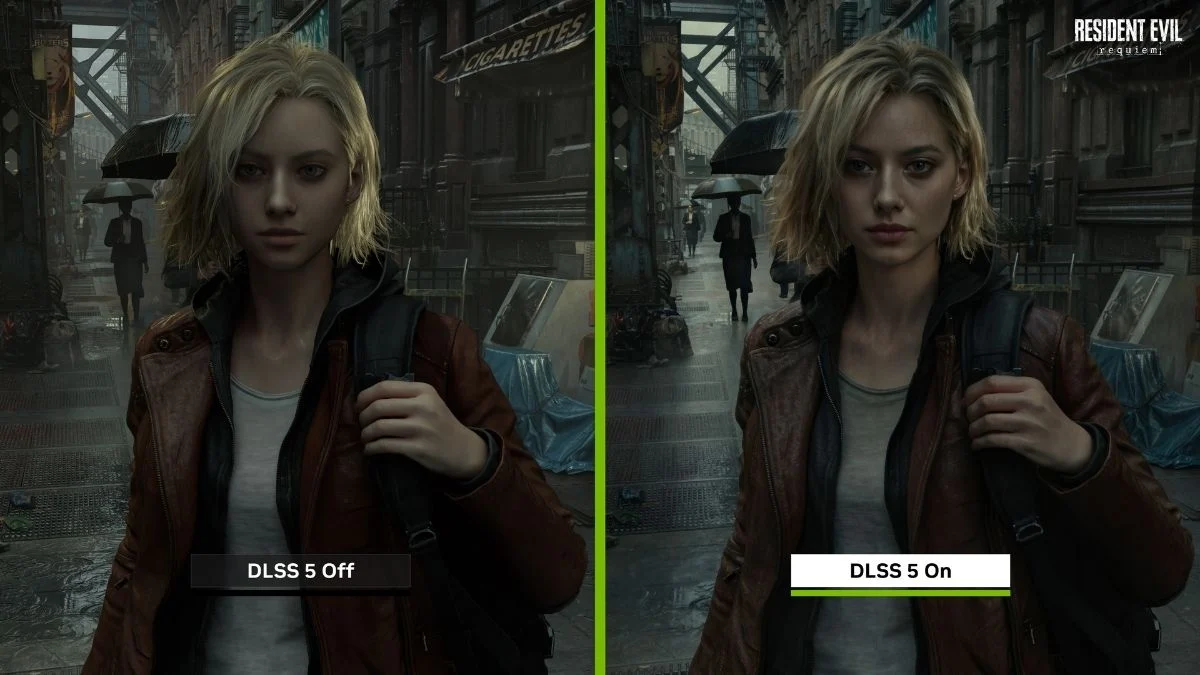
Nvidia’s unreleased DLSS 5 technology has escaped into the wild earlier than expected, and PC modders are already throwing the experimental AI-powered renderer into games it was never officially designed to support. The leaked technology was discovered inside an early-access build of NBA 2K27, and it did not take long for the modding community to start experimenting.
What happened next was exactly the kind of chaos the gaming internet loves. Modders began testing Nvidia’s Neural Rendering technology in games such as Control, Cyberpunk 2077, Final Fantasy 7 Rebirth, The Last of Us Part II, Grand Theft Auto V and others. Some results look surprisingly impressive, while others have transformed familiar characters into uncanny versions that players are already roasting online.
There is one major warning attached to every screenshot, video and performance test currently circulating: this is not the final version of DLSS 5. The implementation being tested comes from an unofficial leaked DLL, the technology is being forced into games through community-made mods, and Nvidia has not publicly released its finished consumer version. Still, these experiments are giving players an unexpectedly early glimpse at what Nvidia’s next major AI rendering technology can actually do.
More Crypto-Fueled Chaos: Nvidia isn’t the only name caught up in an unofficial money trail this week. For more, read our story on GTA 6 leaker Cyberleek’s reported $250,000 crypto cash-out right before Rockstar’s official reveal.
DLSS 5 Isn’t Just Trying to Boost FPS — It Wants to Change How Games Look
Previous versions of DLSS have largely focused on AI-powered image reconstruction, resolution improvements and frame-rate enhancements. DLSS 5 is aiming at something much bigger.
Nvidia’s new technology introduces a real-time neural-rendering model designed to generate photorealistic lighting and materials. Nvidia announced DLSS 5 in March 2026 and described it as a major step toward bringing Hollywood-style visual effects into real-time games.
According to Nvidia, DLSS 5 takes information already generated by a game and feeds it into an AI model. The system uses a game’s color and motion-vector information to add photorealistic lighting and materials while remaining connected to the existing 3D content.
Nvidia explained the technology by saying:
“DLSS 5 takes a game’s color and motion vectors for each frame as input, and uses an AI model to infuse the scene with photoreal lighting and materials that are anchored to source 3D content and consistent from frame to frame.”
The company has also stressed that developers are supposed to remain in control of the final result. DLSS 5 is not intended to simply act as a universal visual filter slapped across an entire game. Nvidia says developers can adjust the effect and decide how it fits their own art direction.
That detail became especially important after the original DLSS 5 reveal triggered criticism over the way the technology appeared to change character faces and other visual details.
More Update Overhauls: Big tech shakeups aren’t limited to graphics cards this week. For more, check out our piece on Phasmophobia’s Quality of Life Part 2 update, adding Restricted maps, smarter evidence tracking and creepier deaths.
Then Modders Found a DLSS 5 Neural Rendering DLL Inside NBA 2K27
The latest controversy started when a DLSS Neural Rendering DLL was discovered inside the early-access PC version of NBA 2K27.
The file, identified as nvngx_dlssnr.dll, is associated with Nvidia’s Neural Rendering technology. Analysis of the discovery found that the DLL is considerably larger than previous DLSS libraries and appears to contain a substantial amount of AI model data.
That discovery does not mean NBA 2K27 officially supports DLSS 5.
The game does not currently expose a public DLSS 5 or Neural Rendering setting. However, modders managed to extract the library and begin using it outside of the game.
The RenoDX community was among the first groups to get the leaked technology running in Control. The initial experiment focused specifically on character models, allowing players to see how Nvidia’s Neural Rendering technology could alter their appearance.
SwurvGaming highlighted the experiment on X, writing:
“🚨DLSS 5 Running On Control with renodx
so one of the renodx guys has dlss 5 neural rendering (ai filter) running on control. This was using the dlss nr dll found in nba 2k27. They have it working on character models only so far.
Theres 7 different styles, the video clip…”
The early experiments revealed seven different styles or presets, along with controls that allow the visual effect to be adjusted.
But this is where the giant disclaimer comes in.
The implementation remains experimental, unofficial and unfinished. Nvidia has not approved these tests, and modders are effectively forcing technology intended for future supported games into titles that were never originally built around it.
More Legal Enforcement: Unofficial tech isn’t the only thing publishers are cracking down on hard right now. For more, read our story on Activision’s dramatic cease-and-desist doorstep visit targeting a Call of Duty cheat seller.
The RTX 5070 Ti Performance Test Is Already Raising Eyebrows
Visual quality is not the only thing players are watching.
The unofficial testing has also provided an early look at how demanding DLSS 5’s Neural Rendering component could be in its current form.
One test using an RTX 5070 Ti at 4K reportedly saw Control drop from 71 FPS to 35 FPS after the experimental DLSS 5 implementation was enabled. Another demonstration involving an RTX 5090 showed a similarly substantial reduction in frame rate.
Those figures should not be treated as final DLSS 5 benchmarks.
The software being tested comes from an unofficial leaked build, the technology is being integrated through mods, and Nvidia has not released the finished consumer version. Performance could therefore change substantially before the official launch.
Still, the experiments suggest that DLSS 5’s neural-rendering component can carry a significant computational cost in its current state.
Early compatibility was also focused on Nvidia’s RTX 50-series hardware. Modders have already been working on ways to run the technology on RTX 40-series GPUs, although those efforts are entirely unofficial and should not be confused with Nvidia-supported hardware compatibility.
More Console Cost Concerns: Hardware demands are causing headaches well beyond graphics cards. For more, read our post on why Sony’s PS6 release date keeps slipping amid rising memory costs and a shifting PlayStation strategy.
DLSS 5 Looks Amazing in Some Games — and Absolutely Unhinged in Others
The biggest reason this leak has exploded across the gaming community is not the performance hit.
It is what DLSS 5 actually does to the games.
Modders have already pushed the technology into Control, Cyberpunk 2077, Final Fantasy 7 Rebirth, The Last of Us Part II, Grand Theft Auto V and other games.
The results vary dramatically.
Some experiments have impressed viewers. In Cyberpunk 2077, players reacted positively to the enhanced appearance, with one comment describing the technology as having “insane potential” despite the implementation still being an early experiment.
Other results have been far less flattering.
Images showing Cloud Strife from Final Fantasy 7 Rebirth generated reactions including “Eww!” and “The real slim shady? This is horrifying” on ResetEra.
A comparison involving Ellie from The Last of Us Part II triggered another brutally direct response:
“Made her look 40.”
That is exactly why this leaked experiment has reignited the controversy surrounding DLSS 5.
The concern is not simply that AI rendering can make a game look different. The bigger question is whether AI-generated changes can alter the artistic identity developers deliberately created.
Character design, lighting, color grading and material presentation are all part of a game’s visual identity. Changing those elements can potentially create a completely different look, even when the underlying geometry and gameplay remain untouched.
More Raid-Ready Returns: Character appearances shifting in unexpected ways isn’t just a PC modding story either. For more, dive into our piece on Armored Mewtwo’s long-awaited comeback during Pokémon GO Fest 2026’s Mega Finale.
The Original DLSS 5 Backlash Never Really Disappeared
When Nvidia first demonstrated DLSS 5 in March 2026, many gamers and developers immediately questioned the way the technology changed familiar characters.
Danny O’Dwyer was among the most outspoken critics, saying:
“Weird that this impressive lighting tech also randomly turns everyone into yassified, looks-maxed freaks. It’s like all this technology can’t help itself but sexualize everything it touches.”
Respawn rendering engineer Steve Karolewics also criticized the technology, writing:
“DLSS 5 looks like an overbearing contrast, sharpness, and airbrush filter. Remarkably different frames with the rationale of photo-real lighting? Nah, I think I’ll stick with the original artistic intent.”
The criticism centered on a question that has now returned in an even bigger way because of the leaked implementation: when does AI-enhanced rendering stop preserving a game’s visuals and start imposing an entirely different artistic look?
That question is particularly sensitive in gaming.
Visual style is not just a technical setting. Developers deliberately choose character designs, lighting, color palettes, materials and post-processing effects to create a specific artistic identity. A technology that changes those elements has the potential to improve realism, but it can also potentially move a game away from the look its creators originally intended.
More Narrative Nuance: Artistic identity debates aren’t limited to rendering tech. For more, read our story on how GTA 6 lets Jason and Lucia’s relationship shift the narrative without a full romance path.
Jensen Huang Says DLSS 5 Critics Are “Completely Wrong”
Nvidia CEO Jensen Huang addressed the backlash at GTC 2026 and strongly rejected the argument that DLSS 5 takes creative control away from developers.
When asked about criticism that the technology was changing games in undesirable ways, Huang responded:
“Well, first of all, they’re completely wrong.”
He continued:
“The reason for that is because, as I have explained very carefully, DLSS 5 fuses controllability of the of geometry and textures and everything about the game with generative AI.”
Huang argued that developers can fine-tune the generative AI and determine how the technology behaves inside their games.
He also emphasized that DLSS 5 is not supposed to operate like a traditional post-processing filter applied indiscriminately to completed frames.
Instead, Nvidia describes the technology as “content-control generative AI,” with developers retaining control over the final result.
That distinction could ultimately decide how DLSS 5 is received.
Nvidia’s vision depends on developers being able to use neural rendering to enhance visuals while still preserving their own artistic direction. The leaked modding experiments, however, are showing what happens when that same technology is placed into games without the original developers controlling the implementation.
And the results are already all over the place.
More Beta Weekend Buzz: Community-driven testing is shaping more than just graphics tech this week. For more, check out our guide to everything live in Modern Warfare 4’s Open Beta Weekend Two.
The Leaked DLSS 5 Version Is Not the Final Product
Before anyone decides that DLSS 5 will either revolutionize gaming visuals or destroy every character model in sight, there is another important caveat.
The version currently being tested by modders is unofficial.
The DLL was discovered before Nvidia’s public release, and the RenoDX experiments are effectively using the technology outside its intended development environment.
Some demonstrations also involve other modifications, meaning simple before-and-after comparisons do not necessarily isolate DLSS 5 as the only difference between the images.
VGC specifically noted that the Final Fantasy 7 Rebirth comparison used a Shader Injector and apparently other modifications in its DLSS 5-off footage.
That means the screenshots and videos currently circulating online should be viewed as early technical demonstrations rather than definitive proof of what every officially supported DLSS 5 game will eventually look like.
The same warning applies to performance.
A leaked DLL running through a community-made mod is not the same thing as an officially integrated implementation optimized by both Nvidia and a game’s developer.
More Patch Day Wins: Official, developer-backed updates are landing elsewhere with far less controversy. For more, read our post on Elden Ring’s Patch 1.17, bringing the Tarnished Pack DLC and major buffs.
DLSS 5 Is Already Escaping the Games It Was Designed For
There is one part of this story that Nvidia cannot easily ignore.
Modders have already demonstrated that the technology can be adapted to games that were never officially announced as DLSS 5 titles.
That makes this leak far more interesting than a simple unreleased file accidentally appearing online.
The community has already moved from Control into experiments involving Cyberpunk 2077, Final Fantasy 7 Rebirth, The Last of Us Part II, Grand Theft Auto V and other games.
Every new experiment gives players another example of how Neural Rendering behaves with different art styles, character models and rendering environments.
And that is where things get really interesting.
Nvidia’s official pitch is that DLSS 5 can bring a new level of visual realism to games while giving developers control over the final result.
The modding community is now testing the complete opposite scenario.
What happens when that technology is dropped into games without the original developers controlling it?
The answers so far are mixed.
Some scenes appear more detailed and convincing. Some characters look noticeably different. Some results have become internet memes almost immediately.
More Extended Look Highlights: Official developer-led reveals are proving to be a much smoother experience elsewhere. For more, dive into our story on what playing in GTA 6’s Leonida actually feels like, from wild police chases to unexpected chaos.
Nvidia Still Has Time to Prove DLSS 5 Works as Intended
Nvidia has said DLSS 5 is scheduled to arrive in fall 2026, with support coming to a range of games and publishers.
Until that official release arrives, the leaked DLL should be treated as a fascinating but incomplete preview rather than a representation of the finished technology.
The modding experiments do reveal why DLSS 5 has generated such a different reaction compared with previous versions of DLSS.
Earlier DLSS features largely focused on reconstructing images or generating frames from information already supplied by the game.
DLSS 5’s neural-rendering approach is much more concerned with how the game itself looks, particularly when it comes to lighting and materials.
That gives the technology enormous potential.
It also gives it a much bigger artistic responsibility.
Nvidia could eventually win over many skeptics by showing that developers can use DLSS 5 to improve lighting and materials while preserving the identity of their games. But the backlash is unlikely to disappear if the technology continues producing the uncanny faces and heavily altered visuals that have dominated some of the leaked comparisons.
For now, the modding community has effectively turned Nvidia’s unreleased AI renderer into one giant graphics experiment.
And the gaming internet is getting a front-row seat to what happens when unfinished neural-rendering technology is suddenly given the chance to touch almost every game modders can throw at it.
Some results look incredible.
Some look horrifying.
And with DLSS 5 still months away from its planned fall 2026 launch, the debate around Nvidia’s biggest visual experiment may only be getting started.
More Money Trail Drama: Unofficial leaks carrying real-world financial stakes aren’t unique to graphics tech. For more, read our story on GTA 6 leaker Cyberleek’s reported six-figure crypto cash-out timed right before Rockstar’s Netflix reveal.
Disclaimer: The DLSS 5 implementation currently being tested by modders is unofficial, unfinished and not representative of Nvidia’s final consumer release. Performance figures and visual comparisons from these experiments may change substantially before official launch, and some comparisons use additional mods or different configurations.
Sources
- NVIDIA — DLSS 5 official announcement
- NVIDIA — DLSS 5 technical overview
- VGC — DLSS 5 leak and modding experiments
- VGC — Jensen Huang responds to DLSS 5 criticism
- Tom’s Hardware — Modders run leaked DLSS 5 in Control
- VideoCardz — DLSS 5 Neural Rendering DLL discovered in NBA 2K27
- The Verge — Modders test leaked DLSS 5 across games
- PC Gamer — Early DLSS 5 testing and performance
Featured Image Credit: Nvidia


Leave a Reply