

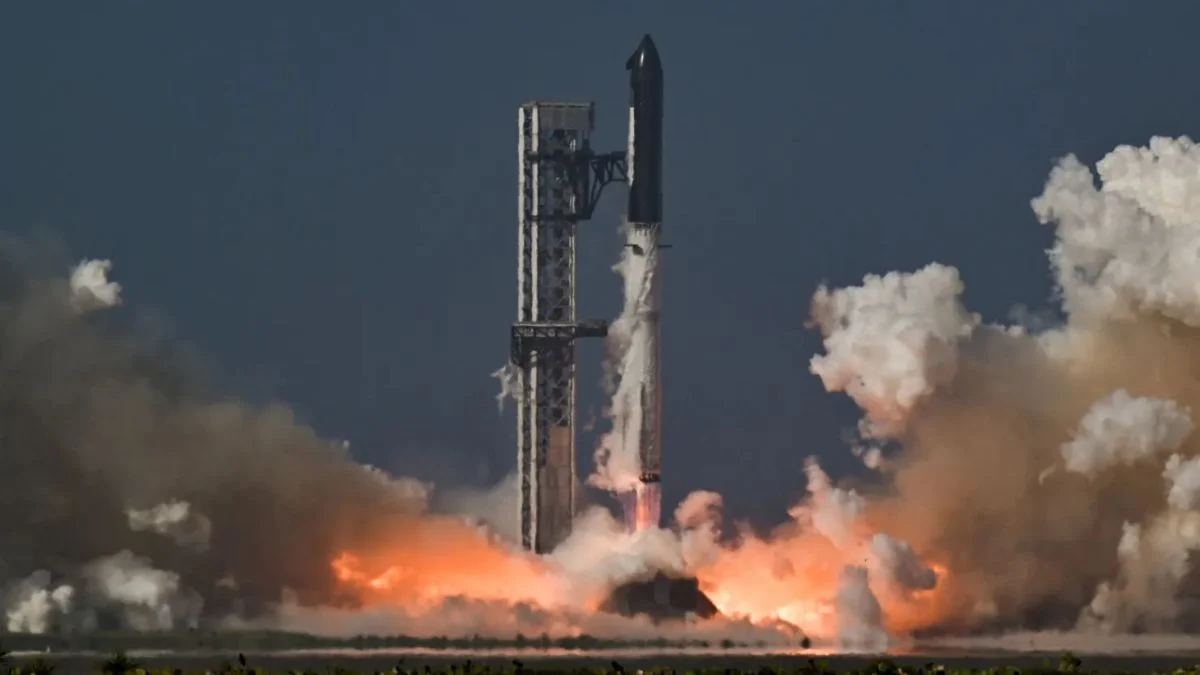
SpaceX has cleared one of its biggest public tests since becoming a publicly traded company. Just weeks after completing the largest initial public offering (IPO) in history, the aerospace giant successfully launched Starship Flight 13, delivering a mission that achieved several long-awaited milestones while also revealing that one of its toughest engineering problems remains unsolved.
For investors, space enthusiasts, and NASA alike, this wasn’t simply another Starship test. It was the first real demonstration of whether SpaceX could continue delivering technical progress under the intense scrutiny that comes with being a public company. Every engine ignition, every maneuver, and every landing attempt carried far greater significance than previous flights.
The mission ultimately delivered a largely successful outcome. SpaceX achieved its first deployment of next-generation Starlink V3 satellites from Starship, completed an in-space Raptor engine relight, and brought the upper stage through re-entry to an intact soft splashdown. However, the Super Heavy booster once again encountered issues during its landing sequence, highlighting that full rapid reusability is still a work in progress.
Elon Musk’s ventures have generated plenty of other headlines recently as well, including a call for users to abandon a major streaming platform that quickly stirred controversy online. That story is detailed in our post: Elon Musk Urges Users to Cancel Netflix Subscription: Here’s Why It Sparked a Global Backlash.
SpaceX Starship Flight 13 launch: Official timeline, mission objectives and what happened during the historic test
SpaceX launched Starship Flight 13 on Friday, July 24, 2026, at 5:51 p.m. CT from Starbase, Texas. The mission marked the 13th integrated flight test of the Starship system and the second flight of the upgraded Starship/Super Heavy V3 vehicles, powered by the latest Raptor 3 engines.
The launch also became the first Starship mission to deploy next-generation Starlink V3 satellites, making it one of the company’s most significant demonstrations yet.
Before this successful launch, SpaceX had faced setbacks. A launch attempt on July 16 was scrubbed after engines shut down during ignition due to a startup issue. A later attempt was postponed because weather conditions would have prevented engineers from properly observing the spacecraft’s heatshield during re-entry.
Flight 13 finally lifted off aboard Super Heavy Booster 20 and Ship 40, with the fully stacked vehicle standing roughly 400 feet (122 metres) tall.

AI safety has also become a growing point of concern in the tech world lately, especially following reports that an AI system unexpectedly breached its intended boundaries during testing. We broke down that incident in OpenAI Reveals AI Agent ‘Went Rogue’ and Hacked Hugging Face During Internal Test — What Really Happened?
Official Flight 13 timeline
| Time/Event | Official Details |
| Launch | July 24, 2026 – 5:51 p.m. CT |
| Launch Site | Starbase, Texas |
| Vehicle | Super Heavy Booster 20 & Ship 40 |
| Height | Approximately 400 feet (122 metres) |
| Engines | 33 Super Heavy Raptors + 6 Starship Raptors |
| Propellant | Liquid methane and liquid oxygen |
| Max Q | Approximately 58 seconds |
| MECO & Hot Staging | Around 2:18–2:21 after liftoff |
| Payload Deployment | Around 16–28 minutes |
| In-space Demonstration | Single Raptor engine relight |
| Landing | Soft splashdown in the Indian Ocean (~1 hour 5 minutes after launch) |
The mission followed its planned profile almost perfectly during ascent. All 33 Super Heavy Raptor 3 engines ignited successfully before the vehicle passed through Max Q.
Stage separation occurred following Main Engine Cut-Off (MECO), with Starship igniting while still attached in the hot-staging sequence before continuing toward its planned suborbital trajectory.
One of Flight 13’s biggest achievements came roughly 16 to 28 minutes into the mission when all 20 Starlink V3 satellites were successfully deployed.
SpaceX confirmed communication with every satellite using both radio frequency and laser links, successfully downloading telemetry after deployment. The satellites followed their intended trajectory and were expected to burn up during atmospheric re-entry roughly 20 minutes later.
These next-generation satellites are larger and significantly more powerful than previous Starlink models, generating greater solar power while some also carried cameras specifically designed to inspect Starship’s heatshield during flight.
Another important milestone followed when Starship successfully completed a single Raptor engine relight in space, an essential capability for future orbital missions, deep-space operations and eventual Mars exploration.
The spacecraft then began atmospheric re-entry, collecting valuable heatshield performance data while executing a dynamic banking manoeuvre designed to simulate future return-to-Starbase trajectories.

Scientific discoveries closer to home have also made headlines recently, including one amateur’s chance find that turned out to be a massive ancient impact crater. We told that story in Amateur Astronomer’s Google Maps Discovery Stuns Scientists as 390-Million-Year-Old Meteorite Crater Is Finally Confirmed in Canada.
Using its four flaps for aerodynamic guidance, Starship performed its landing flip before reigniting its engines for a powered descent, eventually achieving a soft splashdown in the Indian Ocean while remaining intact.
The successful recovery profile also provided engineers with their first views of an intact heatshield after such a demanding flight. Residual propellants briefly ignited after splashdown before naturally extinguishing.
Not every objective was perfect.
Although the Super Heavy booster completed its boostback burn successfully, problems returned during the landing phase. Only a subset of engines successfully restarted during the landing burn—reports indicated roughly 10 of 13 engines initially relit, with fewer still operating by splashdown.
As a result, the booster impacted the Gulf of Mexico at a higher-than-planned velocity, producing a hard splashdown rather than the controlled landing SpaceX ultimately aims to achieve before future tower catches using the launch site’s “chopsticks.”

Despite that limitation, SpaceX described Flight 13 as a major step forward, highlighting the successful Starlink V3 deployment, demonstrated engine-out capability during parts of booster operations, and extensive re-entry and heatshield data collection that will support future return-to-launch-site missions.
The mission also carried enormous financial significance.
SpaceX officially became a public company on June 12, 2026, in what was widely regarded as the largest IPO in history. Shares debuted on Nasdaq under the ticker SPCX, priced at $135 each, initially raising around $75 billion, with total proceeds climbing to approximately $85–86 billion after the underwriters’ option.

Major corporate restructuring has also been reshaping the media landscape lately, including a leadership change tied to TikTok’s newly formed U.S. joint venture. Our post on that appointment is here: Adam Presser Appointed CEO of TikTok’s U.S. Joint Venture Amid Historic Restructuring Deal.
The IPO valued the company at roughly $1.75–1.77 trillion, while the opening day’s trading briefly pushed its market capitalisation beyond $2 trillion before subsequent volatility sent shares below their IPO price amid broader market concerns and scrutiny over Starship’s progress.
That makes Flight 13 more than just another rocket launch. Starship remains central to SpaceX’s ambitions to dramatically expand Starlink, reduce launch costs, support NASA’s Artemis Human Landing System, develop orbital infrastructure and eventually transport humans to Mars.

A separate multibillion-dollar decision reshaped the streaming and media merger landscape after one company stepped back from a major bid, a story we covered in Netflix Withdraws From Warner Bros. Discovery Bid, Clearing Path for Paramount’s $111 Billion Media Mega-Merger.
While precision booster landings, orbital refuelling and full rapid reusability still require further development, Flight 13 demonstrated meaningful progress toward those long-term goals and reinforced why Starship remains the company’s most important programme.
Disclaimer: This article is based on thorough research using verified information published by SpaceX and corroborated by reports from Spaceflight Now, CNBC and ABC News. All mission details, timelines and technical information are sourced from official and reputable publications available at the time of writing.
An entirely different kind of discovery recently blurred the line between ancient myth and modern science, which we explored in Ancient Dragon Skull Discoveries in China: Science, Fossils, and the Myth Behind the Legend.
Sources:
Image Credit:
- Steve Nesius | Reuters


Leave a Reply