

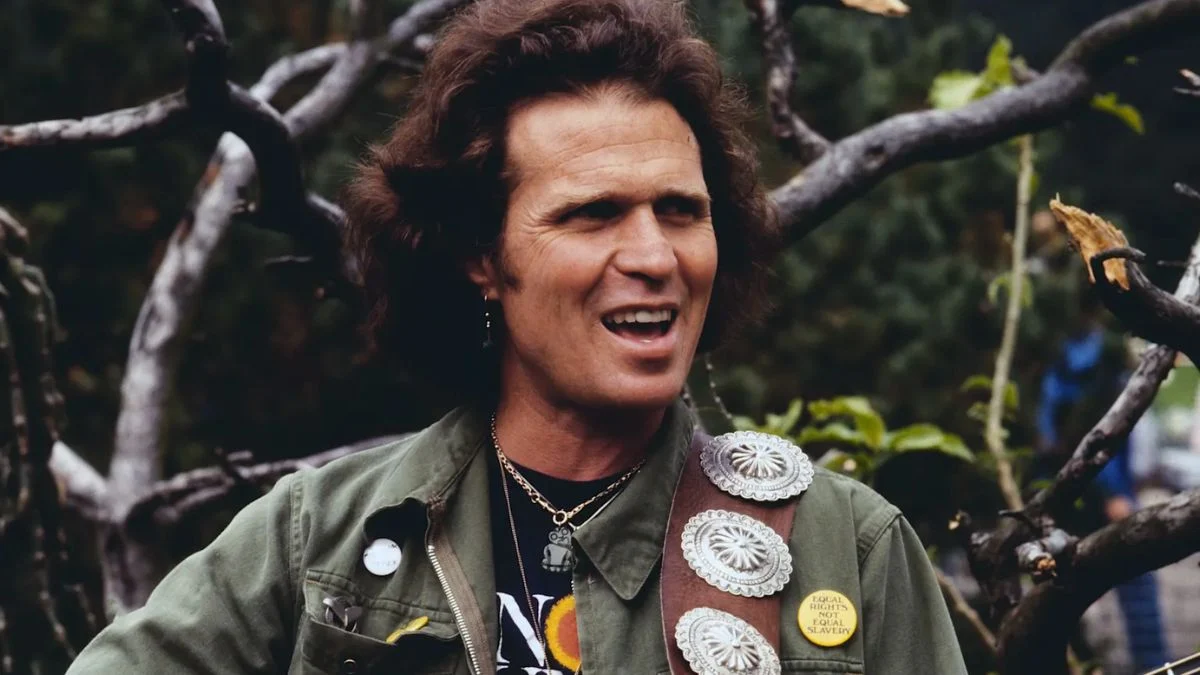
The music world is mourning the loss of one of the most fearless voices of the 1960s counterculture. Joseph “Country Joe” McDonald, the outspoken rock musician and anti-war activist whose satirical anthem “I-Feel-Like-I’m-Fixin’-To-Die Rag” became one of the most recognizable protest songs of the Vietnam War era, has died at the age of 84.
McDonald passed away on Sunday, March 8, 2026, in Berkeley due to complications related to Parkinson’s disease, which had affected him during his later years. His death was confirmed by his wife of 43 years, Kathy McDonald, through a statement released by his publicist.
For millions who came of age during the turbulent Vietnam War years, McDonald’s music was more than entertainment—it was a rallying cry. His biting humor, rebellious lyrics, and unapologetic activism made him one of the defining figures of the 1960s protest movement. As news of his passing spread, fans, musicians, and activists alike began sharing tributes to a man whose songs captured both the anger and idealism of a generation.
Country Joe McDonald’s Death: Key Facts About the Legendary Protest Singer
| Detail | Information |
| Full Name | Joseph Allen McDonald |
| Stage Name | Country Joe McDonald |
| Born | January 1, 1942 |
| Birthplace | Washington, D.C. |
| Died | March 8, 2026 |
| Age at Death | 84 |
| Place of Death | Berkeley |
| Cause of Death | Complications from Parkinson’s disease |
| Famous Song | I-Feel-Like-I’m-Fixin’-To-Die Rag |
| Band | Country Joe and the Fish |
| Spouse | Kathy McDonald |
From Washington D.C. to California: The Unusual Childhood That Shaped a Protest Icon
Born Joseph Allen McDonald on January 1, 1942, in Washington, D.C., he grew up far from the glittering music industry he would later influence. His upbringing took place in the working-class suburb of El Monte, where politics and activism were deeply embedded in family life.
His parents—former Communists—made a bold statement by naming their son after Joseph Stalin. His father was a union activist, while his mother managed the household. Together, they fostered a strong awareness of labor politics and social justice.
Music became an early outlet for the young McDonald. As a teenager, he proved remarkably talented. He played the trombone well enough to lead his high school marching band and later taught himself guitar by ear, exploring folk, blues, and country influences.
Like many aspiring musicians of his generation, he was deeply influenced by the work of Woody Guthrie, whose satirical protest songs would later shape McDonald’s own biting style.

Military Service and the Journey Toward Berkeley’s Counterculture Scene
Before fully committing to music, McDonald took an unexpected path—joining the United States Navy in the late 1950s. He served in Japan aboard the USS Lake Champlain, an experience that exposed him to global culture and the realities of military life.
While the Navy broadened his perspective, it also intensified his growing skepticism toward war. That skepticism would later define his music during the Vietnam era.
After leaving the military in the early 1960s, McDonald briefly attended California State University, Los Angeles, studying English literature. But the pull of music and activism proved stronger.
Soon, he relocated to Berkeley, which was rapidly becoming a hotbed of political protest and artistic experimentation during the Free Speech Movement.
There, McDonald immersed himself in the underground music community, forming experimental groups like the Instant Action Jug Band and the Berkeley String Quartet, blending humor and political commentary into his songs.
The Rise of Country Joe and the Fish During the Psychedelic Rock Explosion
In 1965, at the height of America’s growing involvement in the Vietnam War, McDonald co-founded the psychedelic rock band Country Joe and the Fish alongside guitarist Barry Melton.
The group quickly became part of the vibrant San Francisco psychedelic music scene, standing alongside artists such as Grateful Dead and Jefferson Airplane.
Their debut album, Electric Music for the Mind and Body, released in May 1967, captured the experimental sound of the era. The record featured extended jams, psychedelic instrumentation, and socially conscious lyrics.
Soon after its release, the band performed at the legendary Monterey Pop Festival, sharing the stage with rock icons like Jimi Hendrix and The Who.
The performance propelled them into the national spotlight.
The Anti-Vietnam War Song That Became a Cultural Lightning Rod
McDonald’s most famous composition, I-Feel-Like-I’m-Fixin’-To-Die Rag, was written in under an hour in 1965 as a promotional piece for his underground magazine Rag Baby.
Despite its quick creation, the song soon became one of the most recognizable protest anthems of the Vietnam War.
Delivered as a satirical talking blues, the track mocked the absurdity of war and the human cost of military conflict. Its chorus became legendary among antiwar protesters:
“And it’s 1, 2, 3, what are we fighting for?
Don’t ask me, I don’t give a damn,
Next stop is Vietnam…”
Before performing the song, McDonald often led audiences through the famous “Fish Cheer”, originally spelling out “F-I-S-H” but later evolving into the far more provocative chant “F-U-C-K.”
The rebellious chant triggered controversy. In 1968, television host Ed Sullivan canceled the band’s planned appearance on The Ed Sullivan Show after learning about the routine.

Woodstock 1969: The Performance That Cemented His Legacy
If one moment defined McDonald’s career, it was his unexpected appearance at Woodstock on August 17, 1969.
With the festival thrown into chaos by rain and scheduling problems, McDonald walked onto the stage alone and began leading the massive crowd—estimated at over 400,000 people—through the “Fish Cheer.”
The mud-soaked audience roared back in unison before launching into the iconic antiwar song.
The electrifying moment was immortalized in the Woodstock documentary, which included bouncing-ball subtitles over the lyrics.
McDonald later clarified that the performance was meant as a direct statement against the Vietnam War.
“The chant was an expression of our anger and frustration over the Vietnam War,” he told the Associated Press years later.
Activism, Legal Battles, and a Life Beyond the 1960s
The song’s popularity also brought controversy.
McDonald was arrested and fined in 1969 for obscenity in Worcester following a performance of the chant.
He was also drawn into the historic Chicago Seven trial, where activist Abbie Hoffman and other protest leaders faced charges related to demonstrations during the 1968 Democratic National Convention.
During his testimony, McDonald recited lyrics from his famous song after Judge Julius Hoffman famously warned that “no singing is permitted in the courtroom.”
Later Career, Environmental Advocacy, and Final Albums
Although Country Joe and the Fish disbanded around 1970, McDonald continued releasing music for decades.
His later albums included:
- Country
- Carry On
- Time Flies By
- 50
He also used his music to advocate for environmental causes, including the song Save the Whales.
In the 1990s, McDonald helped build the Berkeley Vietnam Veterans Memorial, unveiled in 1995 as a gesture of reconciliation between veterans and former protesters.
Personal Life and Relationships
McDonald’s personal life was as colorful as his music career.
He was married four times, but his longest marriage was to Kathy McDonald, whom he wed in 1983.
He is survived by five children and four grandchildren.
During the late 1960s, he also had a turbulent romance with blues-rock legend Janis Joplin, a relationship that inspired his reflective ballad “Janis.”

Tributes Pour In for a Counterculture Pioneer
Following news of his death, social media filled with tributes celebrating his legacy.
Fans described him as a fearless voice of dissent, while musicians praised his role in shaping protest music and psychedelic rock.
Many shared clips of his legendary Woodstock performance, ensuring that his defiant anthem continues to echo decades later.
For those who lived through the Vietnam era, McDonald was far more than a musician—he was a symbol of resistance, satire, and social awareness.
As the years pass and the icons of the 1960s fade away, the music of Country Joe McDonald remains a reminder that songs can challenge authority, inspire movements, and give voice to generations searching for change.


Leave a Reply