

SPOILERS AHEAD!!!
The ending of Your Name does not seek to surprise you. Instead, it invites you to pause and understand what has quietly endured after time has taken its toll. By the final scene, the film has already resolved its central conflict. The comet no longer threatens Itomori, Mitsuha lives, and history has been rewritten. What remains unresolved is more intimate and far more human.
Makoto Shinkai closes the story not with spectacle, but with recognition. The final moments ask you to reflect on memory, connection, and whether bonds created by time can survive without names or proof.

Understanding the Two Timelines
At the heart of Your Name lies a temporal divide that shapes every emotional beat. Mitsuha lives in 2013, while Taki exists three years ahead in 2016. Their body swapping bridges this gap, but it also limits what they can truly share. Mitsuha experiences fragments of Taki’s future, while Taki unknowingly steps into Mitsuha’s past.
This imbalance explains much of the confusion early on and the heartbreak later. When Mitsuha meets Taki in Tokyo, he does not recognize her because their connection has not yet begun for him. By the time Taki realizes who Mitsuha is, she has already died in his original timeline. Their relationship exists across mismatched moments, never aligned until the very end.
Mitsuha’s Death Explained
The revelation that Mitsuha died during the comet disaster reframes the entire story. For Taki, this moment transforms curiosity into urgency. The body swapping was never random. It served as a warning that arrived too late to be understood.

Rather than treating fate as fixed, Your Name presents it as something fragile. The tragedy of Itomori was recorded history, yet history itself proved vulnerable. Through the shrine, the kuchikamizake, and the Miyamizu family’s beliefs, the film establishes that time flows like a thread, capable of tangling, stretching, and even reversing under the right conditions.
Why Taki Forgets Mitsuha’s Name
When Taki drinks the kuchikamizake, he crosses fully into the sacred space of time. This act allows him to reach Mitsuha before the comet strikes, but it also demands a sacrifice. Memory becomes the cost of interference.
The film reinforces this rule repeatedly. Mitsuha’s grandmother remembers her own experiences as distant dreams. Messages disappear from phones. Names fade first. Taki knows forgetting is inevitable, which is why he chooses to write “I love you” on Mitsuha’s hand instead of his name. Love carries meaning even when memory fails. A name would vanish, but emotion leaves a trace.
How Itomori Is Saved
Saving the town does not rely on miracles or grand authority. It happens through persuasion, fear, and imperfect human action. Mitsuha and her friends engineer an evacuation using deception because truth alone would not convince anyone.
The plan succeeds not because everyone understands the threat, but because urgency overrides doubt. Mitsuha’s final confrontation with her father completes this effort. He does not need full proof. He only needs to see the conviction in his daughter and the unfolding reality in the sky above.
The comet still strikes, but it strikes an empty town. Fate bends without breaking.
The Staircase Scene Explained
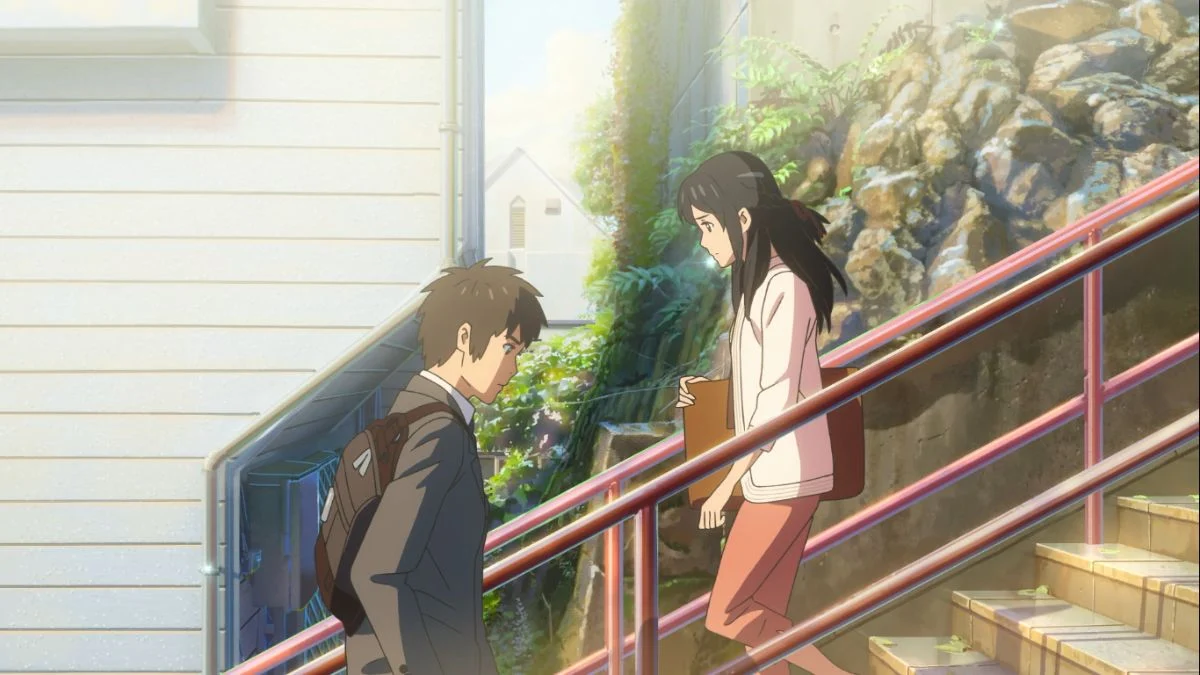
Years later, Taki and Mitsuha live ordinary lives in Tokyo. They no longer remember the body swapping, the comet, or each other’s names. Yet a quiet absence lingers. Both feel as if they are searching for something undefined.

When they pass each other on the staircase, the moment works because nothing dramatic happens. No music swells… No memories return… They simply stop…
That hesitation carries the entire story. It shows that connection does not rely solely on memory. Some bonds settle deeper, beyond language or recollection. When they finally ask for each other’s names, the film closes the circle. This time, they meet in the same moment, unburdened by time.

The True Meaning of the Ending
The ending of Your Name suggests that fate is neither absolute nor meaningless. You cannot control every outcome, but your choices still matter. Taki changed the future not because destiny allowed it, but because he acted despite uncertainty.
At the same time, the film respects loss. Saving Itomori required letting go of shared memories. Love survives, but it changes form. What remains is not the past, but the pull toward one another that endures beyond explanation.
In asking “What is your name?”, Taki and Mitsuha begin again. Not as saviors or time travelers, but as two ordinary people finally standing in the same timeline.


Leave a Reply