

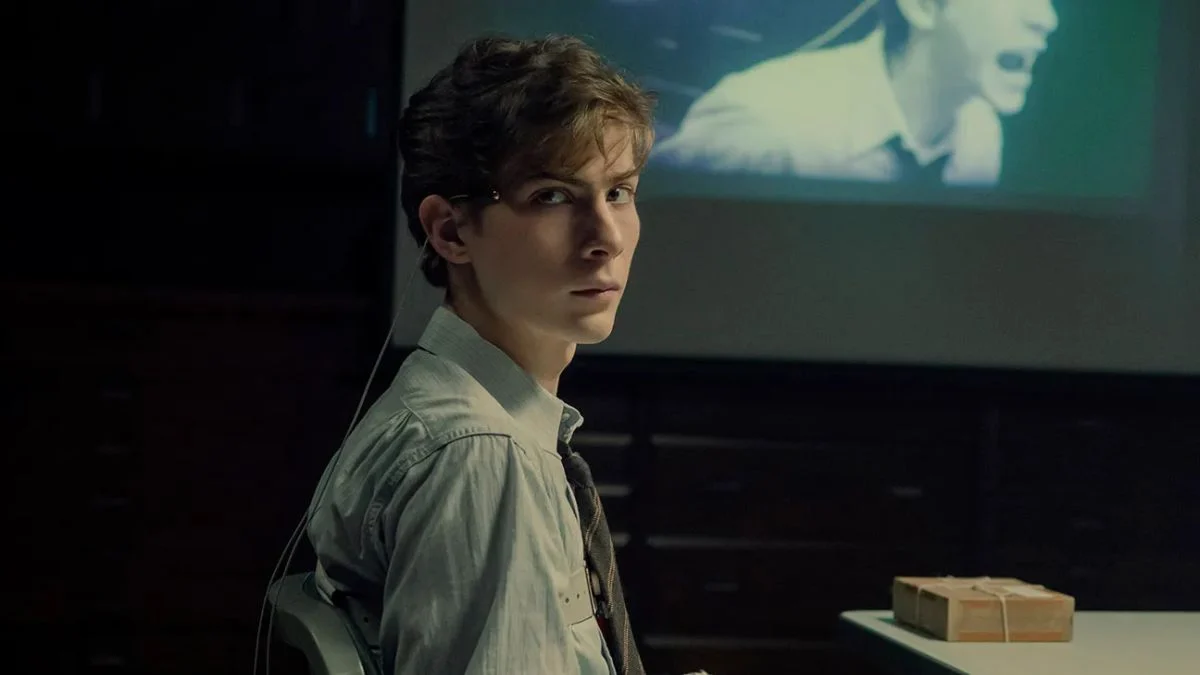
A quiet Montana cabin. A decades-long FBI investigation. A manifesto that reached millions of readers. And a man whose extraordinary academic past seemed almost impossible to reconcile with the criminal case that eventually made his name infamous.
Netflix’s UNABOMBER, released on September 25, 2026, returns to the story of Theodore “Ted” Kaczynski, the man identified as the Unabomber. Starring Jacob Tremblay as the young Kaczynski, Russell Crowe as Harvard psychologist Henry Murray, and Shailene Woodley as FBI agent Joanne Miller, the film moves between Kaczynski’s early academic life and the investigation that ultimately found him. But this is not a documentary. Netflix describes UNABOMBER as a drama “inspired by true events,” meaning the real case and the film’s dramatic storytelling need to be separated carefully.
The man behind Netflix’s UNABOMBER story
Before the FBI knew him as the Unabomber, Theodore John Kaczynski was known for something very different: extraordinary academic ability.
Kaczynski was born in Chicago on May 22, 1942. His academic career moved unusually fast. In 1958, when he was only 16 years old, he entered Harvard University.
He graduated with a mathematics degree in 1962 and continued his studies at the University of Michigan, where he earned a doctorate in mathematics in 1967.
That same year, Kaczynski joined the University of California, Berkeley, as an assistant professor of mathematics. Berkeley records confirm that he taught during the 1967-68 and 1968-69 academic years before resigning effective June 30, 1969.
Then came the change that would eventually become central to the story.
In 1971, Kaczynski moved to land near Lincoln, Montana. There, he constructed a small cabin and increasingly separated himself from mainstream society.
Years later, that remote cabin would become one of the most recognizable locations connected to the Unabomber investigation.
Kaczynski isn’t the only real figure whose complicated legacy is getting the Netflix treatment this fall. Another unsettling documentary trades a Montana cabin for the world of a very different kind of infamous figure. Check our story on Nathan Fielder’s Elizabeth Holmes Documentary ‘You Can See Everything’ Trailer Offers an Unsettling Look Inside Her World
What happened to Ted Kaczynski at Harvard?
Long before the FBI investigation, another part of Kaczynski’s life had already attracted intense historical attention.
While studying at Harvard, Kaczynski participated in psychological research led by Harvard psychologist Henry A. Murray, played by Russell Crowe in the Netflix drama.
Accounts of the experiments describe participants being placed under significant psychological pressure, with deeply held beliefs subjected to aggressive challenges. Because of what Kaczynski later became responsible for, those experiments have received considerable attention.
But there is an important line between what is documented and what remains unproven.
Kaczynski’s participation in the experiments is documented. However, a direct causal connection between those experiments and his later criminal acts has never been established.
That distinction becomes particularly important in UNABOMBER, because the film places the Harvard period at the center of its story.
Director Janus Metz explained the structure of the movie by describing two interconnected timelines:
“We crosscut between two timelines, roughly speaking: the making of the Unabomber and the capture of the Unabomber.”
The approach allows the film to move between Kaczynski’s development and the investigation that eventually led authorities to him.
The Unabomber bombing campaign began in 1978
The story takes a much darker turn in 1978.
Kaczynski began a bombing campaign that continued for approximately 17 years. According to the FBI, his targets included people and institutions he associated with universities, airlines, technology and modern industrial society.
The FBI opened its investigation under the code name UNABOM, derived from “UNiversity and Airline BOMbing.”
The unidentified perpetrator eventually became publicly known as the Unabomber.
Authorities ultimately attributed 16 attacks to Kaczynski. The campaign killed three people and injured 23 others, turning the investigation into one of the FBI’s longest-running and most challenging domestic terrorism cases of the period.
For years, investigators faced the same basic problem: they knew what was happening, but they did not know who was responsible.
Kaczynski had deliberately avoided revealing his identity.
Then his own writing changed the investigation.
If you need a lighter watch after all that investigative tension, there’s a much different kind of throwback in the works. A familiar face is heading back to 1977 for another wild ride. Read our story on Brad Pitt Returns as Cliff Booth in The Further Mis-Adventures of Cliff Booth as David Fincher Takes Tarantino’s Hollywood Into 1977
The manifesto that became a crucial clue
In 1995, Kaczynski sent a lengthy manuscript to The Washington Post and The New York Times.
The document, titled “Industrial Society and Its Future,” was roughly 35,000 words long and attacked modern industrial society and technological development.
Kaczynski demanded that the manuscript be published and promised to stop his campaign if his conditions were met.
That created an extraordinary dilemma for the newspapers and federal authorities. Publishing the document could give the anonymous writer a huge national platform. At the same time, the writing itself might provide investigators with something they had been missing: a way to identify its author.
The Washington Post and The New York Times ultimately agreed to publish the manuscript, citing public-safety considerations. The Post published it in September 1995.
The decision would prove crucial.
The FBI later explained that the writings became important to the investigation because investigators believed the author had a distinctive linguistic style.
The manifesto was therefore more than a statement of Kaczynski’s anti-technology beliefs. It became an investigative tool.
How the FBI finally identified the Unabomber
The breakthrough came after the manifesto entered the public domain.
Kaczynski’s younger brother, David Kaczynski, and David’s wife, Linda Patrik, recognized similarities between the published writing and material they associated with Ted.
Their information ultimately brought investigators closer to Kaczynski’s identity.
The case became a striking example of how linguistic evidence could become enormously significant in a major criminal investigation. FBI investigators compared Kaczynski’s writings with material from his past, helping establish a connection between the anonymous manifesto writer and the man living in Montana.
The investigation finally reached its decisive moment on April 3, 1996.
Federal agents arrested Kaczynski at his cabin near Lincoln, Montana.
A subsequent FBI search uncovered extensive evidence connected to the investigation, including journals and other materials. The cabin itself became one of the most recognizable pieces of physical evidence associated with the case.
Key dates in the real Kaczynski case
| Date | Event |
| May 22, 1942 | Theodore John Kaczynski was born in Chicago |
| 1958 | Entered Harvard University at age 16 |
| 1962 | Graduated from Harvard with a mathematics degree |
| 1967 | Earned a doctorate in mathematics from the University of Michigan |
| 1967–68 and 1968–69 | Taught mathematics at UC Berkeley |
| June 30, 1969 | Resigned from Berkeley |
| 1971 | Moved to land near Lincoln, Montana, and constructed a cabin |
| 1978 | Bombing campaign began |
| 1995 | “Industrial Society and Its Future” was published |
| April 3, 1996 | Arrested at his Montana cabin |
| January 1998 | Sentenced to life imprisonment without parole |
| 2023 | Died at age 81 while incarcerated |
Was Shailene Woodley’s FBI agent Joanne Miller real?
This is where Netflix’s drama clearly separates itself from the historical record.
Shailene Woodley’s Joanne Miller is a fictional character created for the film.
Netflix presents Miller as the FBI agent leading the manhunt in the movie. However, there was no single real-life FBI agent matching that character’s role exactly.
The real investigation involved a large, multi-agency effort rather than one individual detective pursuing Kaczynski alone.
Miller functions as a dramatic perspective through which audiences can follow the investigation and experience the search for Kaczynski.
That distinction matters.
The broad investigation is real. The individual character used to represent it is not.
What happened to Ted Kaczynski after his arrest?
Kaczynski’s arrest in 1996 marked the end of the FBI’s long search, but it was not the end of the legal story.
Following his arrest, Kaczynski eventually pleaded guilty to federal charges connected to the bombing campaign.
In January 1998, he was sentenced to life imprisonment without the possibility of parole. Federal records confirm that his guilty plea resulted in a life sentence for his responsibility for the Unabomber attacks.
He remained in federal custody for many years.
Kaczynski later died in 2023, at the age of 81, while incarcerated at a federal medical facility in North Carolina.
What does Netflix’s UNABOMBER get right — and what is dramatized?
The central historical framework of UNABOMBER is grounded in documented events.
Kaczynski really was a mathematics prodigy who entered Harvard at 16. He earned an advanced mathematics degree at Michigan, taught at Berkeley, moved to a remote Montana cabin and became responsible for a 17-year bombing campaign.
His participation in Henry Murray’s Harvard psychological research is documented. So are the publication of his manifesto, the involvement of his brother David and sister-in-law Linda Patrik, and his eventual arrest in Montana.
But Netflix does not present the movie as a literal reconstruction of every event.
The fictional FBI agent Joanne Miller is one obvious example. The film also uses compressed chronology and character interactions designed for dramatic storytelling.
Netflix’s official description calls the production “inspired by true events.”
That wording is important for viewers approaching the movie as a true-crime story. The central case is real, but not every character, scene or dramatic connection should automatically be treated as documentary fact.
Why the Unabomber case still resonates
The Kaczynski case brings together several unusual strands of American history.
There is elite academic achievement, controversial psychological research, technological anxiety, domestic terrorism, investigative linguistics and the complicated role of the media in a criminal investigation.
Perhaps one of the most striking elements is what happened to Kaczynski’s manifesto.
The document was intended to spread his ideas about modern industrial society and technological development. Yet its publication also helped investigators move closer to identifying its anonymous author.
His distinctive writing became one of the most important clues in the case.
That complicated chain of events is what Netflix’s UNABOMBER is revisiting.
The film moves from Kaczynski’s early academic life and Harvard years to the investigation that eventually captured him. It also brings the controversial experiments involving Henry Murray into the narrative while using fictional elements to turn a sprawling investigation into a more focused television-style crime drama.
For viewers trying to separate the Netflix story from the historical record, the distinction is straightforward: the central events are based on a real case, but individual characters, scenes and dramatic connections should not automatically be treated as documentary fact.
Real-world crime dramas aren’t the only stories getting a closer look right now. A comic book universe is also expanding, with one actor breaking down his character’s corporate twist on a classic hero. Our story covers Nathan Fillion Explains Guy Gardner’s Corporate Green Lantern Role in Lanterns as Man of Tomorrow Future Takes Shape
Conclusion
The real Ted Kaczynski story stretches from a teenage Harvard student and mathematics prodigy to a Berkeley academic, an isolated Montana resident and eventually the man authorities identified as the Unabomber.
His 17-year bombing campaign, the 1995 publication of Industrial Society and Its Future, the crucial information provided by David Kaczynski and Linda Patrik, and the FBI’s eventual arrest of Kaczynski at his Montana cabin form the documented backbone of the case.
Netflix’s UNABOMBER draws from that history while reshaping parts of it for dramatic storytelling. Shailene Woodley’s Joanne Miller, in particular, represents a fictionalized version of an investigation that was actually conducted by a large, multi-agency effort.
The result is a crime drama rooted in a real case — one where the most revealing clue ultimately came from the words written by the person investigators were trying to find.
Disclaimer: This article has been prepared based on thorough research of the sources provided with the original verified material, including Netflix, Netflix Tudum, the FBI, UC Berkeley, the U.S. Department of Justice, The Washington Post and the cited Reuters report. It reflects the information available from those sources and distinguishes documented historical events from dramatized elements of Netflix’s UNABOMBER. It should not be understood as independent verification beyond what the provided source material supports. This article discusses a historical criminal case and a fictionalized film adaptation. It does not endorse or glorify the actions or ideology of Ted Kaczynski.
Sources
- Netflix: UNABOMBER official page
- Netflix Tudum: UNABOMBER cast, release date and story
- Netflix Tudum: UNABOMBER trailer
- FBI: The Unabomber case
- FBI: The Unabomber Case 25 Years Later
- FBI: Unabomber cabin
- UC Berkeley: Kaczynski employment records
- U.S. Department of Justice: 1998 annual report
- The Washington Post: Unabomber manuscript publication
- The Washington Post: Harvard experiment background
- Reuters report on Kaczynski’s death
Featured Image Credit: Netflix


Leave a Reply