

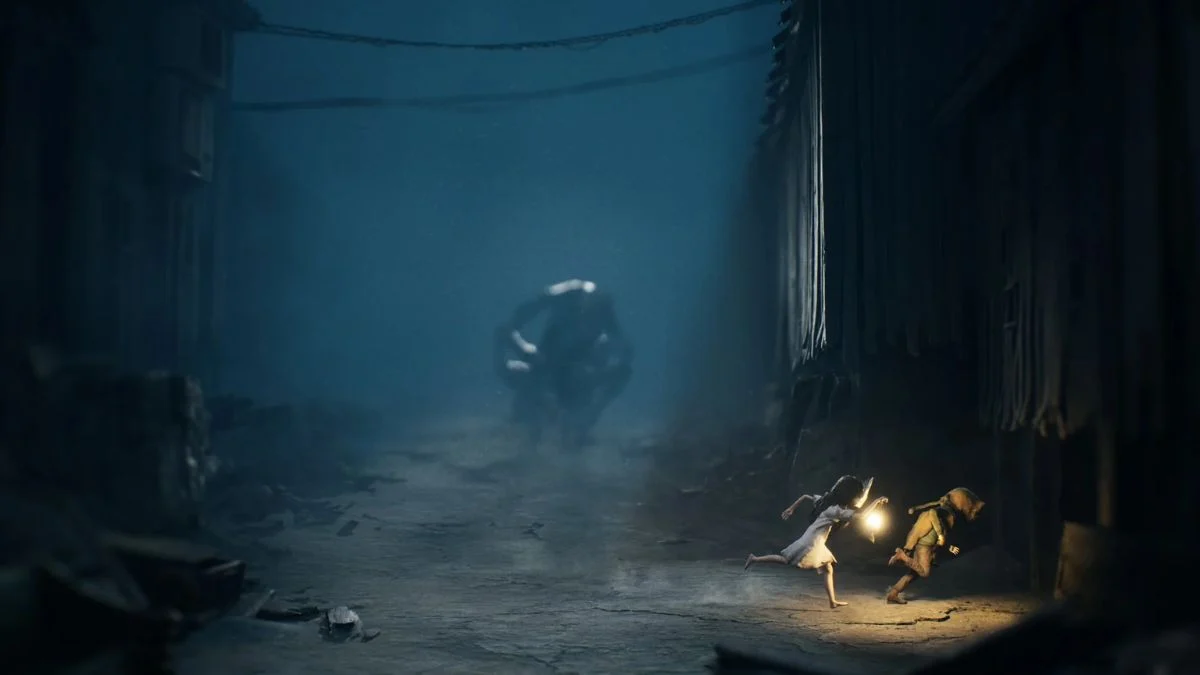
One of the biggest questions surrounding Reanimal since its February 13, 2026 release is whether it connects to the beloved Little Nightmares series. Both games feature small vulnerable children navigating terrifying worlds filled with grotesque monsters. The similarities feel too strong to ignore—so what’s the actual relationship? Let’s break everything down clearly.
Do Reanimal & Little Nightmares Share the Same Universe?
Reanimal and Little Nightmares do NOT exist in the same canonical universe. However, their connection runs much deeper than most players realize, and the similarities between both games aren’t accidental at all.

Why Both Games Feel So Similar
The Developer Connection:
The most important fact to understand is this: Tarsier Studios developed Little Nightmares 1 and Little Nightmares II, and Tarsier Studios also developed Reanimal. Same team, same creative DNA, same atmospheric horror philosophy.
Meanwhile, Little Nightmares III went in a completely different direction. Bandai Namco Entertainment retained the franchise IP while Supermassive Games took over development duties. So technically, Reanimal shares more creative DNA with Little Nightmares 1 and 2 than Little Nightmares 3 does—despite carrying a different title entirely.
Why Tarsier Made a New IP:
After Embracer Group acquired Tarsier Studios in 2019, the studio announced they would develop a brand new intellectual property instead of continuing Little Nightmares. Bandai Namco kept the franchise rights and handed development to Supermassive Games. This legal separation means Reanimal cannot officially connect to Little Nightmares regardless of creative intent.
For legal reasons, Reanimal and Little Nightmares must remain entirely separate franchises.
Spiritual Successor, Not a Sequel
Tarsier Studios themselves consider Reanimal a spiritual successor to the Little Nightmares series. The team designed it to be “more terrifying” than its predecessors while pushing the horror formula further.
Key Design Similarities:
- Small vulnerable children navigating oversized, threatening environments
- Grotesque monster designs rooted in corrupted versions of familiar imagery
- Atmospheric environmental storytelling with minimal exposition
- Cinematic presentation emphasizing tension and dread
- Themes of childhood trauma and confronting a troubled past
Key Differences That Set Reanimal Apart:
- Co-op gameplay as a core design feature—fully playable solo with a competent AI companion that handles the second character’s actions seamlessly (Little Nightmares focused purely on solo play)
- Dynamic camera system that shifts and zooms rather than sticking to fixed side angles
- More dialogue from protagonists (Little Nightmares 1 and 2 were completely wordless)
- More plot-heavy narrative with specific story events players can follow
- Grounded realism rather than fantastical otherworldly settings
Narrative director David Mervik specifically noted that while Little Nightmares felt like a “fantasy land,” Reanimal grounds itself in a heightened but recognizable reality—the monsters belong to this world rather than feeling imported from somewhere else entirely.

The Nowhere vs. Reanimal’s World
Some fans theorize connections between Little Nightmares’ metaphysical “Nowhere” dimension and Reanimal’s disturbing setting. Both games explore twisted versions of reality where normal scale and logic break down.
What We Actually Know:
- In Little Nightmares, children are small while the corrupt world is enormous
- In Reanimal, the world itself feels normal but the monsters are massive
- Both feature children confronting environments that reflect their fears and traumas
- Both use interpretive, deliberately ambiguous storytelling
These parallels exist by design rather than accident. Tarsier Studios built both experiences around similar philosophical foundations—childhood vulnerability, the corruption of safe spaces, and monsters that represent adult authority twisted into something monstrous.
Easter Eggs and Hidden References
Since both games share creators, many players actively hunt for hidden Easter eggs or subtle environmental references connecting the two franchises. While no confirmed crossover exists yet, the community remains hopeful.
Reanimal features an upcoming DLC expansion titled The Expanded World, with the first of three chapters releasing Summer 2026. Whether this expansion includes any subtle nods to the Little Nightmares universe remains to be seen—but fans will certainly be looking closely.

Frequently Asked Questions
No, Reanimal and Little Nightmares are legally and canonically separate franchises. Reanimal serves as a spiritual successor created by the same studio (Tarsier Studios), but no official story connection exists between the two series.
Tarsier Studios, the same team behind Little Nightmares and Little Nightmares II, developed Reanimal. THQ Nordic published it on February 13, 2026 for Nintendo Switch 2, PlayStation 5, Windows, and Xbox Series X/S.
After Embracer Group acquired Tarsier Studios in 2019, Bandai Namco retained the Little Nightmares IP and gave development of Little Nightmares 3 to Supermassive Games. Tarsier then created Reanimal as their own new intellectual property.
Reanimal shares significantly more creative DNA with Little Nightmares 1 and 2, since all three were made by Tarsier Studios. Little Nightmares 3 was developed by a completely different studio (Supermassive Games).
Yes, Tarsier Studios confirmed a DLC expansion titled The Expanded World, with the first of three chapters scheduled to release Summer 2026.
Yes, Reanimal is fully playable in single-player mode. The game features a competent AI companion that controls the second character (your sibling), handling co-op mechanics seamlessly so you can enjoy the full experience alone.


Leave a Reply