

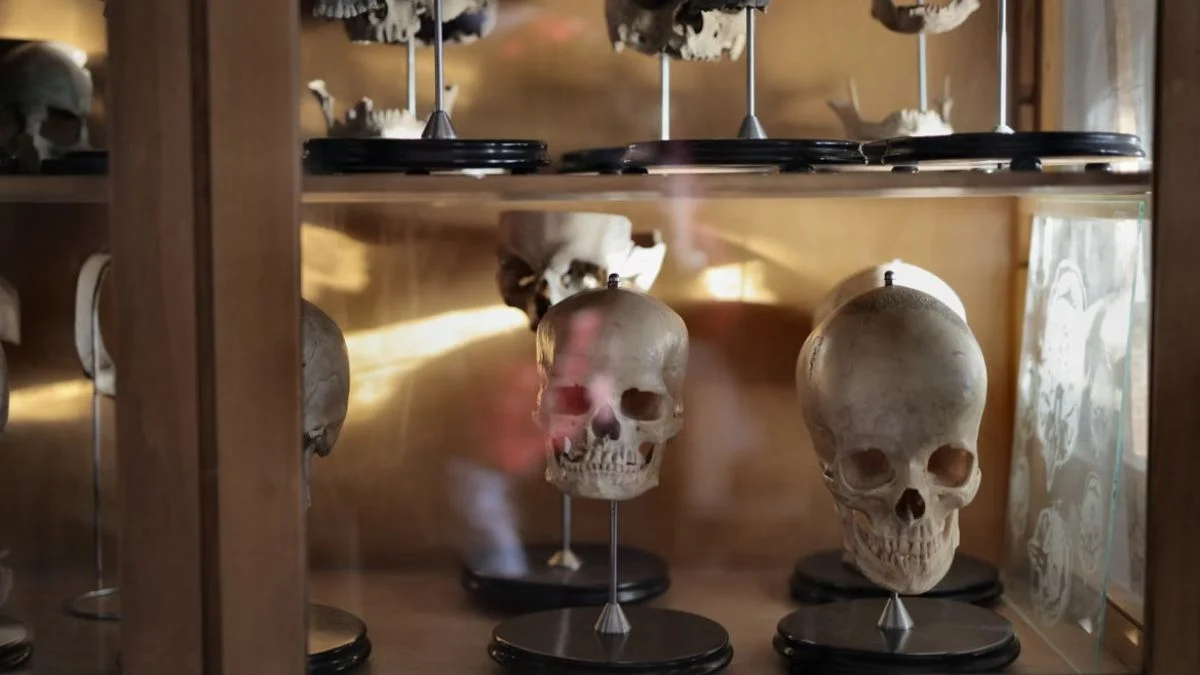
Most creator merchandise follows a familiar formula: branded T-shirts, hoodies, posters and other collectibles designed to turn an online following into a storefront. Horses’ merchandise operation took a much stranger turn when an item appeared that was far removed from the usual creator merch lineup.
A human skull was listed for $3,000 and described as “ethically sourced.” The unusual product quickly drew attention, but the listing also left a major question hanging over it: what exactly does “ethically sourced” mean in this case, and what evidence is available to support that description?
Creator content sometimes veers into territory that feels genuinely uncanny. One recent auction listing has people wondering whether something unusual is lurking inside a famous prop. Check our article on Mike Myers’ $25,000 Cat in the Hat costume drawing “haunted” claims at auction.
Horses listed a $3,000 human skull as merchandise
The human skull appeared on Horses’ online merchandise store alongside his regular products, carrying a price tag of $3,000.
The product was described as an “ethically sourced” human skull, but the publicly reported listing did not provide a detailed explanation of where the remains originated or documentation showing how the ethical sourcing claim had been established.
That lack of detail became an important part of the story because human remains are fundamentally different from ordinary merchandise. Questions about a normal product might involve manufacturing, materials or ownership. A human skull raises additional questions about provenance, consent, acquisition and the treatment of the deceased.
The listing also warned prospective buyers that individual skulls could differ in appearance. That means the specimen eventually received by a customer could vary from the photographed example in characteristics such as color or shape.
The listed shipping estimate was approximately three weeks.
By the time the listing began receiving wider attention, however, it was marked out of stock. There is therefore currently no indication from the available reporting that another purchase can actually be completed through the listing.
The out-of-stock status also leaves several practical questions unanswered. It is unclear whether the skull was a very limited offering, whether it had previously been available, or whether Horses intended it to remain a permanent part of his merchandise operation.
Online communities tend to dig deep when a story leaves obvious gaps. A recent local mystery followed a similar arc before authorities finally closed the loop. Read our story on the Maine Bigfoot sighting that sparked a police hunt before the “creature” was finally found.
The biggest question is what “ethically sourced” means
The unusual product itself is only one part of the controversy. The more significant issue is the sourcing claim attached to it.
The publicly reported listing did not explain the skull’s chain of custody, the identity or circumstances of the person whose remains it came from, the age of the remains, or the documentation used to establish lawful and ethical provenance.
That distinction matters.
Calling a specimen “ethically sourced” does not, by itself, independently establish that the person whose remains are being sold consented to that use.
Reuters has previously investigated the U.S. body-parts industry and found that the country historically had comparatively limited federal regulation of the trade in donated human remains intended for research and education. Its reporting documented a commercial industry in which human bodies and individual body parts could be distributed for medical training and research.
But the existence of a legal market for certain human remains does not automatically establish that a particular specimen was obtained ethically.
Provenance and consent can remain separate questions.
That becomes especially relevant when dealing with older anatomical specimens. Historical collections have sometimes contained remains acquired at a time when modern standards for informed consent did not exist or were not followed.
So, for the Horses listing, the key issue is not simply whether a human skull can be sold under certain circumstances. It is whether the particular remains listed for sale can be traced through a documented history that supports the ethical sourcing description.
Fast food chains keep finding new ways to grab attention with limited-time stunts. One recent throwback brought its own unusual eating challenge along with it. For more, check our article on Wendy’s bringing back the T-Rex Burger after 13 years with a 9-patty, 9-minute challenge.
Reddit viewers questioned the sourcing claim
The listing was spotted by viewers and later discussed on Reddit, where users focused heavily on the lack of publicly available sourcing information.
One commenter wrote:
“I know it says they’re ethically sourced on the page but there wasn’t any details about how and where from,” one person wrote. “I guess this is probably legal where he’s from, but I won’t lie, it’s very off-putting.”
Another Reddit commenter questioned whether buyers could realistically verify where human remains sold on the private market originated:
“You basically never know now where these bones are coming from,” one wrote.
Those comments do not establish that Horses’ skull was obtained improperly. Instead, they reflect the specific concern raised by viewers: the available product information did not allow outsiders to independently verify the sourcing claim.
Horses has not publicly explained the sourcing process behind the listing in the reporting available at the time of publication.
Viral controversies involving service companies can spiral quickly once video evidence spreads online. A recent moving-company incident followed that same pattern before the business stepped in publicly. Our story covers College HUNKS movers facing backlash and issuing an apology after a Pittsburgh TikTok controversy.
U.S. laws on selling human remains vary by state
The legal picture surrounding human remains is considerably more complicated than a simple nationwide rule saying that the sale is either legal or illegal.
Reuters’ previous investigation found that the United States historically lacked a comprehensive federal framework governing the commercial trade in donated human body parts intended for research and education. Its reporting described a market involving body brokers and medical-training companies and documented the movement of human remains between states and internationally.
At the same time, individual states can impose significant restrictions.
The Horses listing reportedly excludes particular states, and state laws help explain why geographic restrictions can appear on products involving human remains.
| State | Relevant information in the provided material |
| Minnesota | State law prohibits the sale or offer for sale of human remains, with defined exceptions involving legitimate medical, scientific and educational purposes. Human remains are broadly defined to include any part of a dead human body, and a violation is a felony. |
| Florida | Florida laws restrict the sale and purchase of human remains. The 2026 statute states that a person who sells or buys human remains, or certain parts of them, in violation of the statute commits a first-degree misdemeanor, subject to specified exceptions. |
| Louisiana | State law defines human remains as the body or parts of a deceased person and defines “trade” broadly to include offering for sale, buying, selling, exchanging, giving, receiving and donating. The law generally prohibits possession and trade of human remains except where otherwise permitted. |
| Tennessee | Laws protect human remains and restrict unauthorized disturbance, excavation and disinterment of human burials. The Tennessee Division of Archaeology states that human remains are protected regardless of age or cultural affiliation. |
| Georgia | Cemetery and funeral-services laws regulate the sale of burial and funeral merchandise and impose registration requirements on businesses dealing in such products. |
The differences are important because a transaction involving human remains can depend on the state involved, the origin of the remains, how they were acquired, their intended use and other circumstances.
The geographic restrictions shown on the Horses listing therefore should not be interpreted as proof that the sale is lawful everywhere else in the United States. They demonstrate only that the seller or store has identified jurisdictions where the product cannot be shipped.
Creator careers can take unexpected turns when older projects resurface under new scrutiny. One YouTube figure’s history recently came back into focus for reasons tied to a much bigger controversy. Read our article on how a YouTube lawn-care star became connected to the Toy Freaks controversy.
Louisiana takes a particularly explicit approach to human remains
Louisiana’s statutory framework provides another example of why the legal context matters.
The state defines “human remains” as the body or parts of a deceased person. Its definition of “trade” is also broad, covering activities including offering for sale, buying, selling, exchanging, giving, receiving and donating.
Louisiana generally prohibits the possession and trade of human remains except where otherwise permitted by law.
The state legislature has also expressly stated that Louisiana has not recognized ownership rights in human remains and that the commodification of human remains can contribute to the looting and desecration of cemeteries and sacred sites.
That does not determine the legal status of the Horses listing. It demonstrates instead how differently states can approach the treatment and commercial handling of human remains.
Georgia adds another layer through its cemetery and funeral-services framework, while Tennessee’s archaeological rules protect human remains regardless of their age or cultural affiliation.
The result is a legal landscape in which broad statements about whether human skulls are simply “legal” or “illegal” across the United States can be misleading.
Legal trouble can follow public figures even after previous controversies fade from the news cycle. One creator’s latest arrest adds to a pattern that’s drawn scrutiny before. Check our story on Jack Doherty’s arrest on a domestic battery charge in Fort Lauderdale.
The history of body brokers adds context
The controversy surrounding the Horses listing also connects to a much larger history involving the commercial distribution of human remains in the United States.
Reuters reported that American body brokers have operated a significant commercial market involving donated bodies and body parts. One investigation found that a broker could distribute thousands of individual body parts from American donors, including heads, limbs and other anatomical specimens, to medical-training and research customers.
Another Reuters investigation examined how easily human body parts could be purchased in the United States. Journalists investigating the industry were able to acquire human anatomical specimens from a body broker.
That reporting emphasized that the legal treatment of donated body parts intended for research or education differed substantially from the rules governing transplant organs.
The investigations also raised questions about whether donors and their families always understood how donated remains might ultimately be used.
That history helps explain why the phrase “ethically sourced” can prompt questions beyond whether a transaction is technically permitted.
A specimen can exist within a legal commercial framework while still raising issues involving consent, provenance, intended use and respect for the deceased.
Those broader concerns do not establish that Horses’ particular skull was obtained unethically. They explain why viewers are asking for more information about where it came from.
There is currently no evidence Horses obtained the skull illegally
Despite the attention surrounding the listing, the available evidence does not establish that Horses stole human remains, obtained them from an illegal source or violated a particular law.
That distinction is central to the story.
The controversy currently concerns the absence of publicly available sourcing information rather than proof of criminal conduct. The product was described as “ethically sourced,” but the reporting available so far does not independently verify that claim.
Likewise, the fact that the product cannot be shipped to certain states does not demonstrate that the seller committed an offense. Those restrictions can reflect the different legal environments surrounding human remains across the United States.
A definitive assessment of the skull’s provenance would require information showing where it came from, how it entered the seller’s possession and what documentation accompanied it.
Horses has not publicly detailed the skull’s provenance
One of the most notable unanswered questions is the history of the individual specimen itself.
The available reporting does not identify the deceased person, the original institution or collection associated with the remains, or the documentation used to establish the ethical sourcing claim.
Without those details, outsiders cannot independently assess the specimen’s history.
That does not automatically make the sourcing claim false. It means the assertion remains a claim that has not been independently demonstrated in the reporting currently available.
For a conventional piece of creator merchandise, provenance might involve questions about manufacturing, labor or intellectual property. Human remains carry a fundamentally different set of considerations because the product was once part of a living person.
The listing comes amid another unusual creator-merchandise controversy
The Horses listing arrived during a week that had already produced another unusual development in creator merchandise.
Mighty Mike Plays recently faced backlash after turning a story involving $118,000 in accidental advertising expenditure into $100 AI-generated merchandise.
The two situations are unrelated in substance. The Horses story concerns human remains and questions surrounding provenance, while the Mighty Mike Plays controversy involved merchandise connected to an advertising mishap.
Still, both illustrate how creator merchandise has expanded far beyond conventional branded clothing and accessories.
For Horses, the human skull is especially unusual because it moves the conversation away from standard creator products and into questions surrounding the ownership, sale and ethical treatment of human remains.
What happens to the $3,000 skull listing next?
For now, the skull remains marked out of stock, and Horses has not publicly provided a detailed explanation of its provenance in the reporting available as of September 20, 2026.
Several questions therefore remain unanswered. They include how the remains were acquired, what documentation exists to support the “ethically sourced” description and whether the product will be offered again.
The confirmed story is narrower than some of the speculation surrounding it.
Horses’ store listed a $3,000 human skull described as “ethically sourced.” The listing provided limited publicly reported information about its provenance, stated an approximately three-week shipping estimate, warned that individual skulls could differ in appearance, and restricted shipment to several jurisdictions. Online viewers subsequently questioned what evidence supported the sourcing claim.
There is currently no verified evidence establishing that the skull was illegally obtained.
Conclusion
The Horses merchandise listing has attracted attention not simply because a human skull appeared in a creator storefront, but because the product’s most important claim remains difficult for outsiders to independently assess.
The skull was offered for $3,000 and described as ethically sourced, yet the publicly reported information does not detail its chain of custody, origin, age, previous institutional association or documentation supporting the sourcing description. At the same time, U.S. laws governing human remains vary by jurisdiction, making the reported shipping restrictions an important legal detail rather than proof of wrongdoing.
For now, the skull is out of stock, the provenance remains publicly unexplained in the available reporting, and there is no verified evidence that Horses obtained the remains illegally or unethically.
Source Disclaimer
This article has been prepared based on thorough research of the sources provided for this report, including reporting from Dexerto and Reuters and the relevant state statutes and government resources listed below. It reflects the information available from those sources and preserves the distinction between verified facts, product-listing claims, legal information and online reactions. The available material does not independently establish the provenance of the skull or demonstrate that it was obtained illegally or unethically.
Sources
- Dexerto: YouTuber Horses is selling $3,000 “ethically sourced” human skulls
- Reuters investigation on U.S. body brokers and human remains
- Reuters investigation into the U.S. market for human body parts
- Minnesota Revisor of Statutes: Sale of Human Remains
- Florida Department of State: Human Remains and applicable laws
- Florida Senate: 2026 statute on selling, buying or conveying human remains
- Louisiana State Legislature: Human remains and prohibited trade
- Louisiana State Legislature: Legislative findings on commodification of human remains
- Tennessee Division of Archaeology: Human Remains and Burials
- Georgia Code: Cemetery and Funeral Services regulations
Featured Image Credit:
- Andrea Piacquadio on Pexels


Leave a Reply