

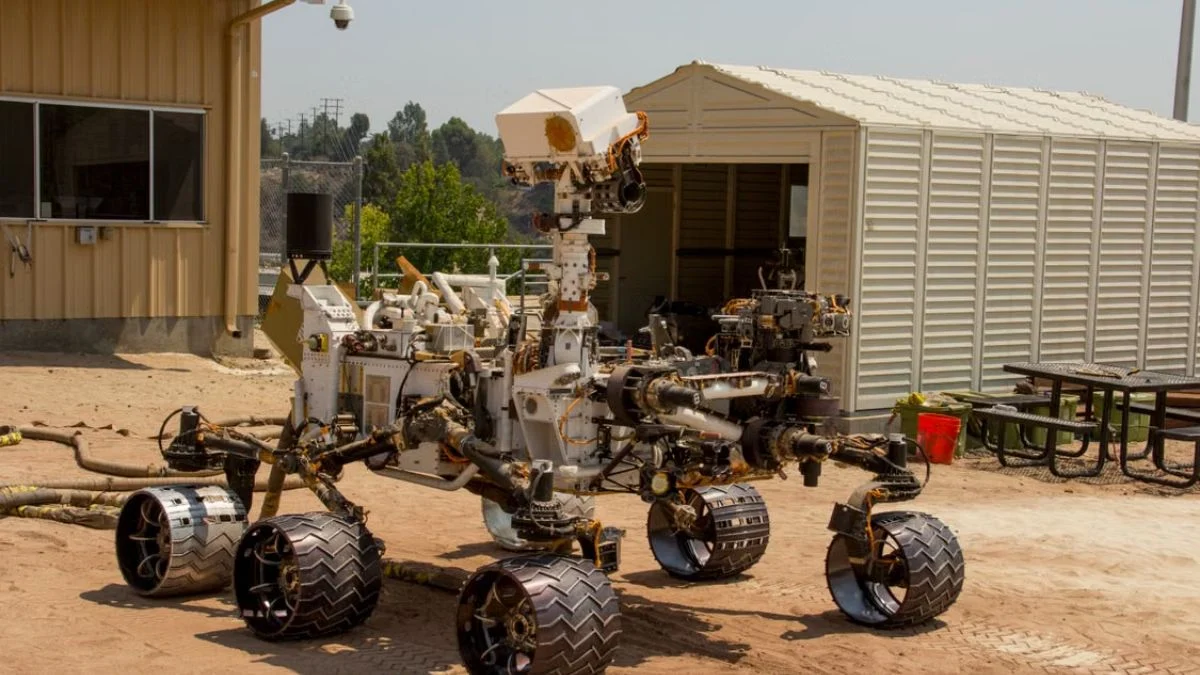
A Steam Deck is usually associated with games, portable PC libraries and gaming on the go. But inside Airbus’ Stevenage facility in the UK, the familiar handheld has taken on a much stranger job: helping control a prototype connected to one of Europe’s biggest Mars exploration projects.
The unusual setup was shown to YouTuber Tom Scott during a visit to Airbus, where he was given the chance to operate the rover prototype himself. What looks at first like a gaming session is actually part of the engineering work preparing technology for a mission that is ultimately expected to send the Rosalind Franklin rover to Mars in 2030.
Tom Scott gets behind the controls of the Mars rover prototype
Tom Scott visited Airbus’ Stevenage campus as part of his current series exploring interesting locations around the UK. During the visit, he was shown the company’s rover development work and given a quick lesson before taking control of the prototype.
The control device handed to him was not some futuristic-looking spacecraft controller. It was a Steam Deck running custom software.
Scott described the experience in his published video, “This Mars rover’s cool. But have you seen its wheels?”
He explained:
“a quick course in how not to break it, and then was handed what’s basically a gaming console,”
The Steam Deck’s familiar physical controls were being used to send commands to the rover. Its thumbsticks, triggers and face buttons provided the inputs needed to operate the machine during the demonstration.
And then came one of the most visually striking parts of the test.
A control on the handheld allowed the rover’s wheels to turn through roughly 90 degrees. That gives the vehicle the ability to move sideways in a crab-like fashion rather than depending solely on conventional steering.
On screen and in practice, the experience can look surprisingly similar to controlling a vehicle in a video game. But behind that familiar interface is a much more practical engineering purpose.
Repurposing familiar tech for unexpected new jobs isn’t the only kind of reinvention making headlines this week. A major coffee chain is going through its own restructuring, closing hundreds of locations while investing heavily elsewhere. Check our story on Starbucks to Close 250 U.S. and Canada Stores as ‘Back to Starbucks’ Turnaround Takes Another Turn
Why is Airbus using a Steam Deck to control a rover?
The Steam Deck is fundamentally a compact Linux-based PC with an integrated display and physical gaming controls. Unlike a closed-purpose gaming console, its computing environment can be used for applications far beyond playing games.
That makes the handheld useful for experimental rover testing.
Engineers working with a prototype need a way to run specialist software while also having responsive physical controls. The Steam Deck already combines a computer, screen, wireless connectivity and a full set of gaming controls in a compact, portable device.
For development work, that means engineers do not necessarily need to create an entirely new handheld controller simply to move a prototype around a test facility.
However, there is an important distinction here.
The Steam Deck is not the rover’s main autonomous brain, and it is not being prepared for deployment on Mars. It is being used as a terrestrial testing tool while the rover technology is developed and evaluated on Earth.
Reports from the demonstration also note that Airbus has not publicly detailed the specific custom software or communication method being used by the Steam Deck.
The Steam Deck is a testing tool, not Mars equipment
That distinction matters because the eventual Rosalind Franklin rover will face a very different operating environment.
Engineers can directly control a prototype while it is sitting in a test facility in Stevenage. Once the actual rover reaches Mars, however, operators on Earth cannot simply drive it continuously like a remote-controlled vehicle.
The huge distance between Earth and Mars creates communication delays, making real-time driving impractical.
That is where autonomous navigation becomes critical.
Handheld gaming gear isn’t the only unexpected technology making waves this week. One new AI demo is letting people talk directly to a synthetic version of a major public figure in real time. Read our story on ACTx486 AI Demo Lets Viewers Interrupt Elon Musk’s Podcast and Make a Synthetic Musk Answer Questions
Rosalind Franklin will need to navigate Mars by itself
The ExoMars Rosalind Franklin mission has been designed around autonomous capabilities that allow the rover to determine how it moves across the Martian surface.
ESA has described autonomous navigation as one of the key technologies demonstrated by the mission. The rover will use onboard systems and cameras to help determine how it should move across the terrain.
That puts the Steam Deck demonstration into perspective.
The handheld allows engineers to directly control, test and evaluate the prototype on Earth, while the eventual rover must rely on its own onboard systems when operating on Mars.
The difference between the two situations is enormous: one involves a person standing nearby with a gaming-style controller, while the other involves a rover making navigation decisions on another planet.
The Steam Deck is only one small part of the ExoMars project
The unusual controller is arguably the most fun part of the demonstration, but the technology being tested is tied to a much larger programme.
The vehicle is connected to ESA’s ExoMars Rosalind Franklin mission, which is intended to investigate Mars and search for evidence of past or present life.
One of the rover’s defining capabilities is its drill.
Rosalind Franklin is designed to drill up to two metres below the Martian surface and collect material from depths where samples can be better protected from the harsh surface environment.
Airbus originally designed and built the Rosalind Franklin rover at its Stevenage facility before delivering it to Thales Alenia Space in 2019.
The mission was initially planned for an earlier launch. However, the programme was subsequently redesigned following the cancellation of ESA’s cooperation with Russia.
The rebuilt mission now includes a new European landing platform.
In March 2025, Airbus announced that it had been selected by ESA and Thales Alenia Space to develop key systems for that landing platform.
Airbus is building critical landing hardware too
Airbus’ role in ExoMars therefore goes beyond the rover itself.
Under contract to Thales Alenia Space, Airbus teams in Stevenage are developing the mechanical, thermal and propulsion systems for the ExoMars landing platform.
The platform is designed to help the spacecraft survive its descent and touchdown before the rover is deployed.
Its systems include:
- The landing structure
- Propulsion for final braking and landing
- Landing gear designed to stabilise the platform after touchdown
- Two ramps that will allow the rover to leave the platform and reach the Martian surface
The landing system faces a particularly demanding speed reduction during descent.
Airbus said the ExoMars landing system will need to reduce the platform’s speed from around 45 metres per second at the end of the parachute descent phase to less than 3 metres per second before touchdown, using retro rockets.
The hardware has also undergone extensive testing.
ESA reported in 2026 that full-scale landing-platform models had been subjected to drop tests on both hard and Mars-like soft surfaces. Later testing examined the deployment of the landing legs and the system’s ability to withstand demanding conditions.
| ExoMars detail | Supplied information |
| Rover | Rosalind Franklin |
| Rover development location | Airbus, Stevenage, UK |
| Original rover delivery | Thales Alenia Space, 2019 |
| Planned launch | 2028 |
| Expected Mars arrival | 2030 |
| Maximum planned drilling depth | Up to 2 metres |
| Landing speed after parachute phase | Around 45 m/s |
| Target speed before touchdown | Less than 3 m/s |
| Ground-testing controller | Steam Deck |
| Rover landing access | Two ramps |
The 2028 launch is aimed at a 2030 Mars landing
The current mission architecture calls for a 2028 launch, followed by arrival at Mars in 2030.
ESA says the timing is intended to allow the spacecraft to reach Mars during a more favourable period for surface operations while avoiding the planet’s global dust-storm season as much as possible.
Once it reaches the Martian surface, Rosalind Franklin is expected to combine mobility with subsurface investigation.
ESA describes it as the first rover intended to drill as deep as two metres into Mars and analyse those samples using instruments carried onboard.
The mission is also intended to demonstrate technologies that could support future planetary exploration, including autonomous movement, sample handling and scientific analysis.
Airbus managing director Kata Escott previously summed up the scale of the undertaking:
“Getting the Rosalind Franklin rover onto the surface of Mars is a huge international challenge and the culmination of more than 20 years’ work.”
That makes the Steam Deck footage even more amusing.
A device designed to fit into a gamer’s hands is helping engineers test a machine ultimately intended to operate millions of miles away, where there will be no convenient human operator standing beside it.
From gaming handheld to Mars robotics development
The demonstration also shows why the Steam Deck can be more flexible than its gaming-focused image suggests.
Because it is essentially a portable PC rather than a closed-purpose console, developers can use its computing environment for applications beyond gaming. Its integrated controls provide a familiar physical interface, while its screen and wireless capabilities make it practical for experimental robotics setups.
That does not mean Valve has suddenly entered the space industry, nor does it mean a Steam Deck is becoming standard Mars equipment.
Instead, the Airbus demonstration shows how off-the-shelf consumer hardware can be repurposed as a useful development tool when its underlying capabilities fit an engineering problem.
In this case, that problem involves a rover designed to investigate Mars, drill beneath its surface and search for evidence of ancient life.
Not every recent story involves cutting-edge technology or space exploration. One well-known online figure is instead marking a very different kind of return after time spent away from the public eye. For more, read our post on Lady Gaga Fan Account Owner Kirill Returns After Two Years in Prison During the MAYHEM Era
Conclusion
The sight of a Steam Deck controlling a Mars rover prototype may look like an unexpected crossover between gaming and space exploration, but the technology has a straightforward purpose. Airbus is using the handheld as a convenient ground-testing control interface at its Stevenage facility, allowing engineers — and, during his visit, Tom Scott — to operate and evaluate the rover prototype.
The eventual Rosalind Franklin rover will not depend on a Steam Deck when it reaches Mars. Its mission is built around autonomous navigation and other onboard technologies because real-time remote driving from Earth is not practical across the enormous distance between the two planets.
With a 2028 launch and 2030 Mars arrival currently planned, the Steam Deck demonstration is a small but memorable glimpse of the engineering work happening before one of Europe’s most ambitious planetary exploration missions attempts to reach the Red Planet.
Source Disclaimer
This article has been prepared based on thorough research of the sources provided with the original material, including information from ESA, Airbus, Tom Scott’s published video and relevant reporting available at the time of publication. The article reflects the information contained in those provided sources and does not imply independent verification beyond what that material supports. The Steam Deck described in the article is a ground-testing control interface and should not be confused with the autonomous systems intended for the Rosalind Franklin rover’s Mars operations.
Sources
- Airbus: ExoMars rover lander platform press release
- ESA: ExoMars Rosalind Franklin rover and European landing platform
- ESA: ExoMars rover mission overview
- ESA: ExoMars Rosalind Franklin mission FAQ
- ESA: 2026 ExoMars landing-leg testing
- Tom Scott: “This Mars rover’s cool. But have you seen its wheels?”
Featured Image Credit: Ramaz Bluashvili on Pexels


Leave a Reply