

Introduction: A Late-Night Comedy Show Became a Political Battleground
Late-night comedy shows have long been a space where politics, satire, and free speech collide. But in February 2026, The Late Show with Stephen Colbert unexpectedly became the center of a national media controversy involving FCC regulations, corporate caution, political pressure, and the First Amendment.
What began as a routine pre-taped interview with a Democratic Senate candidate escalated into a viral debate about censorship, regulatory power, and the role of corporate media in American democracy. Within hours, the story trended across major outlets—including PBS NewsHour, Variety, CNBC, CNN, BBC, and The Washington Post—and exploded across social media platforms.This article breaks down the full verified timeline, the legal background, the key players, and why the incident is being described as a defining moment for media freedom in 2026.
The FCC Equal Time Rule Explained: Why This Law Suddenly Matters Again
To understand the controversy, it’s crucial to understand the FCC’s Equal Time (Equal Opportunities) Rule.
What Is the Equal Time Rule?
The Equal Time Rule (Section 315 of the Communications Act) requires U.S. broadcast TV and radio stations to offer equal airtime to legally qualified political candidates if one candidate appears on their programming.
- If one candidate gets airtime, opponents can request comparable airtime.
- It does not require equal viewpoints—only equal opportunity.
- The rule applies to broadcast television and radio, not cable or streaming platforms.

The Bona Fide News Exemption
Historically, broadcasters relied on the “bona fide news exemption”, which allows newsworthy interviews to air without triggering equal time obligations—if the broadcaster acts in reasonable, good-faith judgment that the interview is newsworthy and not partisan.
Late-night shows like The Tonight Show, Politically Incorrect, and others have historically benefited from this exemption.
January 2026 FCC Guidance: A Shift That Triggered Industry Panic
On January 21, 2026, the FCC Media Bureau issued Public Notice DA 26-68, clarifying how broadcasters should interpret the rule.
Key points included:
- Late-night and daytime talk shows cannot automatically assume they qualify for the news exemption.
- Interviews motivated by partisan purposes may not qualify.
- Broadcasters must make case-by-case determinations.
- Formal exemptions require petitions for declaratory rulings.
- Stations must file equal-opportunity reports.
Political Reactions to the Guidance
- FCC Chairman Brendan Carr, appointed during the Trump administration, highlighted the guidance on X and criticized “legacy TV networks” he believed were partisan.
- Democratic Commissioner Anna Gomez warned it could lead to censorship and urged broadcasters not to self-censor.
- The FCC also probed ABC’s The View over similar political appearances.
This guidance set the stage for the explosive Colbert controversy.
The Colbert–Talarico Interview That Never Aired on Broadcast TV
Who Is James Talarico?
James Talarico is a Texas Democratic state representative and a prominent Trump critic running in the Texas Democratic primary for U.S. Senate. His opponents include Rep. Jasmine Crockett, among others, with early voting already underway.
In mid-February 2026, Talarico recorded a pre-taped interview for The Late Show with Stephen Colbert.
CBS Legal Intervention
According to Colbert, CBS and Paramount Skydance lawyers intervened and told him the interview could not air on broadcast television because it could trigger equal-time obligations for other candidates.
Colbert said:
- He was told “in no uncertain terms” the interview could not be broadcast.
- He was instructed not to mention the issue on air.
- He described this as unprecedented in his 20+ years in television.
Colbert’s On-Air Monologue and Viral Fallout
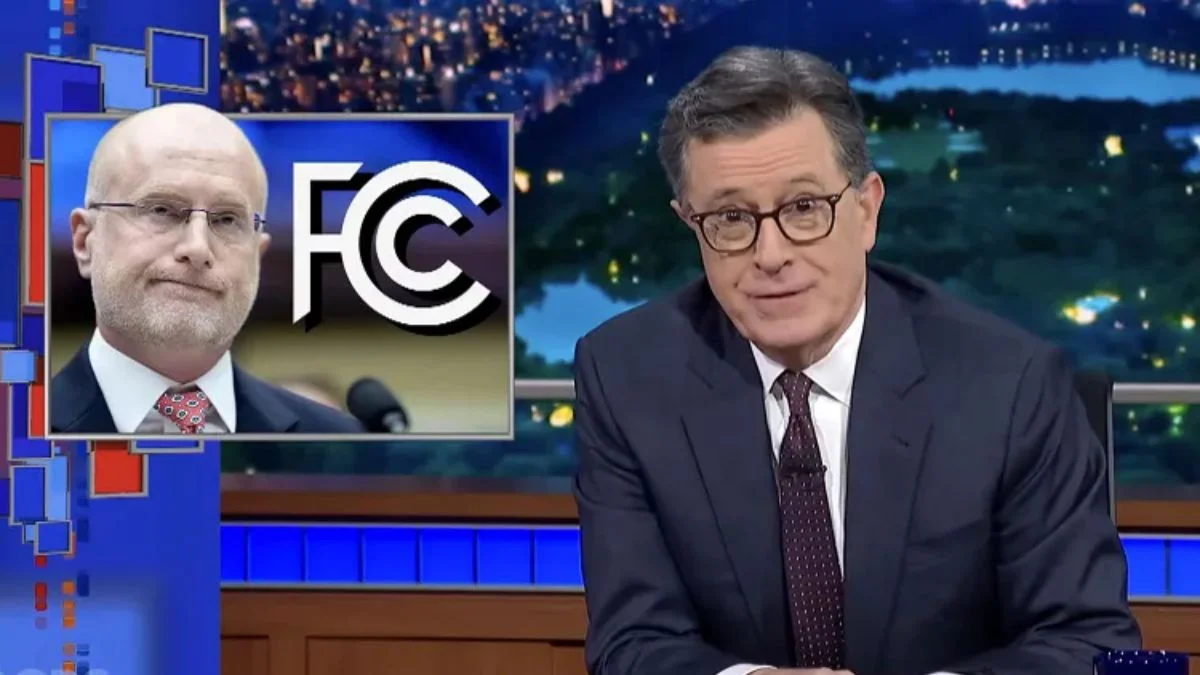
Instead of airing the interview, Colbert delivered a monologue explaining the situation and mocking FCC Chairman Brendan Carr with sharp satire. He directed viewers to watch the full interview on YouTube, which is not subject to broadcast equal-time rules.
Viral Impact
- The YouTube interview quickly amassed millions of views, with reports ranging from 1.5 million to over 4.4 million.
- Clips from Colbert’s monologue spread rapidly on X and other platforms, fueling debates about censorship vs. compliance.
Talarico’s Reaction
Talarico accused corporate media executives of “selling out the First Amendment to curry favor with corrupt politicians.”
CBS Responds—and Colbert Fires Back
CBS Official Statement
The CBS stated that The Late Show was not prohibited from airing the interview, but legal guidance warned it could trigger equal-time obligations for other candidates. The network said the show was given options for fulfilling equal-time requirements and chose to release the interview on YouTube with on-air promotion.
Colbert’s Rebuttal
On the following night’s show, Colbert:
- Held up CBS’s statement and called it “crap.”
- Dramatically discarded it on air.
- Claimed CBS lawyers unusually vetted his entire script and gave backstage notes.
- Accused the network of enforcing FCC guidance for financial and regulatory reasons, including corporate merger and FCC approval concerns.
- Urged CBS and Paramount to “stand up to the bullies” in the Trump administration.
He even referred to CBS as his “soon-to-be-former network,” sparking speculation about future contract and merger implications.

FCC Commissioner Anna Gomez’s Explosive Criticism
Official Statement
FCC Commissioner Anna Gomez, the sole Democratic commissioner, condemned CBS’s decision as corporate capitulation.
She stated that:
- The FCC has no lawful authority to pressure broadcasters in this manner.
- CBS is protected by the First Amendment.
- Corporate interests should not justify retreating from free speech.
- Broadcasters should stand firm against unlawful pressures.
PBS News Hour Interview Highlights
In a detailed PBS NewsHour interview, Gomez clarified:
- The January guidance did not change the law—it merely reiterated existing rules.
- Broadcasters still have discretion based on reasonable good-faith judgment.
- Historically, talk shows have qualified for exemptions.
- She accused the administration of trying to control and censor media content.
- Warned broadcasters are already self-censoring ahead of midterms, creating a precarious moment for free speech.
- Said the FCC should stay out of content regulation.
- Noted the YouTube workaround does not eliminate the chilling effect.
Timeline of Key Events
| Date | Event | Key Figures | Details |
| Jan 21, 2026 | FCC issues Public Notice DA 26-68 | FCC Media Bureau, Brendan Carr | Clarifies equal-time rule guidance |
| Feb 16, 2026 | Talarico interview recorded | James Talarico, Stephen Colbert | Pre-taped Late Show segment |
| Feb 17, 2026 | Colbert reveals interview blocked | Stephen Colbert | Monologue replaces interview |
| Feb 17, 2026 | CBS issues statement | CBS/Paramount Skydance | Says legal guidance was provided |
| Feb 17–18, 2026 | Anna Gomez criticizes CBS | FCC Commissioner Gomez | Calls decision corporate capitulation |
| Feb 17–18, 2026 | Interview trends online | Talarico, social media users | Millions of YouTube views |
Why This Controversy Matters Beyond Late-Night TV
1. Free Speech vs Corporate Risk
The incident highlights the tension between First Amendment protections and corporate risk management. Networks facing regulatory scrutiny and merger approvals may err on the side of caution, potentially limiting political speech.
2. Regulatory Power in a Polarized Era
The FCC guidance, though technically a clarification, has been interpreted as a tool for political pressure. Critics argue it creates a chilling effect on broadcasters.
3. The Rise of Digital Workarounds
The fact that the interview aired on YouTube underscores how digital platforms bypass traditional broadcast regulations—reshaping political communication strategies.
4. Election-Year Implications
With the Texas Democratic Senate primary underway and no Democratic statewide win since 1994, the controversy intersects directly with high-stakes electoral politics.
Media Coverage and Public Reaction
The story dominated major media outlets across the political spectrum, including:
- PBS NewsHour
- Variety
- CNBC
- CNN
- BBC
- Hollywood Reporter
- Washington Post
- Politico
- Deadline
- Al Jazeera
- LA Times
- Time
Public reactions ranged from accusations of censorship to arguments that CBS was simply following the law. The divide mirrored broader debates over media bias, government regulation, and corporate power.

No FCC Enforcement Yet—but the Debate Is Just Beginning
As of February 18, 2026:
- No formal FCC complaint or enforcement action has been filed regarding this interview.
- Since the interview aired on YouTube, broadcast rules technically do not apply.
- The broader debate continues over how broadcasters should interpret equal-time obligations in a digital age.
Conclusion: A Defining Moment for Media, Politics, and Free Speech
The Stephen Colbert–CBS controversy is more than a late-night TV drama. It is a microcosm of modern American media politics, where regulation, corporate interests, satire, and free speech collide in real time.
Whether CBS acted prudently or capitulated under political pressure remains a matter of perspective. But one thing is certain: this incident has reignited national scrutiny of the FCC, corporate media power, and the boundaries of political expression in broadcast television.
As the 2026 election cycle heats up, this controversy may become a precedent-setting case for how broadcasters handle political content—and how far they are willing to go to avoid regulatory risk.


Leave a Reply