

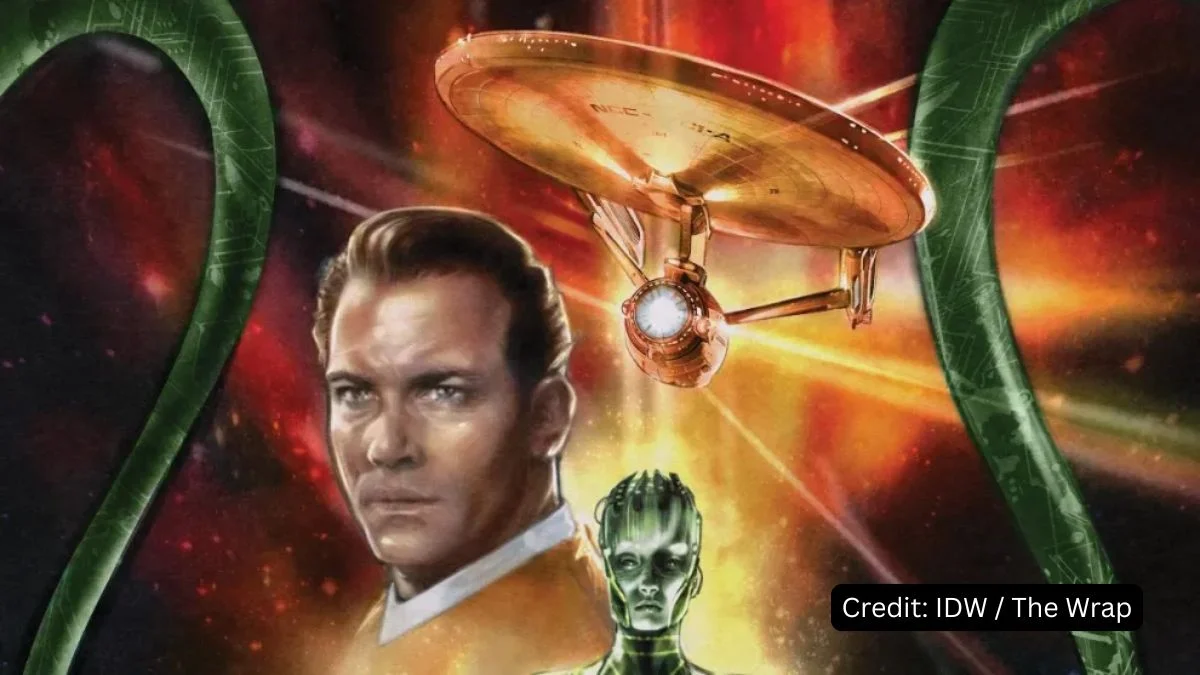
The Star Trek universe has always been defined by optimism, exploration, and the belief that cooperation can overcome even the deepest divisions. But Star Trek: The Last Starship, IDW Publishing’s ambitious comic series launched in September 2025, turns that hopeful legacy on its head. Set in the immediate aftermath of The Burn, the story pushes Starfleet, the Federation, and the Klingons into one of the bleakest eras the franchise has ever explored.
Written by Collin Kelly and Jackson Lanzing, with art by Adrián Bonilla and colors by Heather Moore, the ongoing series takes readers into the 31st century, roughly a hundred years before the events of the TV series Star Trek: Starfleet Academy. While IDW coordinates closely with Paramount for continuity, the comics remain semi-canonical unless officially referenced in live-action or animation. Still, the scale of the story, its emotional weight, and its shocking revelations about the Klingons make The Last Starship feel like essential reading for modern Star Trek fans.
Rather than rushing into galaxy-ending twists, the comic unfolds its tragedy carefully—starting with survival, then leadership, and finally exposing how peace itself can fracture under pressure.
What Is Star Trek: The Last Starship? A New Era of Post-Burn Storytelling

Star Trek: The Last Starship begins in a universe still bleeding from The Burn, the catastrophic event first introduced in Star Trek: Discovery Season 3. In 3069, dilithium—the mineral that stabilizes warp cores—became violently unstable across the galaxy. Countless ships detonated at once. Trillions died. Interstellar travel collapsed almost overnight, and the United Federation of Planets was shattered.
The comic picks up immediately after that disaster. Starfleet is no longer a vast armada of explorers; it is a desperate collection of survivors. Resources are scarce. Worlds are isolated. Old alliances rot in the vacuum of space.
At the center of the story is the USS Omega, the last operational starship hastily assembled from scavenged parts and experimental technology, including a Borg transwarp drive. The ship itself symbolizes the era: half hope, half horror.
Commanding the Omega is Captain Delacourt Sato, a principled officer whose diplomacy echoes the traditions of Jean-Luc Picard. Yet this is not Picard’s galaxy anymore. Peace talks fail faster than weapons fire, and ideals collapse under the pressure of extinction.
The series also delivers one of its boldest ideas early: the resurrection of Captain James T. Kirk.

The Return of Captain Kirk Through Borg Technology
Centuries after his death in Star Trek: Generations, James T. Kirk is brought back using Borg technology. This resurrected Kirk is not simply a nostalgic cameo. Instead, he becomes a living philosophical conflict.
Kirk questions whether he is truly himself or just a constructed imitation of a legendary officer. He carries tactical brilliance, but also trauma. At times, he mistakenly refers to the USS Omega as the Enterprise, revealing how deeply the past still haunts him.
Serving under Captain Sato creates tension. Kirk’s instincts lean toward aggressive survival, while Sato clings to diplomacy. Their dynamic embodies the comic’s central question: can Starfleet ideals survive when the galaxy no longer does?
Adding further complexity is Agnes Jurati, reimagined here as a Borg character developing emerging emotions. Her presence injects interpersonal drama into a universe already emotionally fractured.
Together, the crew sets out not to explore, but to rally what remains of the Federation.
Understanding The Burn and Its Galaxy-Wide Impact on Star Trek Lore
To grasp why everything feels so broken in The Last Starship, it’s essential to revisit The Burn. Introduced in Star Trek: Discovery Season 3, The Burn was a galaxy-spanning catastrophe in which dilithium across the universe destabilized simultaneously.
Warp cores detonated across fleets, stations, and colonies. Ships vaporized mid-flight. Entire civilizations lost contact with one another overnight. Starfleet was nearly erased, and the Federation shrank into a shadow of its former self.
Species like the Klingons were hit particularly hard. Their culture is built on honor, combat, and meaningful death. The Burn gave them none of that. Instead, countless Klingons died without battle, without glory, and without purpose.
The comic emphasizes how psychologically devastating this was. Klingons didn’t fall in war—they vanished in isolation. And that cultural trauma becomes the spark for everything that follows.

USS Omega’s Mission: Rebuilding Starfleet in a Broken Galaxy
The early issues of The Last Starship establish the state of the galaxy slowly. Worlds are cut off. Trade routes are dead. Resources are hoarded. Fear replaces trust.
Captain Sato attempts to reconnect fragments of the Federation through diplomacy, but everywhere the Omega travels, desperation has replaced optimism. Former allies behave like strangers. Enemies return without warning.
Kirk provides tactical muscle, but struggles internally with his identity crisis and the moral ambiguity of survival-first leadership. His PTSD-like moments, calling the Omega the Enterprise, reinforce that Starfleet’s past glories now feel like myths.
This quiet tension builds the story toward its most explosive turn: the arrival of the Klingons.
The Klingon Attack on Earth and the Rise of the Black Path Cult
In issue #2, the calm fractures completely. A fleet of Klingon vessels emerges in Earth’s solar system, using warp despite the dangers of unstable dilithium. They ignore all hails and launch an immediate assault.
Instead of traditional invasion, they drop warp cores as antimatter bombs. San Francisco, London, and Rome are devastated. Earth is no longer a safe center of civilization—it becomes a battlefield.
The attack is led by Ha’shet, a militant Klingon who rose to power through a radical movement called the Black Path, sometimes referred to as the Black Mind. This cult rejects centuries of peace, including treaties like the Khitomer Accords, calling them “Utopian corruption.”
Ha’shet’s manifesto explains their rage:
“In the burning detonations across the stars, did annihilation come to our people. More lives than any battle. More souls than any plague. Gone without meaning. Without honor… Now we walk a new path. A Black Path. And with it, a new promise: The Federation’s end.”
For the Black Path, peace weakened Klingon identity. The Burn proved that survival without honor was worse than death. Their solution: restore their “true nature” through war.

Captain Sato vs Ha’shet: Honor, Power, and a Fatal Decision
The USS Omega engages the Klingon fleet in a brutal confrontation. Kirk pushes for aggressive tactics, while Sato tries diplomacy until it becomes impossible.
The conflict reaches a personal climax when Sato confronts Ha’shet in direct combat using a massive bat’leth forged from programmable matter. By Klingon honor codes, defeating Ha’shet grants Sato temporary command over the fleet.
Instead of destroying them, Sato makes a decision that feels merciful at first. He orders the Klingons to retreat to their homeworlds.
But in a post-Burn galaxy, mercy carries consequences.
The Destruction of 29 Klingon Worlds Explained
Issue #3 delivers one of the darkest moments in modern Star Trek storytelling.
As the Klingon ships return home, residual dilithium instability—still echoing from The Burn—triggers catastrophic chain reactions in their warp cores. Across the Empire, worlds ignite in simultaneous explosions.
Qo’noS, the Klingon homeworld, is lost. In total, twenty-nine Klingon core planets detonate.
Captain Sato’s log records the horror:
“They go into the darkness on my order… Soon, the screaming starts. Twenty-nine Klingon worlds light up with dilithium detonations, their last transmission is a roar in a thousand voices. And then they’re just gone.”
The Klingon Empire effectively collapses in minutes. Their culture, already wounded by dishonorable deaths, is pushed to the brink of extinction.
Worse, Starfleet is indirectly responsible.
Starfleet’s Role in the Klingon Downfall
Sato did not intend genocide, but his command sent the Klingons back into unstable warp corridors. The comic frames this as reckless leadership under impossible pressure.
This moment permanently reshapes Starfleet’s image. They are no longer untouchable heroes. They are fallible leaders whose decisions carry irreversible costs.
The aftermath is just as brutal politically. Earth declares independence from the Federation, accusing Starfleet of dangerous overreach. Non-Earth members are asked to leave, marking one of the darkest days in Federation history.
The ideals of unity fracture just as badly as the Klingon Empire.
The Klingons’ Dark History After The Burn
The Last Starship reframes Klingon history in four devastating ways:
Cultural Radicalization
The Black Path cult rises from dishonor and isolation, rejecting peace as weakness and weaponizing ancient myths.
Extinction-Level Losses
The destruction of twenty-nine worlds leaves Klingons scattered refugees with no empire, no homeworld, and no unified leadership.
Starfleet’s Indirect Guilt
Sato’s order links Starfleet to the Klingon collapse, permanently altering human–Klingon relations.
Honor Without Battle
Without meaningful combat deaths, concepts like Sto’vo’kor lose power, pushing Klingons toward suicidal vengeance and cultural erosion.
Rather than fading quietly from history, the Klingons fall screaming into myth.

How The Last Starship Connects to Star Trek: Starfleet Academy
The comic directly supports the timeline seen in Star Trek: Starfleet Academy. In the series, Klingons appear as refugees with only eight major houses remaining and Qo’noS already destroyed.
In the episode “Vox in Excelso,” Klingon cadet Jay-Den Kraag helps negotiate aid for his people, including the proposal of Faan Alpha as a replacement homeworld. Klingons resist charity because dependence feels dishonorable.
While the show attributes Qo’noS’s destruction to dilithium mines exploding during The Burn, the comic expands this by showing cascading warp-core detonations from returning ships.
Together, they form a narrative bridge explaining how a proud empire became displaced survivors.
Creative Impact, Reception, and the Future of Star Trek Comics
Issue #3 released in December 2025, and further arcs are planned. Reviews praise the series for blending classic Star Trek philosophy with post-apocalyptic tension. Kirk’s resurrection adds emotional gravity, while programmable matter and Borg technology ground the story in 31st-century innovation.
Though not strictly canon, the coordination with Paramount suggests the ideas could influence future storytelling. An upcoming tie-in, Star Trek: Starfleet Academy – Lost Contact, launches in April 2026, expanding the era further.

Why The Last Starship Changes Star Trek Forever
At its core, Star Trek: The Last Starship is not about explosions or resurrected legends—it’s about accountability. It asks what happens when peace fails, when honor collapses, and when even Starfleet’s best intentions destroy civilizations.
By slowly revealing the Klingons’ fate, the comic transforms them from warriors into ghosts of a fallen empire. It also forces Starfleet to confront a future where optimism alone is no longer enough.
In the ashes of The Burn, exploration becomes survival, leadership becomes tragedy, and the final frontier becomes a mirror reflecting the cost of every command given in desperation.
And in that darkness, The Last Starship proves that Star Trek’s most powerful stories are still being written—one shattered world at a time.


Leave a Reply