

हिंदी में पढ़ें: हिंदू पुराणों के प्राचीन सर्प देवता
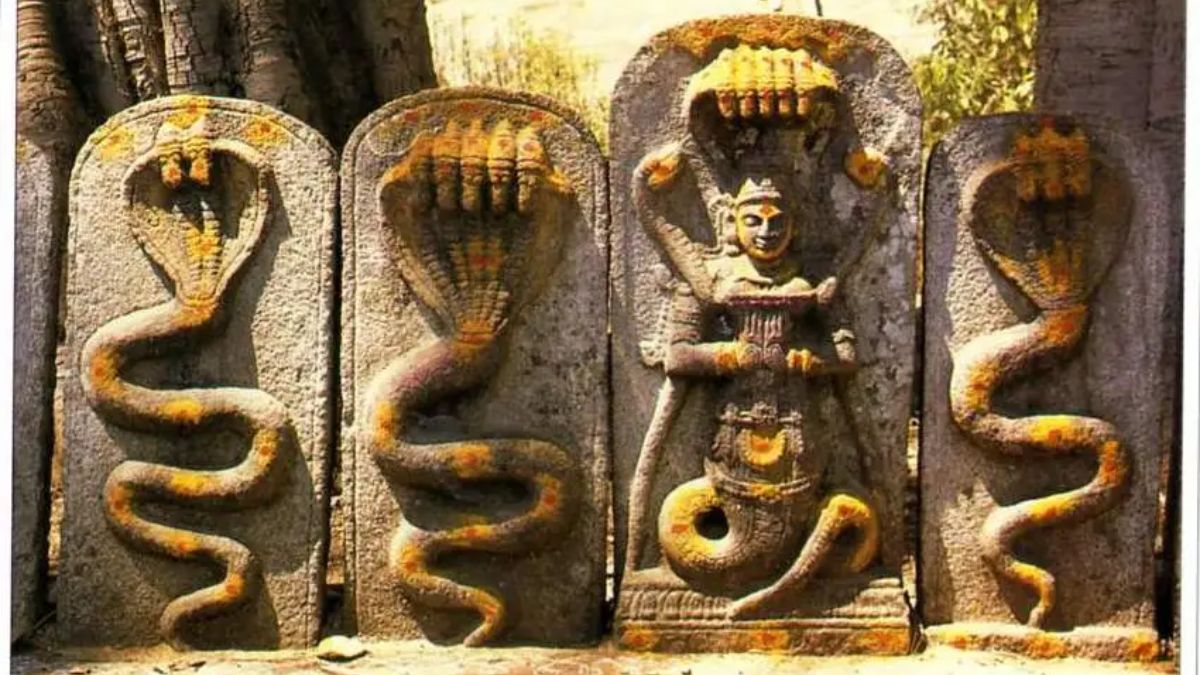
In the labyrinthine corridors of Hindu mythology and folklore, where ancient wisdom meets modern urban mythology, there exists a race of beings whose very existence challenges our understanding of reality. The Nāgas (Sanskrit: नाग) emerge not as mere mythological constructs, but as living entities whose worship and reverence have transcended centuries, evolving into contemporary urban folklore and spiritual awakening practices that continue to shape deity worship across South Asia.
These half-human, half-serpent deities have maintained their grip on human consciousness for over 2,000 years, their stories weaving through ancient texts into modern spiritualism and urban myth. What began as sacred folklore has evolved into a complex system of deity worship that bridges the gap between ancient wisdom and contemporary spiritual awakening.
Origins and Etymology: Decoding the Serpent’s Name
The very word “nāga” carries within it layers of ancient meaning that scholars continue to unravel. In Sanskrit, nāga primarily denotes a snake, most commonly represented by the dreaded Indian cobra (Naja naja). The linguistic connections run deeper than mere nomenclature – the word shares cognates with the English “snake,” tracing back through Germanic snēk-a- to the Proto-Indo-European (s)nēg-o-.

Yet the etymology holds darker secrets. Alternative theories suggest an Indo-European root meaning “hairless, naked animal,” connecting to the English word “naked.” This interpretation explains why the Sanskrit nāga can also mean “cloud,” “mountain,” or “elephant” – entities that appear bare and exposed to the natural world.
The Divine Serpent Hierarchy
Nagaraja: Kings of the Underworld
At the apex of this serpentine hierarchy stands the Nagaraja – the king of all nāgas. These are not mere serpents but cosmic entities whose power extends across dimensions. Female nāgas, known as Nagin or Nagini, possess equal mystical abilities and are revered as both protectors and destroyers.

According to ancient legends, all nāgas trace their lineage to the sage Kashyapa and his wife Kadru, making them among the most ancient beings in Hindu cosmology. This divine parentage explains their supernatural abilities and their complex relationship with both gods and mortals.
Sacred Texts and Scriptural References
The Mahabharata: First Chronicle of the Serpent Race
The Mahabharata stands as the first comprehensive text to document the nāgas in intricate detail, establishing the foundation for what would become both sacred Hindu mythology and enduring urban folklore. Within its vast narrative, cosmic serpents like Shesha, Vasuki, Takshaka, Airavata, and Karkotaka emerge as pivotal characters whose actions influence the fate of gods and humans alike.

The epic introduces us to Princess Ulupi, a nāga princess whose love story with Arjuna reveals the complex emotional nature of these beings. Her tale demonstrates that nāgas are not merely monsters but beings capable of profound love, jealousy, and sacrifice – themes that resonate deeply in contemporary spiritualism and deity worship practices.

Might Interest You: The Forbidden Mysteries of the Yakshinis
The Brahma Purana: Visions of the Serpent Realm
The Brahma Purana provides one of the most detailed descriptions of nāga civilization in Patala:
“During the night, the light of the moon is not utilised for its coolness but only for illumination. Since that passes away is not taken notice of by the nāgas who enjoy with gaiety the foodstuffs and the edibles they consume and the great beverages they drink.”
– Brahma Purana, Chapter 19

This passage reveals a realm where time flows differently, where lunar cycles hold no sway over beings who have transcended mortal concerns. The text continues to describe Adishesha, the primordial serpent:
“The Tāmasī form of Viṣṇu, named Śeṣa, is beneath the lower regions… He has a thousand hoods, and he is clearly bedecked in Svastika ornaments devoid of impurities. He illuminates all quarters by a thousand jewels on his hoods.”
– Brahma Purana, Chapter 19
The Kamba Ramayana: Vasuki’s Cosmic Role
The Kamba Ramayana chronicles the legendary Samudra Manthana (churning of the ocean), where Vasuki becomes the cosmic rope:

“Garuḍa, who was haughty of his strength and speed, went to the city of the nāgas (serpents) and requested Vāsuki to come to the sea of Milk. Vāsuki replied that if the matter was so urgent, he had no objection to being carried to that place.”
– Kambar, Ramayana, Yuddha Kanda

This tale reveals the immense size and power of these beings – even Garuda, the mighty eagle deity, could not carry Vasuki’s full form.
Sacred Geography: The Naga Kingdoms
Patala-loka: The Jeweled Underworld
The primary domain of the nāgas is Patala-loka or Naga-loka, an underground realm that defies human comprehension. Ancient texts describe it as a place “filled with gems, gold and other earthly treasures,” where the very architecture sparkles with supernatural luminescence.

Regional Naga Worship
The influence of nāgas extends far beyond mythology into living traditions:
- Kullu Valley: Nāgas are revered as divine rulers of the region
- Berinag: Local traditions maintain active nāga worship
- Pindar River Valley: Ruled by the ninefold Naiṇī Devī
- Kashmir: The Nilamata Purana describes the region, beginning as a nāga-populated lake
- Kathmandu: The Swayambhu Purana narrates similar aquatic origins
The Goddess Manasa: Serpent Queen of Devotion
The Devi Bhagavata Purana introduces us to Manasa, perhaps the most complex nāga deity in Hindu mythology, whose story exemplifies the pinnacle of spiritual awakening and divine deity worship:

“Manasā is the mind-born daughter of Maharṣi Kaśyapa; hence she is named Manasā… She finds pleasure in Her Own Self, the great devotee of Viṣṇu, a Siddha Yoginī. For three Yugas She worshipped Śrī Kṛṣṇa and then She became a Siddha Yoginī.”
– Devi Bhagavata Purana, Chapter 47
Manasa’s story spans three Yugas (cosmic ages), during which she performed intense austerities. Her devotion was so extreme that Krishna himself was moved to grant her divine status. She earned multiple titles:
- Jagad Gaurī: The fair-colored one of the world
- Śaivī: Disciple of Shiva
- Vaiṣṇavī: Devoted to Vishnu
- Nageśvarī: Queen of serpents
- Nāga Bhaginī: Sister of serpents
- Viṣahari: Destroyer of poison’s effects
Living Traditions: Modern Naga Worship
South Indian Practices
In South India, ancient folklore persists in unexpected places, demonstrating how Hindu mythology seamlessly integrates with contemporary spiritualism. Termite hills are considered sacred dwelling places of nagammas (female nāgas), and locals perform rituals to appease these underground guardians. This practice represents a fascinating blend of ancient deity worship and modern urban folklore, where the connection between termites and nāgas reveals an understanding of the earth’s hidden networks that modern science is only beginning to comprehend.
Himalayan Guardianship

In the Himalayan regions, nāgas like Naiṇī Devī of Pindar Valley are worshipped as protectors of water resources and village welfare. These deities are believed to control rainfall, river flow, and the overall well-being of mountain communities, representing a living tradition of spiritual awakening that connects ancient wisdom with ecological consciousness.
The Eternal Conflict: Nagas vs. Garuda

The cosmic drama between nāgas and Garuda represents one of mythology’s most enduring conflicts. Garuda, the legendary bird-deity and vehicle of Vishnu, serves as the eternal nemesis of the serpent race. This rivalry symbolizes the perpetual struggle between earthly and celestial forces, between the grounded wisdom of serpents and the soaring freedom of birds.
Divine Associations: Serpents and Gods
Vishnu and Shesha

Vishnu is eternally portrayed reclining on Sheshanāga, the cosmic serpent whose thousand heads support the universe. This iconic image represents the divine rest between cosmic cycles, with the serpent serving as both bed and protector of the supreme deity.
Shiva’s Serpent Garland

Shiva is frequently depicted wearing serpents as garlands, symbolizing his mastery over death and time. The serpent around his neck represents the conquered ego and the transcendence of temporal limitations.
Ganesha’s Serpent Forms

Ganesha incorporates serpents in multiple forms – around his neck, as a sacred thread (yajñopavīta), wrapped around his stomach as a belt, held in his hands, coiled at his ankles, or even as a throne. Each position carries a specific symbolic meaning related to wisdom, protection, and spiritual transformation.
The Philosophical Significance
The sage Patanjali, compiler of the Yoga Sutras, is considered by many scholars to be a manifestation of the serpent of eternity. As noted in Maehle’s interpretation, “Patanjali is thought to be a manifestation of the serpent of eternity.” This connection between the greatest yogic text and nāga consciousness suggests that serpent wisdom forms the foundation of spiritual practice, linking ancient Hindu mythology with modern spiritualism and spiritual awakening practices.

Communities of Serpent Descent
Several communities across South Asia and Southeast Asia claim direct descent from nāgas, maintaining living traditions that blur the lines between folklore and urban mythology:
- Nagavanshi: A prominent clan in Indian society
- Khmer: The people of Cambodia
- Eelamese: Ancient inhabitants of Sri Lanka
These communities maintain traditions, rituals, and cultural practices that honor their serpentine heritage, keeping alive connections to powers that most of humanity has forgotten. Their practices represent a fascinating intersection of ancient deity worship and modern urban folklore, where spiritualism meets ancestral identity.
The Continuing Mystery
After 2,000 years of continuous worship and reverence, the nāgas remain as mysterious as ever, their influence extending from ancient Hindu mythology into contemporary urban mythology and spiritual awakening movements. They dwell in spaces between the known and unknown, serving as guardians of ancient wisdom and protectors of natural resources. Their dual nature – capable of both benevolence and destruction – mirrors the very forces of nature they represent.

The study of nāgas reveals layers of meaning that extend far beyond simple mythology. These deities embody humanity’s relationship with the natural world, the unconscious mind, and the hidden forces that shape reality. Their stories continue to unfold in temples, sacred groves, and the dreams of those who still remember the old ways, bridging ancient folklore with modern spiritualism and deity worship practices.
As urban folklore and urban myth continue to evolve in our digital age, the nāgas adapt and persist, finding new devotees among those seeking spiritual awakening and deeper connections to the mysteries that ancient Hindu mythology has always preserved.
This concludes Part 1 of our exploration into the enigmatic world of Nagas. In Part 2, we will delve deeper into the specific powers, abilities, and modern encounters with these ancient beings. Keep reading to uncover more secrets of the serpent realm…
References
- Sanskrit etymology and linguistic connections
- Ritual practices spanning 2,000 years across South Asia
- Brahma Purana, Chapter 19
- Kambar, Ramayana, Yuddha Kanda
- Devi Bhagavata Purana, Chapter 47
- Mahabharata (various sections)
- Nilamata Purana of Kashmir
- Swayambhu Purana of Kathmandu
- Regional folk traditions of Kullu Valley, Berinag, and Pindar River region
- South Indian termite hill worship practices
- Himalayan naga veneration traditions

Leave a Reply