

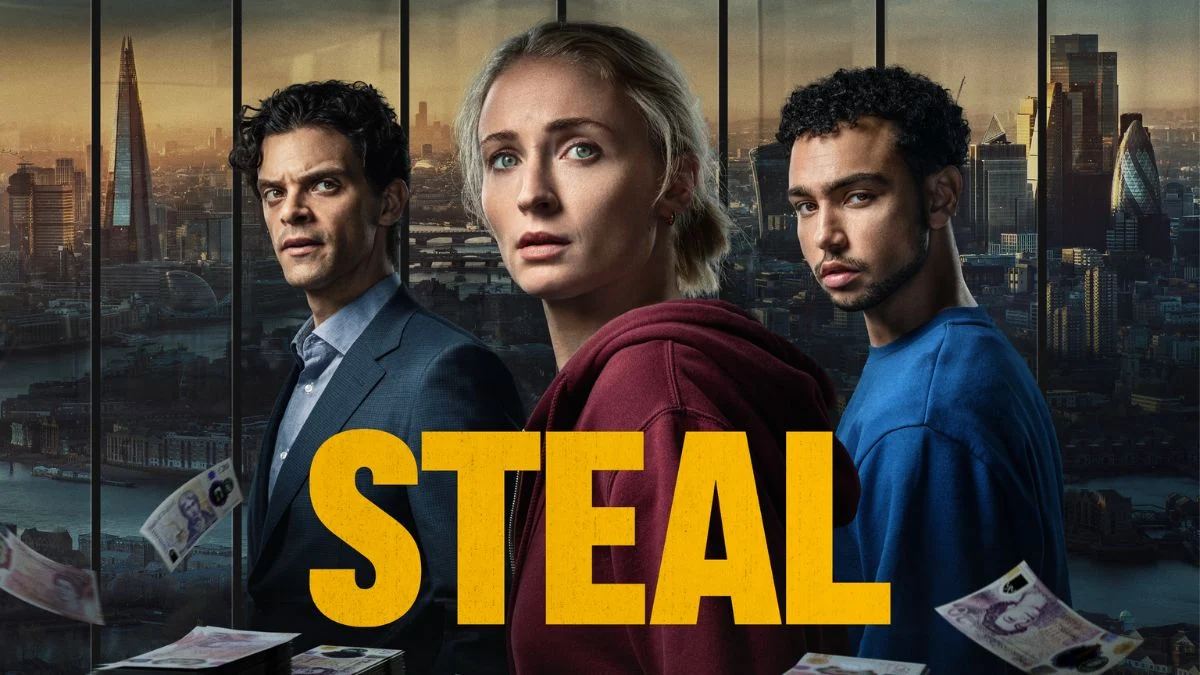
When Steal premiered on Prime Video on January 21, 2026, it arrived quietly—but it didn’t stay that way for long. The six-episode British thriller series, created by S.A. Nikias, quickly climbed Prime Video charts across multiple countries, fueled by word of mouth, binge-watchability, and a morally complex lead performance from Sophie Turner.
Set in contemporary London, Steal is not just another slick heist drama. It blends crime thriller, corporate conspiracy, and character study, using a single catastrophic financial crime to interrogate modern capitalism, invisible theft, and the personal cost of money. While critics have been divided on its execution, few disagree that Steal is tense, addictive, and thematically ambitious.
In This Post:

What Is Steal (2026) About? Prime Video’s Corporate Heist Thriller Explained
At its core, Steal revolves around a high-stakes heist at Lochmill Capital, a fictional pension fund investment firm housed in a London high-rise. The target is not a vault of diamonds or bearer bonds, but something far more unsettling: ordinary people’s pension funds.
The series stars Sophie Turner as Zara Dunne, a mid-level trade processor trapped in a dead-end corporate job. Alongside her are Archie Madekwe as Luke, her colleague and confidant; Jacob Fortune-Lloyd as DCI Rhys Kovac, the detective tasked with investigating the crime; and a strong supporting cast including Anna Maxwell Martin and Eloise Thomas.
From the outset, Steal establishes itself as a story about corporate greed, moral ambiguity, and the corrupting influence of money—themes that grow more uncomfortable as the narrative unfolds.
The Opening Episode “Fill or Kill”: A Masterclass in Real-Time Tension
The series opens on what appears to be an unremarkable workday. Zara Dunne arrives at Lochmill Capital hungover, disillusioned, and dealing with a nosebleed in the office bathroom. She is asked to show around a new intern, Myrtle Clark (Eloise Thomas), setting a mundane tone that quickly collapses.
Without warning, armed robbers storm the building, wearing sophisticated facial prosthetics designed to defeat facial recognition software. The employees are split by class and power: executives are locked in one room, while lower-level staff—including Zara, Luke, and Myrtle—are herded into another.
What follows is the heart-pounding premise of Steal: Zara and Luke are forced to use their access to the trade-processing system to execute a series of transactions transferring over £4 billion out of pension funds and into anonymous accounts.
The crime is framed as especially cruel. These aren’t abstract numbers; they represent the retirement security of working- and middle-class savers, stripped away in real time.
The First Major Twist: Zara Dunne Is Not Just a Victim
As the opening episode unfolds with near real-time pacing, Steal pulls its first major narrative reversal.
Zara is not entirely innocent.
Through carefully placed flashbacks, the series reveals that Luke recruited Zara months earlier for what she believed was a low-key cyber hack—a “victimless” crime involving insured funds that could be reimbursed. For Zara, stuck in a dead-end job and weighed down by a strained relationship with her bitter mother, the offer represented escape.
The full-scale armed takeover was never part of the plan she agreed to.
This revelation reframes the entire heist, turning Steal into a story not just about crime, but about how small compromises spiral into life-altering catastrophes.
After the Heist: A Fugitive, a Detective, and a Dangerous Alliance
Following the chaos of the robbery, the narrative shifts sharply. Zara becomes a prime suspect, forcing her into hiding as she tries to untangle who truly orchestrated the crime.
Enter DCI Rhys Kovac (Jacob Fortune-Lloyd), the detective leading the investigation. Rhys is no spotless lawman; he carries crippling gambling debts, making him dangerously susceptible to corruption. Rather than serving as Zara’s clear antagonist, Rhys forms an uneasy alliance with her.
Their relationship blurs the line between justice and complicity, reinforcing the show’s central theme: in a corrupt system, everyone is compromised.

Corporate Conspiracy and the Rot Inside Lochmill Capital
As Zara digs deeper, her suspicions turn inward—to Lochmill Capital itself. Executives like the sleazy Morgan emerge as key antagonists, embodying the arrogance and entitlement of financial elites.
Flashbacks and present-day investigations reveal layers of deceit, insider trading, corporate espionage, and red herrings, painting the heist as part of a much larger web. What initially seemed like an attempt to expose unethical practices slowly reveals itself as something darker.
The series repeatedly emphasizes that systemic financial theft happens every day—quietly, legally, and without guns. The armed robbery is merely a loud version of a crime that corporations commit invisibly.
Rising Stakes: Betrayals, Threats, and Moral Collapse

Midway through the series, Steal escalates its personal stakes. Zara faces attempts on her life, betrayals from supposed allies, and increasingly impossible moral choices.
Luke’s loyalty wavers under pressure. Myrtle’s innocence raises the emotional cost of every decision. Zara’s search for the truth leads her to Milo, a shadowy figure in possession of a cold wallet holding additional stolen funds.
The heist’s original justification—punishing unethical corporate behavior—fully collapses, replaced by pure greed.
The Morgan Confrontation: A Turning Point for Zara Dunne
One of the series’ most explosive moments comes when Zara confronts Morgan, who dismisses her as a mere “office girl.” In a moment charged with rage, fear, and long-suppressed humiliation, Zara uses a taser on him, delivering a fatal shock.
The act sits deliberately in moral limbo—self-defense or vigilante justice—and marks Zara’s irreversible transformation. She is no longer a passive participant swept along by others’ schemes, but an active agent shaping outcomes, for better or worse.
Steal Ending Explained: The £4 Billion Truth and the £20 Million Secret
The finale ties together its sprawling conspiracy with a series of sharp twists. The heist’s true architects are revealed to be a combination of insiders, including Morgan and potentially higher-level executives at Lochmill, driven by personal enrichment rather than any ideological cause.
Zara strikes a secret deal with MI5, returning the majority of the stolen £4 billion, positioning herself as a whistleblower. The pension funds are recovered, and her public name is cleared.
But Steal saves its most electric revelation for last.
Zara secretly keeps £20 million from Milo’s cold wallet, hiding it in plain sight to evade detection during searches. She walks away wealthy, free, and unpunished, leaving viewers to grapple with whether survival justifies theft.
The series ends on an ambiguous note, teasing potential Season 2 storylines involving Rhys’ unresolved secrets and Zara’s future reinvention.

Critical Reception: Is Steal Worth Watching on Prime Video?
Steal has received mixed but generally positive reviews. On Rotten Tomatoes, early critiques place it at around 70%, praising its tense pacing and addictive twists while criticizing uneven momentum in the middle episodes.
Critics widely agree that the first and final episodes are standout achievements, while the middle occasionally leans on clichés and strained plausibility. IMDb user reviews average around 7/10, with many calling the reveals “earned and satisfying.”
While not as groundbreaking as Money Heist, Steal has been compared favorably to British thrillers like The Night Manager and Bodyguard.
Sophie Turner’s Performance: The Beating Heart of Steal
Across reviews, one consensus stands firm: Sophie Turner is the show’s greatest strength.
Her portrayal of Zara Dunne is unvarnished, messy, and magnetic, balancing terror, humor, vulnerability, and steely resolve. Critics describe her as a “cornered terrier,” grounding the show’s wild turns with emotional authenticity.
Turner’s physicality shines in high-stakes scenes, particularly the taser confrontation, and her performance carries weaker episodes with sheer presence. Many reviewers call it one of her best roles to date, solidifying her transition into mature thriller leads ahead of projects like Tomb Raider.
Final Verdict: Why Steal (2026) Sticks With You
Steal is not a perfect series—but it is a compelling one. Its flaws are outweighed by its ambition, social commentary, and a lead performance that keeps viewers emotionally invested until the final frame.
By reframing a heist as a mirror of everyday financial exploitation, Steal delivers a thriller that is entertaining, unsettling, and timely. It leaves audiences asking not whether Zara deserved her ending—but whether the system she exploited ever plays fair in the first place.
For fans of twisty conspiracies, morally gray protagonists, and binge-worthy British dramas, Steal is well worth your time.

Leave a Reply