

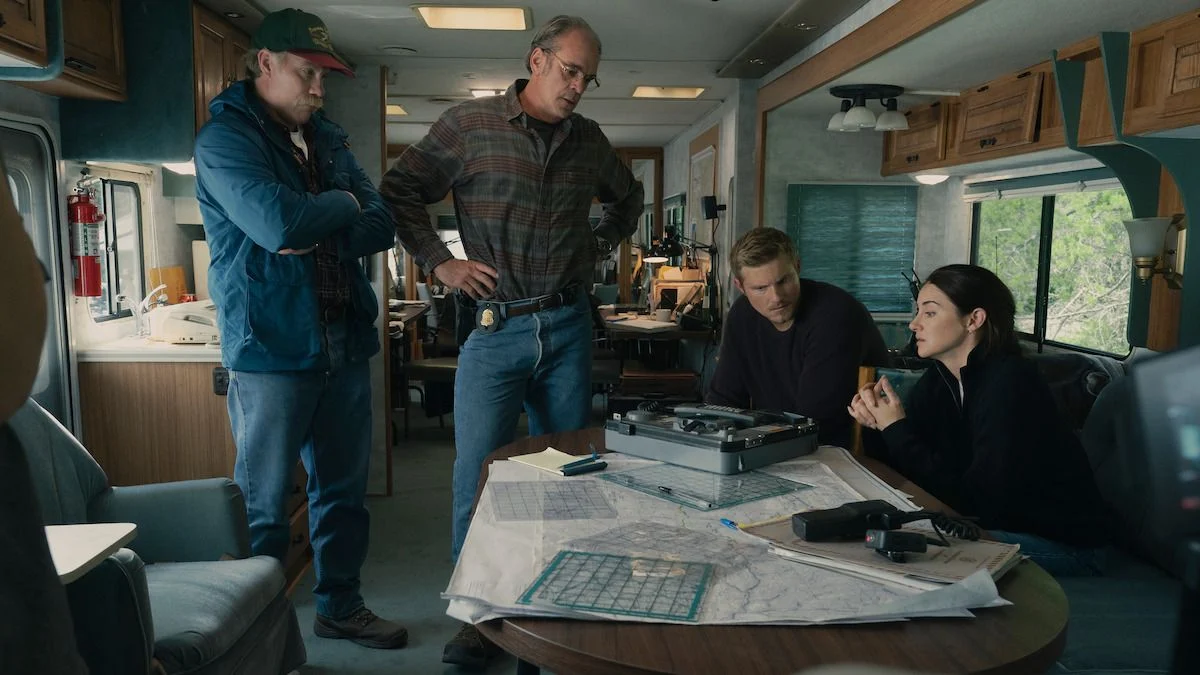
Netflix’s Unabomber spends much of its story making viewers look in two directions at once. One timeline follows Ted Kaczynski as a young Harvard student, while the other follows the investigation that slowly closes in on the man responsible for the Unabomber attacks. By the time those timelines begin to converge, one question becomes impossible to ignore: how did investigators finally find him?
The answer is more complicated than the movie’s dramatic final arrest suggests. Some of the most important pieces really happened, while others were created or compressed for the film. And at the centre of it all is something Kaczynski himself deliberately put into the world: his writing.
How Does Netflix’s Unabomber End?
The ending of Unabomber brings the movie’s two timelines closer together as the FBI investigation reaches its decisive stage.
Shailene Woodley plays FBI agent Joanne Miller, who becomes increasingly convinced that the Unabomber can be identified by examining his language, ideas and writing. But there is an important catch: Joanne Miller was not a real FBI agent.
Netflix identifies Miller as a fictional character created for the movie. She gives the audience a way into the investigation and represents the analytical approach used in the film.
Her storyline eventually intersects with the real breakthrough that changed the case — the involvement of Kaczynski’s brother, David Kaczynski, and David’s wife, Linda Patrik.
That connection begins with a document that had already become central to the investigation.
Unabomber isn’t the only recent release leaving viewers with plenty to unpack. One fantasy epic just delivered its own jaw-dropping betrayals and a dragon battle that changes everything going forward. Read our breakdown of House of the Dragon Season 3 Episode 7 Ending Explained: The Shocking Betrayals, Dragon Battle, and Sunfyre’s Return Change Everything
The Unabomber Manifesto Changed Everything
In 1995, the Unabomber sent a lengthy manifesto to the media. The FBI describes it as a 35,000-word essay.
Investigators agreed to its publication, hoping that someone who knew the author might recognise something in the writing.
That is exactly what happened.
Linda Patrik recognised similarities between the manifesto and writings associated with her brother-in-law, Ted Kaczynski.
David was initially reluctant to believe that his brother could be responsible. Eventually, however, he contacted the FBI through an attorney and provided investigators with letters and other documents written by Ted.
Suddenly, investigators had something extremely valuable: two sets of writing that could be compared.
The FBI’s linguistic analysis concluded that the author of the documents and the manifesto were almost certainly the same person.
The investigation had found its critical connection.
What Did the FBI Find in Kaczynski’s Writing?
The significance was not simply that Kaczynski and the manifesto expressed similar political or philosophical ideas.
Investigators identified similarities in word choice, phrasing and sentence construction.
The FBI has cited the phrase “sphere of human freedom” as one example of language appearing in both Kaczynski’s earlier writing and the manifesto.
That linguistic evidence was combined with other information from the investigation.
Together, it provided the basis for obtaining a search warrant for Kaczynski’s Montana cabin.
And that is where the film’s dramatic ending takes viewers.
True-crime drama isn’t the only genre delivering finales that demand a closer look this season. One family dramedy wrapped its latest season with twists fans are still arguing about online. Check our breakdown of Ginny & Georgia Season 3 Ending Explained: The Jaw-Dropping Twists, Betrayals & Fan Theories That Are Breaking the Internet
When Was Ted Kaczynski Arrested?
Kaczynski was arrested on April 3, 1996, at his isolated cabin near Lincoln, Montana.
The movie dramatizes the final approach, showing investigators putting a plan into motion designed to prevent Kaczynski from receiving enough warning to escape or destroy evidence.
The film includes a ruse involving people supposedly interested in inspecting property boundaries around the cabin. Kaczynski eventually comes outside, allowing waiting agents to arrest him.
But this is where viewers need to separate the movie from the historical record.
Netflix explicitly identifies Joanne Miller as fictional and explains that the film uses fictionalized FBI agents while drawing on the real investigation.
So, while the arrest itself is real, the movie’s FBI storyline should not be treated as a literal reconstruction of every action taken by investigators.
| Key event | Verified detail |
| Manifesto | Published in 1995; described by the FBI as 35,000 words |
| Family breakthrough | Linda Patrik recognised similarities in Kaczynski’s writing |
| Information provided | David Kaczynski supplied Ted’s writings to the FBI |
| Arrest | April 3, 1996 |
| Location | Kaczynski’s cabin near Lincoln, Montana |
| Search evidence | Bomb components, about 40,000 handwritten journal pages and one live bomb |
| Guilty plea | January 1998 |
| Sentence | Life imprisonment without possibility of parole |
| Death | June 2023, aged 81 |
What Did the FBI Find Inside the Unabomber’s Cabin?
The search after Kaczynski’s arrest revealed far more than investigators might have expected.
According to the FBI, agents found bomb components, approximately 40,000 handwritten journal pages containing bomb-making experiments and descriptions of the Unabomber crimes, and one live bomb ready for mailing.
The cabin itself was extremely small and isolated, measuring approximately 10 by 14 feet.
The FBI has also said that investigators found writings that amounted to confessions to the Unabomber attacks.
In other words, the search did not simply place Kaczynski at the centre of an investigative theory. It uncovered a substantial body of physical and written evidence connected to the crimes.
That evidence became an important part of the case that followed his arrest.
The Moby-Dick Scene Explained
While the FBI storyline moves toward the arrest, Unabomber keeps returning to the earlier story of young Ted Kaczynski and Harvard psychologist Henry Murray, played by Russell Crowe.
One of the movie’s most striking scenes comes when Kaczynski confronts Murray after discovering that the psychological experiment was not what he initially believed it to be.
Murray tells Kaczynski that he believes he is schizophrenic, but Kaczynski rejects the characterisation.
Then the power dynamic changes.
Kaczynski reveals that he has also been manipulating Murray, sending letters that appear to come from respected academics. Those letters flatter Murray and appeal to his desire for recognition.
The reversal is deliberate. Murray believes he has been studying Kaczynski, only for Kaczynski to reveal that he has been observing and manipulating Murray as well.
Before leaving, Kaczynski gives Murray a wrapped package.
It looks ominous.
But inside is not a weapon.
It is Herman Melville’s Moby-Dick.
Kaczynski has underlined a passage about humanity’s confidence in science and skill and the destructive power of the sea.
“however baby man may brag of his science and skill … for ever and for ever, to the crack of doom, the sea will insult and murder him.”
Within the film, the book functions as Kaczynski’s final message to Murray.
It reinforces one of the movie’s central themes: the danger of believing intellectual power gives humans control over forces larger than themselves.
The scene also connects with Kaczynski’s developing rejection of modern industrial society.
After leaving Murray, young Kaczynski walks away and ignores a pedestrian signal — a small visual moment presented as another expression of his growing refusal to accept the rules and structures surrounding him.
Did Henry Murray Really Experiment on Ted Kaczynski?
The Harvard storyline is rooted in a real and controversial period of Kaczynski’s life, although the film dramatizes the circumstances.
Kaczynski entered Harvard at 16 and participated in psychological experiments conducted by Henry Murray.
Historical records have connected that Harvard work to the broader CIA-backed MKULTRA programme.
A declassified CIA document states that there is “considerable amount of credible circumstantial evidence” that Kaczynski participated in CIA-sponsored MKULTRA experiments at Harvard from 1959 through 1962.
The document describes the Harvard experiments as involving Kaczynski and other undergraduate students and characterises them as disturbing and ethically indefensible.
But there is an important distinction.
The existence of those experiments does not establish that Murray caused Kaczynski to become the Unabomber.
The movie uses the Harvard experiences as part of its exploration of Kaczynski’s development. Director Janus Metz also emphasises the broader tragedy of people becoming convinced that their beliefs justify extreme action.
The historical record, however, does not provide a factual basis for saying the experiments directly caused Kaczynski’s later crimes.
What Happened to Henry Murray?
The movie’s closing cards explain that Murray retired in 1962 and that his report was considered a disappointment.
His real-life career continued after the period depicted in the film.
Murray died in 1988 at the age of 95.
The movie also places the Harvard experiments within the wider history of CIA research into interrogation and mind-control techniques. A declassified CIA document states that MKULTRA involved research conducted through numerous institutions and describes the Harvard experiments associated with Murray.
Again, the film uses that history to create a dramatic connection between Kaczynski’s youth and the later investigation, while the historical record needs to be kept separate from the movie’s interpretation.
Why Was the Manifesto the Real Breakthrough?
This is arguably the most important detail in the entire ending.
The Unabomber was not finally identified because an FBI investigator simply discovered a hidden cabin.
The breakthrough came from words.
For years, investigators had examined bomb evidence, victim information and possible suspects. Kaczynski deliberately lived an isolated life and attempted to avoid conventional forensic clues.
Then the manifesto gave investigators an unusually large sample of the Unabomber’s own writing.
David Kaczynski’s decision to provide his brother’s documents gave investigators something to compare against it.
The linguistic similarities became crucial.
That evidence helped investigators obtain the search warrant that led them to Kaczynski’s Montana cabin.
The arrest then produced physical evidence that strengthened the case.
So the real ending of the investigation has an unusual twist: Kaczynski’s own words ultimately helped reveal who he was.
What Happened to Ted Kaczynski After His Arrest?
The movie does not spend much time dramatizing the legal proceedings that followed.
Kaczynski eventually pleaded guilty in January 1998.
He was sentenced to life imprisonment without the possibility of parole. The National Archives records his sentence as four consecutive life sentences plus 30 years.
He spent years in federal prison before later being transferred to a federal medical facility in North Carolina.
Kaczynski died in federal custody in June 2023, aged 81.
The legal ending therefore came years after the arrest that forms the dramatic climax of the film.
How Accurate Is the Ending of Unabomber?
The broad outline is historically grounded, but several important parts are fictionalised or compressed.
What Really Happened
Kaczynski attended Harvard at 16 and participated in controversial psychological experiments.
He later lived in an isolated Montana cabin, sent the manifesto to newspapers, was identified after his brother David supplied his writings, and was arrested on April 3, 1996.
Investigators then discovered extensive evidence inside the cabin.
The FBI’s historical record states that the Unabomber attacks resulted in three deaths and 24 injuries. Netflix promotional material uses 23 injuries, making the FBI historical record the figure used here.
What Netflix Changed
Joanne Miller, played by Shailene Woodley, is fictional.
The FBI investigation is also dramatised through fictionalised characters and compressed events. Netflix’s writers have been explicit about the distinction, while screenwriter Nelson Greaves and director Janus Metz explain that the FBI storyline draws from the real investigation while creating characters and dramatic conflicts for the movie.
That means the final arrest should be understood as a dramatized version of a real investigation, rather than a literal record of every FBI action in 1996.
Unabomber isn’t the only chilling story getting more attention after its ending landed. One AMC horror series has already locked in its next chapter following a shocking finale of its own. For more, read our story on The Terror Season 4 Confirmed: Everything We Know So Far About AMC’s Next Horror Chapter After Season 3’s Shocking Ending
The Final Meaning of Unabomber
The movie ultimately brings its two timelines together in a disturbing way.
The young Kaczynski’s confrontation with Henry Murray explores the experiences and ideas that the film associates with his development. Decades later, investigators searching for the Unabomber find their decisive clue in the words he chose to publish.
David Kaczynski’s decision to contact the FBI becomes the crucial human link. The manifesto gives investigators the writing sample. David provides Ted’s documents. Linguistic analysis connects them. A search warrant follows. Then the Montana cabin reveals physical evidence that strengthens the case.
The final archival footage brings the story back to the real person behind the dramatization.
Kaczynski’s own statement is also included:
“My personal preference is to be depicted truthfully.”
His political and ideological views are presented as his own stated beliefs, not as an explanation or justification for the violence he committed.
In the end, Unabomber is not simply about how investigators found an isolated cabin in Montana. Its final twist is that the investigation was ultimately helped by the suspect’s own attempt to make himself heard.
The manhunt ended when his words, combined with information supplied by his brother and linguistic analysis, led investigators back to him.
The article discusses a dramatized film inspired by real criminal events. It has been prepared based on research of the Netflix, FBI, CIA, U.S. Department of Justice and National Archives sources provided in the source material above. Where the film differs from the historical record, those distinctions are identified according to the supplied sources. The article should be understood as a presentation of the information available from those sources and does not imply independent verification beyond that material.
Sources
- Netflix Tudum — UNABOMBER Ending Explained
- FBI — The Unabomber Case
- FBI — The Unabomber Case, 25 Years Later
- FBI — Inside the FBI Podcast: The Unabomber Case
- FBI — Unabomber Bomb Shrapnel
- CIA Reading Room — Declassified MKULTRA Records
- U.S. Department of Justice — Unabomber Settlement Statement
- National Archives — Insight into the Unabomber Case
Featured Image Credit: Netflix


Leave a Reply