

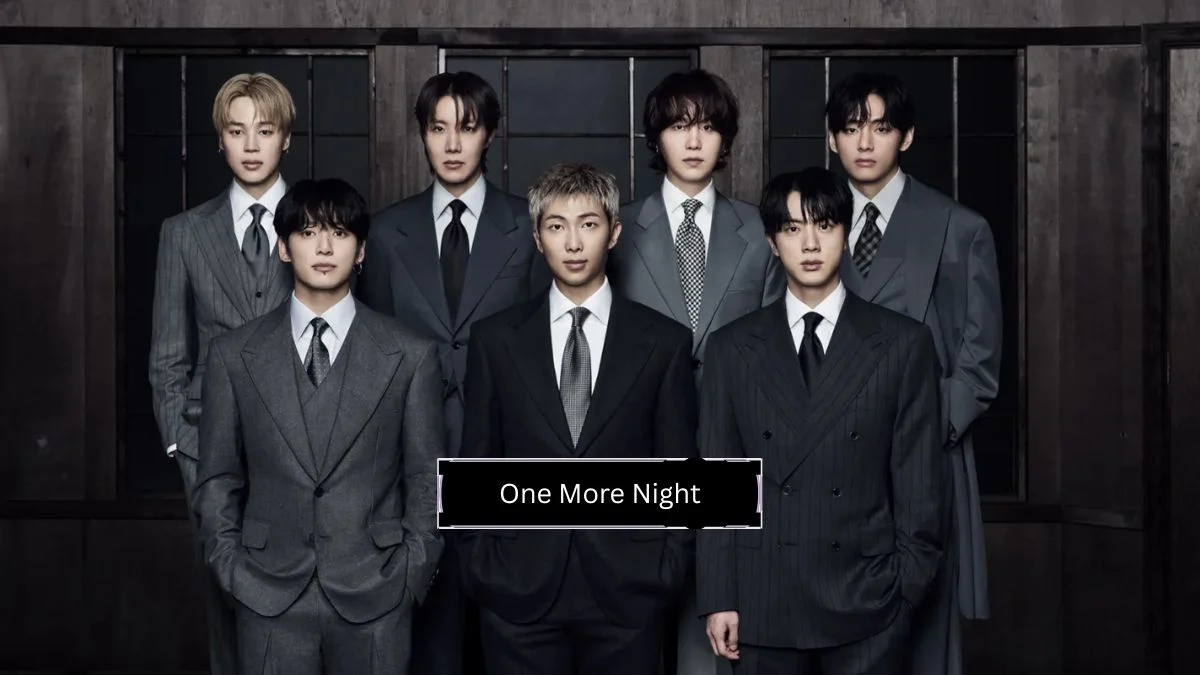
Track 12 of BTS’s fifth studio album ARIRANG is one of the most emotionally layered songs on the entire record. ‘One More Night’ arrives after a run of high-energy tracks and shifts the mood into something altogether more intimate and dreamlike. Since its release on March 20, 2026, the song has generated an enormous response from ARMY worldwide, with fans calling it one of the most beautiful vocal performances the group has delivered in years. Here is a full breakdown of the track, its meaning, its credits, and what makes it stand out.
‘One More Night’ Theme
At its core, ‘One More Night’ explores the feeling of being so deeply absorbed in a moment or a person that you actively resist waking up from it. The song sits at the intersection of longing, intimacy, and the bittersweet awareness that beautiful things are temporary.
The track opens with RM reflecting on a memory tied to a particular place, someone who once caused deep emotion, and the quiet sadness of recognising how much two people’s shadows have come to resemble each other over time. This sets up the central tension of the song: the awareness that something is ending or already gone, alongside the desire to hold onto the feeling for just a little longer.
The recurring pre-chorus, shared across V, Jimin, and Jin, builds on this with imagery of being submerged in thought for twenty-four hours, resisting waking precisely because the dream feels too good to leave. The phrase “don’t wake me up” runs through the song like a refrain that resists reality rather than seeking it.

One More Night Tone
SUGA’s verse shifts the tone slightly toward warmth and presence. Rather than loss, his section focuses on the small, wordless moments of being beside someone, mornings without the need for grand declarations, simply the comfort of another person’s company. This contrast between RM’s nostalgic opening and SUGA’s quiet contentment gives the song an emotional range that feels genuinely human rather than stylised.
The bridge, delivered by j-hope, introduces the figure of Selene, the Greek goddess of the moon, as a point of comparison for the person being addressed. This mythological reference grounds the song’s dreamy atmosphere in something older and more universal, the idea that someone’s beauty and presence are not just personal but elemental, something that illuminates even the darkest hours. j-hope calls for one more night past dawn’s light, reinforcing the song’s central wish to extend the moment indefinitely.
The outro brings Jin, RM, V, and j-hope together to close the track with lines that blur the boundary between dream and reality entirely. By the end, the “fantasy” described throughout the song does not feel like escapism. It feels like a genuine emotional state that the listener is invited into.
Who Sings What: Member Breakdown
Every BTS member contributes to ‘One More Night’, with the song structured to showcase the contrast between the vocal line and the rap line within the same dreamlike atmosphere.
| Section | Member(s) |
| Verse 1 | RM |
| Pre-Chorus 1 | V |
| Chorus 1 | Jung Kook, Jimin, RM |
| Verse 2 | SUGA |
| Pre-Chorus 2 | Jimin |
| Chorus 2 | Jung Kook, V, j-hope |
| Post-Chorus | Jin, j-hope |
| Bridge | j-hope |
| Pre-Chorus 3 | Jin |
| Chorus 3 | Jimin, Jung Kook, j-hope |
| Outro | Jin, RM, V, j-hope |
Fan reaction has particularly highlighted Jin’s contribution throughout the track, with many noting how smoothly and powerfully his voice carries in the pre-chorus and outro sections. V’s opening pre-chorus moment and SUGA’s Verse 2 delivery have also drawn significant praise.

One More Night: Key Themes and Symbolism
The Fantasy as Emotional Truth
Throughout ‘One More Night’, the word “fantasy” repeats in a way that could suggest delusion but actually functions as the opposite. The fantasy described is not a denial of reality but a recognition that certain emotional experiences feel too vivid and important to be classified as ordinary life. The song argues, quietly and without declaration, that love and longing at their peak always carry a quality of the unreal.
Shadows and Resemblance
RM’s opening verse references how the speaker’s shadow has grown to resemble another person’s. This is a rich image because shadows are both personal and inescapable. To say two people’s shadows have merged is to say that their identities, their ways of moving through the world, have become intertwined in ways that cannot be easily undone even after separation.
Selene and Moonlight
j-hope’s bridge draws directly on Greek mythology by invoking Selene, the goddess of the moon. The moon has always carried associations with longing, with the night, with things that are beautiful precisely because they are temporary or cyclical. Using Selene as a point of comparison elevates the subject of the song beyond a single relationship into something that feels timeless and archetypal.
The Resistance to Morning
The repeated imagery of not wanting to wake up, of bad mornings and the desire to stay in a midsummer night’s dream, frames daylight as the enemy of emotional truth. Morning brings reality, practicality, and the end of the heightened emotional state the song inhabits. The song’s resolution is not acceptance of morning but a continued insistence on staying in the night just a little longer.
Fan and Critical Reaction
The response to ‘One More Night’ since its March 20 release has been overwhelmingly positive. On YouTube, fans noted that the vocal line gave some of their strongest individual performances on the entire ARIRANG album. Comments highlighted Jin’s smoothness and emotional clarity, V’s ability to convey depth in a relatively short pre-chorus, and the collective power of having all seven members woven through a single track so cohesively.
One widely shared fan comment summarised the feeling many expressed: the journey from BTS’s ‘Just One Day’ in 2014 to ‘One More Night’ in 2026 feels like witnessing a group that has grown without losing the emotional sincerity that made them resonate in the first place.
The broader consensus from the ARMY community places ‘One More Night’ firmly in the upper tier of the ARIRANG tracklist, alongside SWIM and Into the Sun, as one of the songs most likely to endure beyond the album’s initial release momentum.
One More Night: Production and Writing Credits
‘One More Night’ brings together an impressive group of producers and writers spanning Korean and international talent.
| Role | Contributors |
| Producers | Diplo, Pdogg, NITTI |
| Writers / Composers | Diplo, Pdogg, Beau Nox, NITTI, RM, SUGA, j-hope, Ant Clemons |
| Vocal Arranger | Pdogg |
| Recording Engineer | Pdogg |
| Mixing Engineer | Yang Ga |
| Mastering Engineer | Mike Bozzi |
| Synthesizer | Pdogg and NITTI |
| Drums | Diplo and NITTI |
| Background Vocals | Jung Kook, RM, Beau Nox |
| Lead Vocals | RM, Jin, SUGA, j-hope, Jimin, V, Jung Kook |
The collaboration between Diplo and Pdogg as lead producers gives the track a distinctive blend of Western electronic production and the melodic sensibility that Pdogg has long brought to BTS’s music.

‘One More Night’ sits in the album’s final stretch, arriving after the emotional weight of ‘they don’t know ’bout us’ and before ‘Please’. This placement in the tracklist is deliberate. By Track 12 the album has already moved through high-energy bangers, introspective mid-tempo tracks, and now settles into this dreamlike space before building toward the album’s closing sequence.


Leave a Reply