

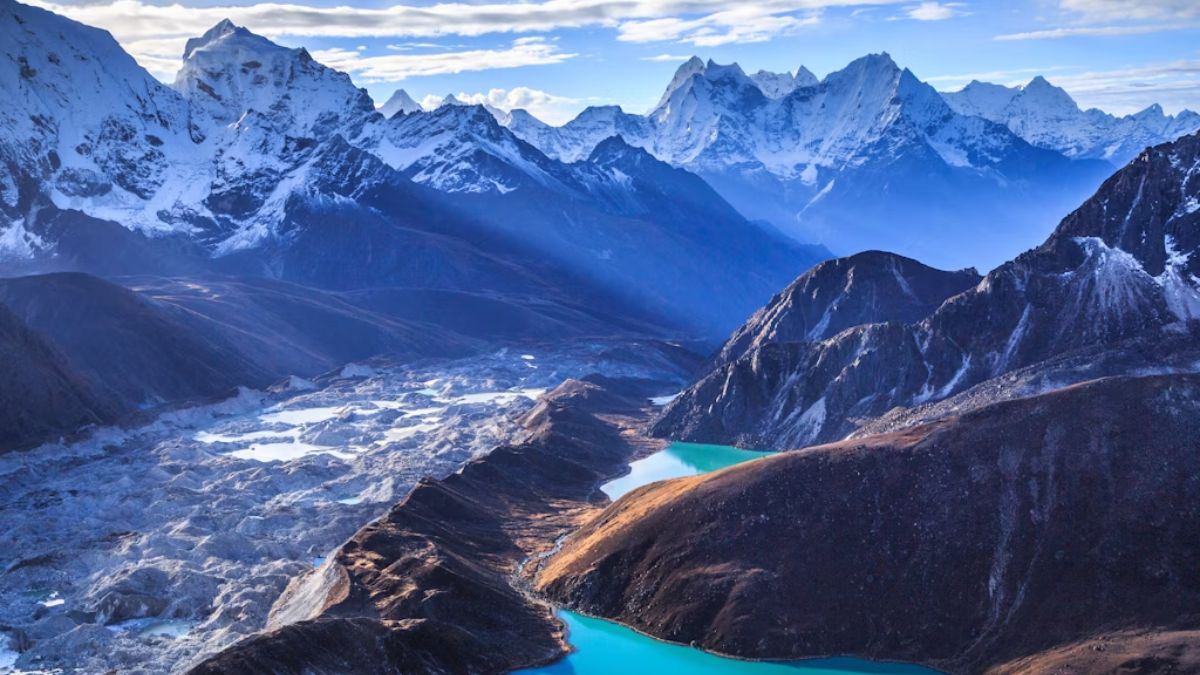
In the shadow of the world’s tallest peaks, where oxygen grows thin and reality becomes malleable, the Himalayas harbor secrets that defy explanation. These towering giants, draped in eternal snow and mystery, have witnessed countless souls attempt to conquer their heights, and many never return. But sometimes, it seems, those who perish in these frozen heights refuse to rest quietly.
What follows are documented accounts of encounters that blur the line between the living and the dead, between scientific explanation and supernatural phenomena. These are not mere scary ghost stories told around campfires, but recorded incidents that have left seasoned climbers, scientists, and locals questioning everything they thought they knew about the thin air between earth and heaven.
The Spirits of Mount Everest
The Pemba Dorji Sherpa Incident (2004)
The world’s tallest mountain holds many secrets, but none more chilling than what Pemba Dorji Sherpa encountered in May 2004. As he approached the summit of Mount Everest, the experienced climber suddenly found himself face-to-face with something that shouldn’t exist—dark, shapeless forms moving against the pristine white of the death zone.

“They were black shapes,” Pemba later recounted, his voice still trembling with the memory. “The ghosts of climbers who died on the mountain.” But these weren’t passive apparitions. As these shadow figures approached him, they extended their hands in a desperate, almost human gesture, begging for something to eat. The incident was officially documented in mountaineering records, adding another layer of mystery to Everest’s already creepy ghost stories.
The Third Climber Phenomenon (1975)
British climbers Dougal Haston and Doug Scott were no strangers to extreme conditions, but what they experienced during their 1975 British expedition defied all logic. Trapped in a snow hole just below Everest’s summit, facing a night without food and with failing oxygen supplies, the two men were certain they would not survive.

That’s when they felt it—a presence. A third climber had somehow joined them in their cramped shelter, a comforting entity that spoke to them through the long, terrifying night. This phantom companion guided them through their ordeal, offering encouragement when death seemed imminent. When dawn broke and they emerged from their snow cave, they were alone. The third climber had vanished, leaving behind only the memory of a voice that had kept them alive.
The Phantom Communications
The K2 Radio Ghost (1992)
K2, the “Savage Mountain,” claimed its place in the annals of scary scary stories with an incident that still sends shivers down the spines of mountaineers. In 1992, American climbers Thor Kieser and Scott Fisher were settling into the unusual quiet of base camp when their communications radio crackled to life.
“Camp IV to Base Camp, do you read, over?”

The voice was clear, unmistakable—and impossible. Both men knew with absolute certainty that no one was on the mountain at that time. The voice belonged to a British woman, speaking from a camp that should have been empty. This true, scary story remains one of the most well-documented supernatural encounters in high-altitude climbing history.
The Midnight Call from Beyond (1992)
After renowned climber Wanda Rutkiewicz perished in 1992, her friend Ewa Matuszewska thought she had said her final goodbye. But the mountains, it seems, had other plans. In the middle of the night, Matuszewska was awakened by her telephone ringing. Heart pounding, she answered, only to hear a voice that should have been silenced forever.

“We are all in despair. Where are you?” Matuszewska pleaded, recognizing her dead friend’s voice immediately.
The response came from beyond the grave: “I am cold, I am very cold, but don’t cry. Everything will be fine.”
A Haunting Discovery: The Roopkund Lake Mystery (1942-Present)
Perhaps no location in the Himalayas holds more secrets than Roopkund Lake, a remote glacial lake that serves as an open-air morgue for hundreds of souls. The discovery of this creepy real story began in 1942 when H.K. Madhawl, an Indian forest official, stumbled upon what would become one of the most enduring mysteries of the modern age.

Scattered around and within the frigid waters of this high-altitude lake, at over 5,000 meters above sea level, lie the skeletal remains of between 300 to 800 individuals. The thin air and freezing temperatures had preserved these remains for centuries, creating a macabre museum of death in one of the world’s most remote locations.

Recent scientific investigations have revealed that these skeletons cluster into three distinct groups, suggesting multiple tragic events occurred at this cursed location. The mystery deepens with each new discovery, making Roopkund Lake one of the most compelling, real spooky stories in the archaeological record.
Village Encounters and Mountain Spirits
The Bemni Village Encounter (2009)
Not all supernatural encounters occur at extreme altitude. Mohan Singh, a resident of the Himalayan village of Bemni, discovered that the mountain spirits can descend to lower elevations when the mood strikes them. During the winter months of 2009, Singh was chopping wood outside his home when the sky suddenly turned black.

A strange man appeared, demanding to know why Singh was cutting the trees. This wasn’t a typical environmental activist—there was something otherworldly about the figure, something that made Singh’s blood run cold. The encounter, documented by local authorities, adds another chapter to the growing collection of creepy stories emerging from the Himalayas.
Frank Smythe’s Otherworldly Encounters (1930s)
British climber Frank Smythe was among the early pioneers attempting to conquer Everest in the 1930s, but his encounters with the supernatural would prove more memorable than his climbing achievements. During his expeditions, Smythe encountered not one but two distinct paranormal phenomena that would haunt him for the rest of his life.

The first presence was benign, almost friendly, so real that Smythe actually offered it some of his mint cake. The second encounter was far more disturbing. Smythe described seeing strange hovering objects, one with “what looked like squat, underdeveloped wings,” while the other had “a beak-like protuberance like the spout of a teakettle.” These entities “distinctly pulsated… as though they possessed some horrible quality of life.”
The 1996 Everest Disaster: When Reality Becomes Nightmare
The 1996 Everest disaster stands as one of the mountain’s deadliest seasons, claiming eight lives in a single storm. But for those who survived, the line between reality and hallucination became terrifyingly blurred. Jon Krakauer, in his haunting account “Into Thin Air,” describes a particularly chilling moment during his descent.

Fighting through the mounting storm, Krakauer was certain he had encountered his teammate Andy Harris. They had a conversation, Harris seemed real and present—until Krakauer later discovered that he had been speaking to an entirely different person, and that Harris had already died higher up on the mountain.
Was it oxygen deprivation? Extreme stress? Or something more inexplicable? The incident remains one of the most documented examples of how the mountains can play tricks on even the most experienced climbers.
Ghost Stories to Tell in the Dark: The Scientific Perspective

While these accounts read like scary ghost stories to tell in the dark, the scientific community offers several explanations for these supernatural encounters:
- High Altitude Cerebral Edema (HACE): This condition can cause severe hallucinations and disorientation
- Extreme physical and mental stress: Leading to sensory disturbances and false perceptions
- Oxygen deprivation: Affecting brain function and creating vivid, realistic hallucinations
- Cultural and psychological factors: Influencing how experiences are interpreted and remembered
Yet even with these scientific explanations, some incidents resist easy categorization. The documented nature of many encounters, witnessed by multiple experienced climbers and recorded in official expedition logs, suggests that the full truth may be more complex than simple altitude sickness.
The Thin Air Between Worlds

In the thin air between earth and sky, where human endurance meets its limits, the line between the living and the dead becomes as fragile as the ice beneath a climber’s feet. These creepy real stories serve as a reminder that in the face of nature’s ultimate power, we are all just temporary visitors in a realm that belongs to forces far greater than ourselves.


References and Sources
- Mental Floss – “Ghost Stories From the World’s Tallest Peaks” (February 17, 2016)
- Nature Communications – “Ancient DNA from the skeletons of Roopkund Lake reveals Mediterranean migrants in India” (Peer-reviewed scientific journal)
- National Geographic – Documentary “Riddles of the Dead: Skeleton Lake” and various articles
- The Himalayan Database – Elizabeth Hawley’s expedition archives
- Jon Krakauer’s “Into Thin Air” – First-person account of 1996 Everest disaster
- Jennifer Jordan’s “Savage Summit” – Documented accounts of K2 climbers
- Ranker.com – “For Decades, Climbers Have Encountered Ghosts And Supernatural Phenomena On Mount Everest” (September 23, 2021)
- India’s Centre for Cellular and Molecular Biology (CCMB) – Scientific investigations
- Live Science – “Hundreds of skeletons fill this remote Himalayan lake” (February 24, 2021)
- Wikipedia – Various articles with cited sources on Mount Everest disasters and Roopkund Lake
Disclaimer
Important Notice: While these accounts have been documented and reported through various sources, the interpretation of supernatural elements varies significantly. Many of these incidents can be explained by well-documented physiological and psychological effects of extremely high-altitude conditions, including High Altitude Cerebral Edema (HACE), extreme physical and mental stress, oxygen deprivation, and cultural/psychological factors affecting the interpretation of experiences.
The scientific community generally attributes most “supernatural” encounters in high-altitude environments to these known effects of extreme conditions. However, some incidents remain unexplained and continue to be subjects of investigation.
Sources Verification: All cited sources are publicly available and have been cross-referenced where possible. Readers are encouraged to consult original sources for complete context and to form their own conclusions about these documented incidents.

Leave a Reply