

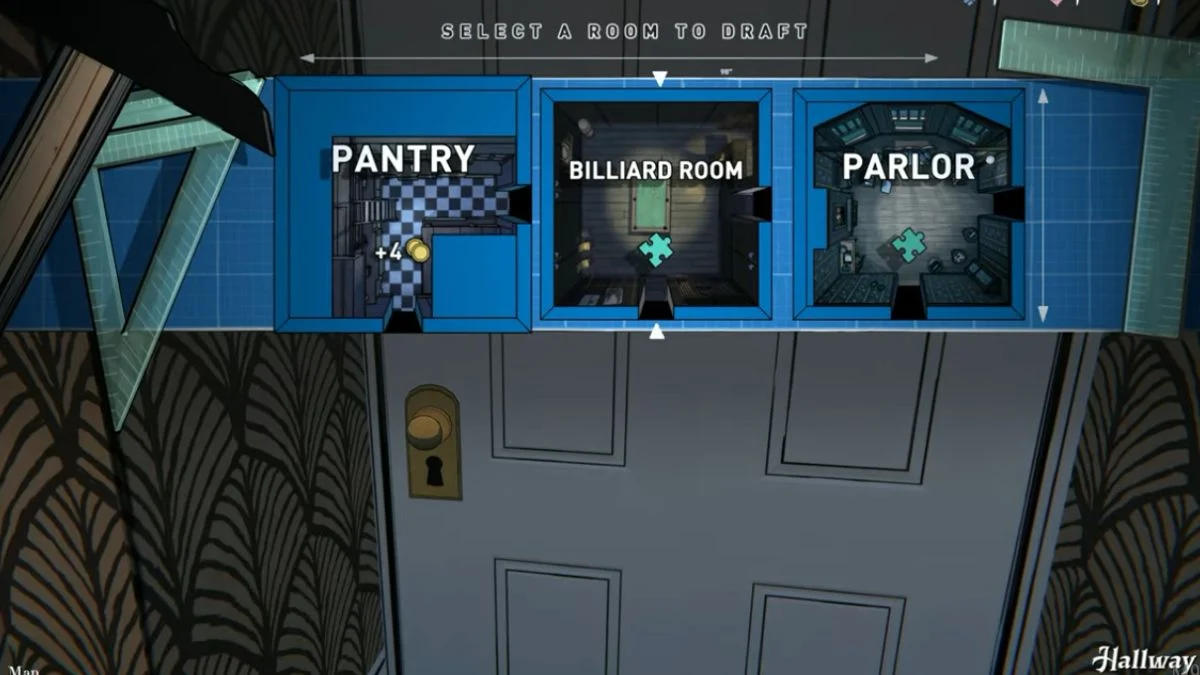
The Billiard Room in Blue Prince sits early in your path, yet the dartboard puzzle inside it sets the tone for the game’s curious take on arithmetic and pattern recognition. A simple board becomes an engine of layered calculations, and each round grows sharper in difficulty. The puzzle looks playful at first, but the structure hides a language of colors, symbols, and rhythm. Once you learn this language, the Billiard Room turns into one of the most consistent key farms in the entire house.
This guide walks you through the system behind the puzzle and explains how the board wants you to think. The process stays clear, step by step, so you can solve puzzles quickly even when the board begins to stack modifiers.
How the Dartboard Works in Blue Prince
The dartboard creates an arithmetic chain. Each colored panel represents one operation and the numbers around the outer ring represent the values used in that operation. You solve the puzzle by reading it from the center outward. This structure never changes and gives the puzzle a comforting rhythm once you grow familiar with it.

Core Colors and What They Mean
The game uses color as shorthand for each mathematical operation. You always start at the first colored panel closest to the bullseye.

- Blue: Addition
- Orange: Subtraction
- Pink: Multiplication
- Purple: Division
If the first inner ring shows a pink segment on the number 6, you multiply the current total by 6 before you move to the next ring.
Reading the Board from Center to Edge
Think of the board as a sequence of nested parentheses. The inner circle resolves first and each ring outward adds one more stage to the equation. You follow this pattern:
- Identify the first colored panel closest to the bullseye.
- Apply that operation and number.
- Move outward to the next ring.
- Repeat until all rings with color have been resolved.
This simple rule stays constant even in advanced puzzles.
When the Bullseye Joins the Puzzle
After you complete several boards, the bullseye begins to display symbols. These symbols modify specific colored steps and create extra operations that follow the main equation.
Bullseye Symbols and Their Effects
- Square symbol: Square the number for that color.
- Diamond symbol: Reverse the digits of that number.
- Two Squares: Square the number, then square the result again.
- Two waves: Round the current value to the nearest whole number.
- Four waves: Round to the nearest ten.
- Six waves: Round to the nearest hundred.
- Red dots: Repeat that step that many times.
- Red X: Ignore that step.
- Red slash: Halve your final number at the end.
Color still matters. If a green square appears in the bullseye, you apply its rule to the numbers within green segments only.
Stacked Symbols
Sometimes the bullseye shows two symbols nested inside one another. The outer symbol happens second. For example, if a diamond surrounds a square, you square the number first and reverse its digits afterward.
Recognizing One Third Segments
A colored segment that fills only one third of its panel means you divide that number by three. If the panel shows 9 with only a third colored, treat it as 3 instead of 9.
Rounding rules step in when these adjustments create decimals. The rounding type depends on the wave symbol in the bullseye. Half values always round upward.
Outer Panel Modifiers
At higher difficulty levels, a final ring appears outside the numbers. This ring contains symbols that alter the numbers directly before any arithmetic begins.
- Cross: Do not use this number at all.
- Slash: Halve this number.
- Two dots: Double this number.
- Diamond: Reverse this number’s digits.
- Modifier slash: Ignore one bullseye modifier for this number only.
These rules let the board reshape the values before operations begin. They also allow some clever late-game twists in puzzle chains.
Practical Strategy for Faster Solves
A few observations make the Billiard Room much easier to read at higher speeds.
The Final Answer Always Lands Between 1 and 20
Even when your mid-calculation value rises into the hundreds or dips below zero, the final result must return to the 1 to 20 range. If you hit a large number, expect the next ring to divide or round it. If you hit decimals, expect rounding or a halving effect later.
The Board Often Cancels Its Own Steps
Many advanced darts include repeated adjustments to the same number. Doubled values may get halved later. Numbers that reverse may reverse again. When you recognize these patterns, you can shorten your work.
You Can Brute Force If Needed
Nothing punishes a wrong guess. If you struggle with a complicated ten-step puzzle, you can test answers manually. The board reveals itself after a few inputs. This makes the late puzzles less daunting than they appear.
What You Get for Solving the Puzzle
Each completed puzzle grants keys. The rewards scale as you keep solving.
- One to three regular Keys
- Silver Key
- Keycard
- Secret Garden Key
- Prismatic Key
The puzzle becomes one of the most reliable ways to build key inventory during long runs.
More Trending Game Guides for You:


Leave a Reply