

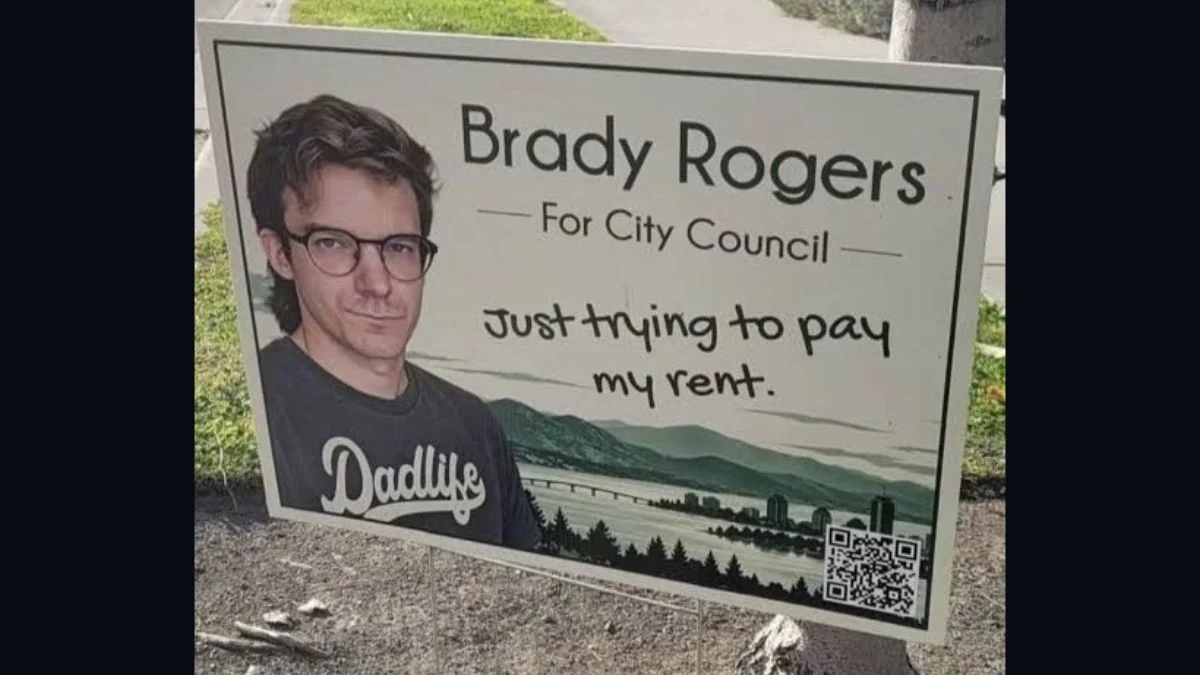
Brady Rogers took an unconventional route into politics, trading traditional campaign promises for roadside signs that poked fun at his own qualifications. His blunt humour caught the attention of social media users, turning the Kelowna business owner into an unexpected talking point during British Columbia’s municipal election.
But behind the jokes was a candidate with an engineering background, a small business built from recycled plastic and a list of concerns about his city’s future. Rogers’ campaign raised an intriguing question: could a first-time politician who openly admitted he had never held elected office win voters over through honesty, humour and a practical approach to local problems?
Who Is Brady Rogers? Meet the Kelowna City Council Election Winner
Brady Rogers, 33, was born in Williams Lake, British Columbia, and grew up in Kelowna after moving to the city at the age of 10. His campaign biography reflects his personal connection to the community, including the streets, parks and neighbourhoods that shaped his childhood.
Before entering politics, Rogers studied at the University of British Columbia Okanagan (UBCO), graduating around 2015. He subsequently spent four years working as a robotic automation engineer, developing experience in technical problem-solving and complex systems.
Despite finding the work interesting, Rogers eventually wanted to pursue something he believed would have a more direct impact on people’s lives.
“As cool as the job was, it was soulless, and I wanted to use my abilities for more than just helping huge companies save money,” Rogers wrote on his campaign website.
In 2019, he and his wife began building The Rogerie, a business that transforms plastic waste into new products. The venture began modestly, with the couple selling products from a farmers’ market booth beside a shopping mall and making items from discarded plastic in their laundry room.
Over the following seven years, the business grew into a downtown Kelowna shop near Sprout, where Rogers spends much of his time.
His journey from engineering to entrepreneurship would become an important part of his explanation for entering public life. Although he had never been an elected politician, he believed his experience with business, systems and problem-solving could offer something useful to municipal government.
Another Election Story
School elections can also draw attention when questions arise about how the results are handled. This report looks at a separate case involving a principal and a student election in the Santa Barbara student election controversy.
Why Brady Rogers Ran for Kelowna City Council Despite Joking About Being Unqualified
Rogers did not initially present himself as a conventional political candidate. His campaign website opened with a candid admission:
“I guess I’m running for Kelowna city council.”
He then delivered the line that would become central to his public image:
“Do I enjoy politics? No. Do I know what I’m doing? No. But am I qualified? Also no.”
The self-deprecating introduction stood out in a campaign environment where candidates commonly emphasise their experience, leadership and readiness for office.
Rogers also described himself as someone who dislikes meetings, rigid schedules and formal office environments. Yet he explained that his decision to run was driven by a feeling that he should contribute to the community he cares about.
“Honestly? Some decisions feel right before you understand them, and this is one of those times.”
He went on to explain his priorities:
“What I do know is that I care a lot about my city and the people who live in it. I care about small businesses, about the homeless, and about people having the opportunity to live life the way they want.”
His campaign was built around the idea that understanding a problem should come before attempting to solve it. Rogers connected that principle directly to his engineering background.
“Engineering taught me that finding good answers starts with asking good questions. Understanding comes before solutions. I think that’s as true in politics as it is in engineering. So while I don’t claim to have all the answers, I do know how to keep asking questions until I understand something.”
He also questioned the idea that government decisions should feel beyond the influence of ordinary residents.
“I believe that government is for the people and needs to defend our interests. Far too often, we feel like the systems around us are happening to us. But they aren’t forces of nature. We built them, we can question them, and when they stop working for us, we can change them.”
The distinction matters: Rogers was joking about his lack of political experience, not claiming that he had no education, professional skills or relevant expertise.
How Brady Rogers’ Viral Campaign Signs Captured Attention
Rather than relying on polished political slogans, Rogers used humour to make his candidacy memorable.
One roadside sign announced “Brady Rogers for Mayor”, only to correct itself with “Just kidding. City Council.” Another featured the message “Just trying to pay my rent.”
Other signs carried the line “I barely want to do this”, while one promised “Don’t worry, I’ll fix everything,” followed by the qualification “terms and conditions apply.”
The same irreverent tone continued on his campaign website, which repeated “I barely want to do this” before eventually declaring, “Fine. I’ll do it.”
The strategy helped Rogers stand out among 37 candidates competing for eight available council seats. His campaign also attracted attention beyond Kelowna.
According to Dexerto’s October 19, 2026, report, the campaign generated more than 100,000 views and attracted the attention of American influencer Mandi Jung, alongside interview requests from media outlets.
Rogers acknowledged that his campaign’s central joke was not meant to be taken entirely literally. Before the election, he told Global News:
“I’m being a little bit tongue-in-cheek when I say I’m unqualified,” he said. “I’ve never been a politician, but I certainly have experience that I think is very relevant and helpful.”
The humour created a memorable public image, while his engineering and business experience provided the substance behind his candidacy.
Housing, Homelessness and Transit: What Are Brady Rogers’ Main Policies?
Beyond the campaign signs, Rogers outlined priorities connected to affordability, infrastructure, transportation, homelessness, small businesses and the challenges of rapid urban growth.
His campaign website described the kind of future he wanted for Kelowna:
“Kelowna is growing quickly. And I keep coming back to one simple idea: as Kelowna grows, it should get easier to live here. Easier to afford a life, get around, run a small business, feel safe, and build a future.”
He added:
“I want to understand how our city works, ask who it’s working for, and help make sure the answer is all of us.”
Housing Affordability and Land-Value Taxation
Rogers has discussed land-value taxation, an approach that would shift more of the tax burden towards land and away from buildings and other improvements.
He has argued that such a system could reduce the financial penalty associated with improving properties and encourage more productive land use.
He has also advocated for development to contribute appropriately to the infrastructure required to support growth, rather than automatically transferring those costs to existing taxpayers.
Another proposal involves capturing some of the additional land value created when municipal rezoning decisions increase property values.
These ideas reflect his interest in managing the costs of Kelowna’s expansion. However, municipal taxation powers are governed in part by provincial law, and the proposals do not guarantee lower housing prices or increased housing supply.
Public Transportation and Household Costs
Rogers has identified public transportation as another important affordability issue.
His preference is for fast, frequent and reliable transit that allows more households to reduce their dependence on private vehicles. He has argued that simply providing bus routes is insufficient if residents cannot rely on them for everyday journeys.
He has also discussed the need for sufficient operational capacity to add buses and make transit a more practical option.
Reducing the need to own multiple cars could lower expenses for some households while helping address congestion. These remain campaign priorities rather than adopted city policies or funded commitments.
Homelessness, Small Businesses and Public Safety
Rogers has repeatedly highlighted homelessness and the challenges facing local businesses as issues he wants to understand and address.
In an interview with Castanet before the election, he explained:
“I’m really good at solving problems, and I also care about problems,” he said. “And sometimes that means I feel obligated to help with them when they arise.”
He has also emphasised transparency, investigating local concerns and considering solutions that have not previously been tried.
“All I’m trying to do is my best to solve some of the problems people care the most about and maybe look at them a different way, bring transparency to them, and maybe come up with some solutions that haven’t been tried that we could experiment with,” he said.
His stated approach also addresses public safety and difficulties businesses may experience in downtown areas. He has emphasised responding to specific concerns while preserving what already works in the community.
Turning these priorities into action will require cooperation with other councillors, municipal staff, budgets and, where necessary, other levels of government.
Brady Rogers Wins 12,635 Votes in Kelowna’s October 2026 Election
Kelowna held its general municipal election on October 17, 2026, with voters choosing a mayor, eight city councillors and four school trustees.
The city’s published results reported that 38,970 voters cast ballots, with turnout estimated at 31% of eligible voters.
Rogers secured 12,635 votes, finishing fourth among the 37 candidates competing for council seats. The unofficial results listed the following eight successful candidates:
| Rank | Candidate | Votes |
| 1 | Gord Lovegrove | 15,462 |
| 2 | Davis Kyle | 14,822 |
| 3 | Kevin Aaron Kraft | 13,505 |
| 4 | Brady Rogers | 12,635 |
| 5 | Rick Webber | 12,512 |
| 6 | Mohini Singh | 11,968 |
| 7 | Laura Thurnheer | 11,949 |
| 8 | Les Bellamy | 11,470 |
Rogers finished ahead of incumbent councillors Rick Webber and Mohini Singh in the overall vote ranking. He also received 1,470 more votes than incumbent Maxine DeHart, who secured 11,165 votes and finished outside the eight available seats.
The election brought five newcomers onto the council alongside three returning councillors.
The mayoral contest was separate from the council race. Tom Dyas received 19,451 votes, followed by Ron Cannan with 18,482 and Andrew Mark Uitvlugt with 556.
As of October 19, the results remained unofficial. The chief election officer was expected to review and formally declare the results by October 21, 2026.
What Happens Next for Brady Rogers After His Election Victory?
Winning a council seat gives Rogers an opportunity to participate directly in decisions affecting Kelowna’s future. However, his election does not mean that his campaign proposals will automatically become policy.
His ideas will have to pass through the council’s decision-making process, where they will be considered alongside competing community needs, available funding, municipal responsibilities and provincial rules.
The transition also marks a new chapter for a business owner whose professional experience comes from engineering and entrepreneurship rather than elected office.
Whether his unconventional approach translates into effective public service will depend on what he does after the election. His campaign has established a clear emphasis on curiosity, transparency and practical problem-solving; his time on council will provide an opportunity to put those principles into practice.
Another Winning Story
Election victories are not the only results that attract attention, as major sporting competitions can also produce memorable finishes. For a separate story about the marathon’s leading competitors, see our Chicago Marathon 2026 race report.
Conclusion: Can an “Unqualified” Candidate Make a Difference?
Brady Rogers’ victory offers a striking contrast between his humorous campaign branding and his stated ambitions for Kelowna. He openly joked about lacking political qualifications, yet presented an engineering background, entrepreneurial experience and a desire to address the city’s practical challenges.
With 12,635 votes and a fourth-place finish in the unofficial council results, Rogers has secured a place in Kelowna’s municipal government, subject to formal declaration of the results.
His campaign demonstrated how humour can help a candidate stand out without replacing substantive policy discussions. The next challenge will be turning his ideas on affordability, transit, homelessness and local business into meaningful contributions to the city.
Source and Research Disclaimer: This article has been prepared using the information and sources provided, including the City of Kelowna’s published election results, Brady Rogers’ campaign website, candidate questionnaire responses and relevant media reports and interviews. It reflects the information available in those materials and does not imply independent verification beyond the supplied sources. Election results were described as unofficial as of October 19, 2026.
Sources
- City of Kelowna — Kelowna Votes 2026: Unofficial Election Results
- City of Kelowna — Election Results
- Brady Rogers — Official Campaign Website
- Castanet — Kelowna Council Candidate’s Social Media Campaign Gets a Boost From a US Influencer
- Global News — Municipal Election Candidates Turn to Humour, Stunts and Social Media to Stand Out
- Strong Towns Kelowna — Brady Rogers 2026 Candidate Profile and Questionnaire Responses
- OK, Let’s Vote — Brady Rogers Candidate Profile
- Dexerto — Man Wins Election After Telling Voters He’s “Unqualified” and Has No Idea What He’s Doing
Featured Image: Image Credit: Brady Rogers / Official Campaign Website


Leave a Reply