

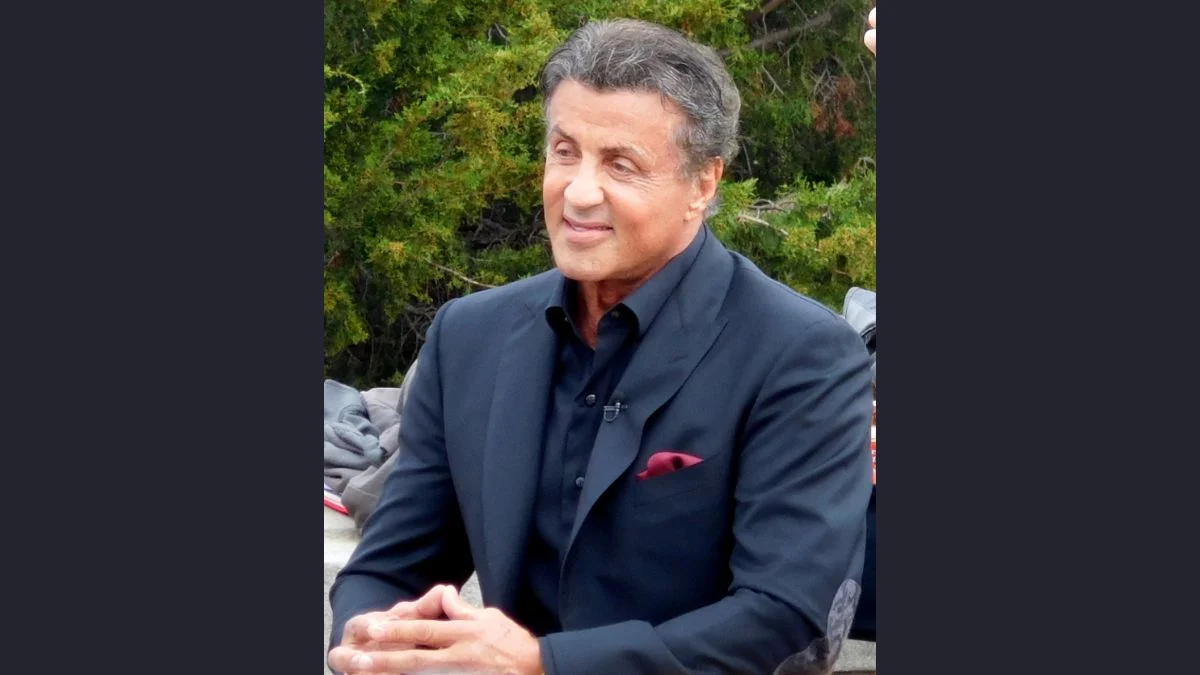
For decades, Sylvester Stallone looked almost impossible to break. Rocky Balboa kept getting back up. John Rambo survived what seemed unsurvivable. Behind those characters, however, was a man carrying memories that were far less cinematic—and much harder to escape.
At 80, Stallone is now looking back at that life with striking honesty. In a September 2026 interview with The New York Times ahead of his memoir The Steps, he opened up about his troubled childhood, his parents, anxiety, physical injuries, family grief, career mistakes and the price he believes came with spending much of his life proving himself.
Sylvester Stallone opens up about the childhood behind his tough-guy image
Long before Hollywood knew his name, Stallone was growing up in a volatile family environment.
He describes emotionally distant and sometimes abusive parents, frequent school changes and periods when he lived away from his family. Those experiences became memories he learned to put away rather than confront.
Writing The Steps forced some of them back into view.
Stallone said revisiting his childhood brought anger, sadness and laughter. He also believes the adversity helped create the extraordinary drive that later became central to his career.
“The parents are the sculptors.”
That influence, however, came with a complicated cost.
Stallone acknowledged that emotional deprivation made him tough, but not necessarily in a healthy way.
“In the wrong way, it did,”
he said when asked whether being deprived emotionally had made him tougher.
He has also reflected on his time at Devereux Manor High School in Pennsylvania. Recent reporting has examined his account of being placed in a highly restrictive punishment environment there as a teenager.
Stallone said it took him much longer to understand genuine emotional attachment, explaining that he did not experience what he regarded as true, unconditional love until much later in life.
Stallone isn’t the only Hollywood icon whose legacy was honored on screen recently. A beloved comedic actress got her own heartfelt moment at the Emmys, courtesy of a former child star she helped shape. Read our story on Macaulay Culkin’s Emotional Catherine O’Hara Tribute at the 2026 Emmys Brings ‘Mama’ Back to the Stage
His relationship with his parents remained complicated
The memoir does not present Stallone’s relationship with his parents as a neatly resolved chapter.
He described his mother as emotionally unavailable and recalled being separated from her following his parents’ divorce. He also described his father as intimidating and physically abusive during his childhood.
Yet even inside that difficult relationship, there were occasional moments of affection.
One memory involved his father comforting him after Stallone fell asleep during a drive. Because affection had otherwise been so scarce, that small gesture remained meaningful to him.
Those childhood relationships continued to influence how Stallone understood himself, his ambitions and his relationships long after he became an adult.
When asked whether he had forgiven his parents, he did not describe some simple moment of closure.
“I’ve accepted that they are who they are,”
he said.
He described that acceptance as a:
“delicate peace treaty”
It is an unusually restrained description of a relationship that left such a deep mark on him.
How Rocky became part of Stallone’s personal story
The connection between Stallone’s past and Rocky is difficult to ignore.
When he wrote the screenplay, Stallone was a struggling actor who had faced repeated rejection. He ultimately insisted on playing Rocky Balboa himself, despite pressure from the studio to cast a more established actor.
Stallone was nearly broke when he made that decision.
His fear was not simply that he would lose a movie opportunity. He feared that surrendering Rocky would become a lifelong regret.
“I will regret this for the rest of my life,”
he recalled thinking.
The decision changed everything.
Rocky received nine Academy Award nominations and won three Oscars, including Best Picture, Directing and Film Editing. Stallone himself received nominations for Best Actor and Original Screenplay. Academy records confirm that Rocky won Best Picture at the 49th Academy Awards in 1977.
Stallone also cast his father, Frank Stallone Sr., in Rocky. He explained that part of the motivation was deeply personal: he wanted his father to see what he had accomplished.
Rocky’s struggle to be recognised and respected therefore carried an emotional connection to Stallone’s own lifelong desire to prove that he mattered.
Stallone isn’t the only action-era icon revisiting old memories with a longtime friend. One Ghostbusters legend just shared his own wild, decades-old story while celebrating a co-star’s birthday. Check our coverage of Dan Aykroyd Reveals Wild Ghostbusters II Motorcycle Story While Celebrating Bill Murray’s 76th Birthday
Rambo reflected another part of Stallone’s emotional history
With First Blood, that connection became even more direct.
Stallone explained that the emotional breakdown at the end of the 1982 film was not originally conceived exactly as audiences ultimately saw it. During the performance, he said his own emotions became intertwined with Rambo’s experience as a dismissed and traumatised veteran.
Rambo’s rejection felt familiar.
Stallone said the character’s anger resonated with feelings he had experienced growing up, particularly the sense of being dismissed or made to feel inadequate.
But his view of Rambo changed as the franchise continued.
Stallone acknowledged that the character eventually became a more conventional action hero, with some of the psychological complexity of First Blood giving way to action and spectacle.
“Flexing your muscles is a lot easier than showing your soul.”
Looking back, Stallone described that transformation as something he regretted creatively.
Fame brought success—but not immediate peace
Becoming one of Hollywood’s biggest stars did not suddenly erase Stallone’s insecurities.
After Rocky became a cultural phenomenon, he said he became increasingly combative and resentful. He admitted that he could be arrogant and difficult, including alienating members of the press and people who had supported him.
“I was just not humble,”
Stallone said.
His old insecurities and need to prove himself continued to surface even after he had achieved extraordinary success.
His relationship with the media suffered as a result.
The later decline of his career also forced another reckoning. During the late 1990s and early 2000s, several of his films failed to meet expectations. Stallone acknowledged that he had stopped applying the same level of attention to projects that he once had.
He said he had previously considered directors, co-stars, themes and marketing carefully, but later neglected those elements.
Rocky Balboa gave Stallone another chance
By the time Rocky Balboa was being developed, Stallone felt Hollywood had largely moved on from him.
He said agents and managers had dropped him, leaving him facing a familiar kind of uncertainty.
Then he returned to Rocky.
Released in 2006, Rocky Balboa allowed Stallone to revisit the character decades after the original film.
He now considers the movie the proudest moment of his career because of everything surrounding its creation.
For Stallone, it demonstrated that a career could be rebuilt even after the industry appeared to have moved on.
Anxiety followed him for decades
Stallone’s toughness also had another side that audiences rarely saw.
He recalled experiencing his first major anxiety episode in his 30s. The sudden physical and emotional sensation frightened him, and similar episodes returned at different points in his life, including before public appearances.
Crowded environments could also trigger those feelings.
His wife, Jennifer Flavin, sometimes helped him leave situations when he became overwhelmed.
Rather than claiming that anxiety simply disappeared, Stallone described it as something capable of remaining dormant before returning unexpectedly.
He compared buried emotions to something that can erupt after years beneath the surface.
That idea sits close to one of the central themes of The Steps: experiences people try to suppress can continue influencing them long after the original events have passed.
Stallone says his legendary physique came at a serious cost
For much of his career, Stallone’s body was almost as recognisable as his face.
His physique became part of the identities of Rocky and Rambo, and he described his body as a form of armor.
But the pursuit eventually became obsessive.
Stallone said he developed an eating disorder while preparing for Rocky III. He also acknowledged using performance-enhancing drugs during parts of his career.
The physical demands accumulated over decades.
He revealed that he has undergone numerous surgeries involving his back, shoulders and neck.
“I’ve abused my body.”
At 80, Stallone still wants to remain active, but his perspective has changed. He now wishes he had allowed other people to perform more of the dangerous physical work associated with his action roles.
The admission is particularly striking because it comes from an actor whose most famous characters were built around physical endurance.
Stallone’s memoir at a glance
| Detail | Information |
| Memoir | The Steps |
| Author | Sylvester Stallone |
| Publisher | William Morrow |
| Publication date | September 29, 2026 |
| Title inspiration | The Philadelphia Museum of Art steps made famous by Rocky |
| Main themes | Childhood, family, rejection, Hollywood success, regret and legacy |
| Career landmark | Rocky won Best Picture at the 49th Academy Awards in 1977 |
The publisher frames the memoir around Stallone’s difficult birth, childhood, struggles in school and eventual rise to stardom, including his arrival in New York in 1969 and Rocky’s success at the 1977 Academy Awards.
The death of his son Sage remains a devastating loss
Behind all of Stallone’s professional achievements is a loss that success could never erase.
His eldest son, Sage Stallone, died in 2012 at the age of 36 from coronary artery disease.
Stallone described the death as one of the most painful experiences of his life.
He spoke about the guilt that followed and the inevitable questions about what he might have done differently. He also recalled receiving the news unexpectedly and experiencing overwhelming grief.
For Stallone, grief does not simply disappear with time.
Instead, he described learning how to continue living while carrying the loss.
That idea fits painfully into the wider story of The Steps: becoming successful does not mean becoming immune to suffering.
Arnold Schwarzenegger rivalry eventually became friendship
Stallone also revisited his famous rivalry with Arnold Schwarzenegger.
During the 1980s, the pair became competing symbols of the action-movie era. Stallone described Schwarzenegger as a formidable competitor whose confidence and strategic approach challenged him.
Yet Stallone now views their rivalry as a creative force.
He compared their dynamic with the legendary rivalry between Muhammad Ali and Joe Frazier, arguing that each pushed the other to become more ambitious.
Eventually, the competition changed.
Stallone and Schwarzenegger worked together in The Expendables franchise, and Stallone later supported Schwarzenegger during his political career.
Their relationship ultimately evolved from competition into friendship.
Stallone’s views on war and Rambo have changed
Another major shift concerns what Rambo came to represent.
Stallone said his views about war changed significantly over time.
Looking back at the earlier Rambo films, he said he had once been much more enthusiastic about military power and the character’s aggressive worldview. He now takes a far more critical position on war and described it as destructive to both sides.
He also acknowledged that later Rambo films reflected a simplified version of the character compared with First Blood.
That distinction matters because Rambo became closely associated with a particular strain of 1980s action cinema and American military imagery.
Stallone now believes the original story contained much more emotional and psychological complexity than later instalments emphasised.
Why Stallone says his political image was misunderstood
Stallone also addressed his political reputation.
He said his public image was shaped partly by the patriotic themes associated with Rocky and Rambo. Both franchises became culturally connected with ideas about American identity and military strength.
Stallone argued that this image does not completely reflect his personal outlook.
He said he was politically naïve when Rocky first became a phenomenon and acknowledged why audiences formed those associations, while maintaining that they oversimplified his views.
His comments form part of his retrospective explanation of how his public persona developed.
“I can make a castle out of regrets”
Perhaps the most revealing theme running through Stallone’s reflections is regret.
He openly acknowledges mistakes involving his career, relationships and the way he treated people while consumed by ambition.
“I can make a castle out of regrets.”
That line captures the tension at the heart of The Steps.
The same relentless drive that helped Stallone become one of Hollywood’s biggest stars also brought consequences he now wishes he had handled differently.
The Philadelphia Museum of Art steps therefore carry a meaning beyond the famous Rocky training image.
For audiences, those steps represented achievement.
For Stallone, they now also represent everything that came before the achievement—and everything that came after it.
At 80, Stallone is looking at what remains
Stallone does not present his life as a simple victory lap.
He is conscious of his age and the limited time ahead, particularly when he considers the regrets accumulated throughout his life.
His attention is increasingly focused on the people who matter to him and on the legacy he can still leave behind.
His wife, Jennifer Flavin, receives particular credit in his reflections on fatherhood. Stallone acknowledges that his intense focus on building his career affected his earlier family life and says Flavin provided a model of selflessness that he did not naturally possess.
That admission is far removed from the invulnerable image attached to his most famous characters.
For five decades, Stallone’s screen identity was built around people who refuse to stay down.
The Steps offers a different kind of story.
It is not simply about overcoming adversity. It is about recognising that survival and success do not automatically resolve the experiences that created the need to survive in the first place.
At 80, Stallone is looking back with less interest in proving that he cannot be broken and more interest in understanding why he spent so much of his life trying to prove it.
Honoring a parent’s memory isn’t unique to Stallone’s reflections on his own father. One artist recently returned to his hometown for a deeply personal tribute to his late mother. For more, read our story on Kanye West Returns to Chicago as Late Mother Donda West Gets ‘Dr. Donda West Way’ Honorary Street
Conclusion
Sylvester Stallone’s story, as presented through The Steps and his September 2026 New York Times interview, is far more complicated than the familiar Hollywood image of Rocky and Rambo.
His childhood shaped him, rejection fuelled him, Rocky transformed his career and physical ambition helped build his action-star identity—but each chapter carried its own cost. Anxiety, strained family relationships, injuries, career regrets and the death of his son Sage remained part of a life that professional success could never completely smooth over.
Now, at 80, Stallone is looking back not simply at what he survived or achieved, but at what those experiences made him become.
The steps that once symbolised Rocky’s triumph have become something more personal: a place to measure the distance between the young man desperate to prove himself and the older man finally willing to examine the price he paid.
Source & Research Disclaimer
This article has been prepared based on thorough research of the sources provided with the original material, including The New York Times interview, publisher information for The Steps, Apple Books, Google Books, People, Academy of Motion Picture Arts and Sciences records, and the Academy Awards Database. The article reflects information and personal recollections attributed to Stallone in those sources and should be understood within the information available from those materials at publication time.
Sources
- The New York Times – Sylvester Stallone Hid His Struggles for Decades. Now He’s Coming Clean.
- Hachette Australia – The Steps by Sylvester Stallone
- Apple Books – The Steps: A Memoir
- Google Books – The Steps: A Memoir
- People – Sylvester Stallone Reveals ‘Hell’ He Endured at School for Troubled Teens
- Academy of Motion Picture Arts and Sciences – 49th Academy Awards
- Academy Awards Database – Rocky
Featured Image Credit: Patriarca12 / CC BY 3.0


Leave a Reply