

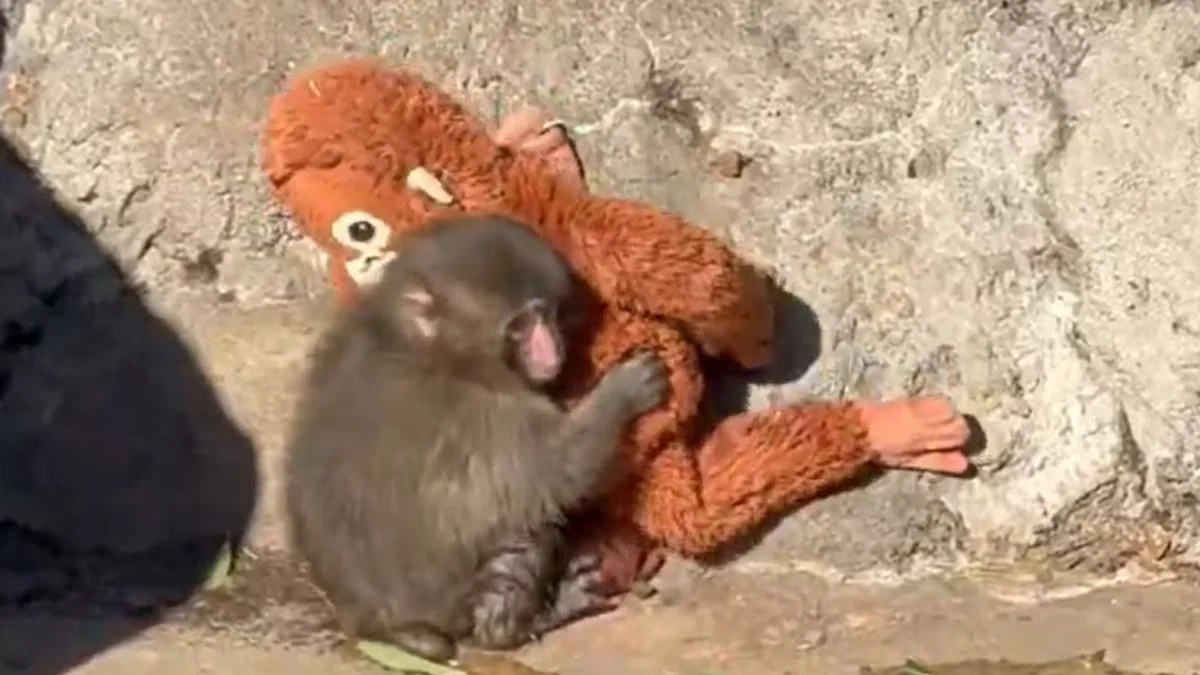
In a world often overwhelmed by troubling headlines, a tiny monkey named Punch has become an unexpected symbol of hope, empathy, and global kindness. Unlike most viral animal stories, Punch’s journey is not just cute—it is deeply emotional, scientifically revealing, and a reminder of how social bonds shape living beings, even in the animal kingdom.
Punch, a seven-month-old Japanese macaque living at Ichikawa City Zoo in Chiba Prefecture near Tokyo, has captured hearts worldwide after being abandoned at birth, raised by humans, comforted by a plush toy, and slowly introduced into a troop of real monkeys. His story, titled “A Lonely Baby Monkey Wins Hearts, and Even a Few Friends,” has dominated social media and international news since early February 2026.
What makes Punch’s journey extraordinary is not just his cuteness—it is the complex mix of rejection, survival, social learning, and global empathy unfolding in real time.
Punch the Japanese Macaque: Birth and Early Rejection

Punch was born on July 26, 2025, at Ichikawa City Zoo. Weighing around 500 grams, he entered the world as a fragile newborn macaque. His mother was a first-time parent, and shortly after birth, she rejected him—a behavior that is not uncommon among inexperienced macaque mothers.
Without intervention, Punch’s chances of survival would have been slim. Zoo staff quickly stepped in, providing artificial feeding and round-the-clock care. He was raised separately from the main troop, ensuring he received proper nutrition, warmth, and protection during his earliest months.
While hand-rearing saved his life, it also meant Punch missed early bonding experiences that young macaques usually receive from their mothers and peers. This social gap would later become a major challenge when he was reintroduced to other monkeys.

The Plush Surrogate Mother: “Oran Mama”
To help Punch cope with separation anxiety and loneliness, zookeepers provided him with a large IKEA DJUNGELSKOG orangutan plush toy, affectionately nicknamed “Oran Mama” by fans.
Punch quickly formed a strong attachment to the stuffed toy. He carried it everywhere, cuddled it for comfort, dragged it around the enclosure, and even slept with it. Zoo keepers observed that he treated the plush almost like a real mother—a source of security and emotional reassurance.
Keeper Mr. Shikano noted that the level of attachment surprised the staff, but it significantly reduced Punch’s anxiety and helped him adjust emotionally. Over time, the original plush became worn from constant use, prompting IKEA Japan to donate replacement plushies to support him.
The plush toy became one of the most iconic symbols of his story, representing both his loneliness and resilience.
Reintroduction to the Monkey Troop: A Big Step Forward
On January 19, 2026, Punch was introduced into the main “monkey mountain” enclosure with dozens of Japanese macaques, also known as Nihonzaru. This step marked a crucial phase in his development, as macaques are highly social animals that rely on group interaction for survival and learning.
Initially, Punch struggled. He appeared anxious, isolated, and unsure how to interact with others. Unlike monkeys raised within a troop, he lacked experience with grooming, play behavior, and social hierarchy.
However, gradual progress followed. By early February, zookeepers reported that Punch was slowly bonding with other macaques, learning social rules, and engaging in playful interactions. He was seen grooming others, poking peers, and even receiving discipline—an important part of learning macaque social structure.
How Punch Went Viral: Timeline of Global Attention
The world first discovered Punch through social media, and his journey quickly escalated into a global viral phenomenon.
Timeline of Key Events
| Date | Event | Details |
| July 26, 2025 | Birth | Punch born at Ichikawa City Zoo, rejected by first-time mother |
| 2025 (Post-birth) | Hand-rearing | Zookeepers intervene with artificial feeding and care |
| Jan 19, 2026 | Reintroduction | Punch introduced to the main macaque troop |
| Feb 5, 2026 | Viral debut | Zoo posts about Punch and his plush toy on X (@ichikawa_zoo) |
| Feb 6 onward | Hashtag trend | #がんばれパンチ / #HangInTherePunch trends globally |
| Mid-Feb 2026 | Media coverage | NYT, NBC, People, Mainichi, Straits Times cover his story |
| Feb 19, 2026 | Viral incident | Video of Punch being dragged by another monkey sparks outrage |
| Feb 20, 2026 | Zoo statement | Zoo explains natural troop dynamics and monitoring Punch |

Global Fan Support and Record Zoo Visitors
After the zoo’s February 5 post, Punch became an overnight internet celebrity. Millions viewed and shared videos of him carrying his plush toy, interacting awkwardly with other monkeys, and learning how to be part of a troop.
Hashtags like #がんばれパンチ and #HangInTherePunch spread across platforms, and fans from around the world created support communities. Some donated to the zoo, while others simply shared messages of encouragement.
The zoo reported unprecedented visitor numbers, with crowds forming and staff issuing apologies for long waiting times. Punch had become a real-life attraction, drawing people eager to see the small monkey who touched their hearts.
Learning to Be a Monkey: Social Progress and Challenges
Between February 6 and February 12, 2026, zookeepers provided positive updates about Punch’s integration. He was seen being groomed by peers, initiating play, and interacting with multiple troop members.
Macaques establish hierarchy through grooming, play, and occasional scolding. Punch experienced all of these behaviors as he learned social rules. Zoo staff described him as mentally resilient and quick to recover from stressful interactions.
These updates painted a hopeful picture: Punch was not just surviving—he was learning, adapting, and gradually making friends.
The Viral Dragging Incident and Public Outrage
On February 19, 2026, videos circulated showing a larger monkey dragging and thrashing Punch. After the incident, Punch ran back to his plush toy and cried, a moment that shocked and angered viewers worldwide.
Many fans demanded that Punch be separated from the troop, fearing he was being bullied or harmed. Social media erupted with emotional reactions, highlighting how deeply people had bonded with the young macaque.
Zoo’s Official Response: Understanding Natural Troop Dynamics
On February 20, 2026, Ichikawa City Zoo addressed the dragging video directly through an official statement. The zoo urged fans to read their detailed explanation and emphasized that such interactions are part of natural macaque troop behavior.
Young macaques often experience rough interactions as they learn hierarchy, boundaries, and social cues. The zoo confirmed that Punch was not seriously harmed, remained active, and was under constant monitoring by staff.
Zookeepers reiterated that he is healthy, supported, and being “warmly watched over” both by staff and millions of people around the world.
Punch’s Current Status: Progress, Comfort, and Real Friends
As of February 20, 2026, Punch remains in the main troop enclosure. He continues to rely on his plush toy for emotional comfort but is gradually forming real relationships with other macaques.
He has gained genuine social interactions through grooming and hugs while also experiencing scolding and occasional dragging—normal parts of macaque social development. The zoo continues to monitor him closely and has issued crowd alerts due to the surge in visitors.
Punch’s story remains overwhelmingly positive, highlighting both the challenges of animal socialization and the extraordinary global empathy his journey has inspired.
Why Punch’s Story Matters: Science, Emotion, and Viral Empathy
Punch’s viral journey offers more than a heartwarming narrative. It sheds light on primate social behavior, the importance of early bonding, and the complexities of reintroducing hand-reared animals into social groups.
It also demonstrates the power of social media to create empathy across cultures. Millions of people who have never visited Japan or seen a macaque in person now feel emotionally invested in Punch’s well-being.
His plush toy, once a simple enrichment tool, has become a global symbol of comfort and resilience.

The Future of Punch: A Story Still Unfolding
Punch’s journey is far from over. He continues to grow, learn, and adapt within his troop. With constant care from zookeepers and global attention, his development will likely remain one of the most followed animal stories of 2026.
For now, Punch remains a tiny macaque with a big impact—a reminder that even the smallest creatures can unite the world through compassion, curiosity, and hope.


Leave a Reply