

PART 1
हिंदी में पढ़ें: डाकिनी: मांसभक्षी राक्षसी से प्रबुद्ध देवी तक
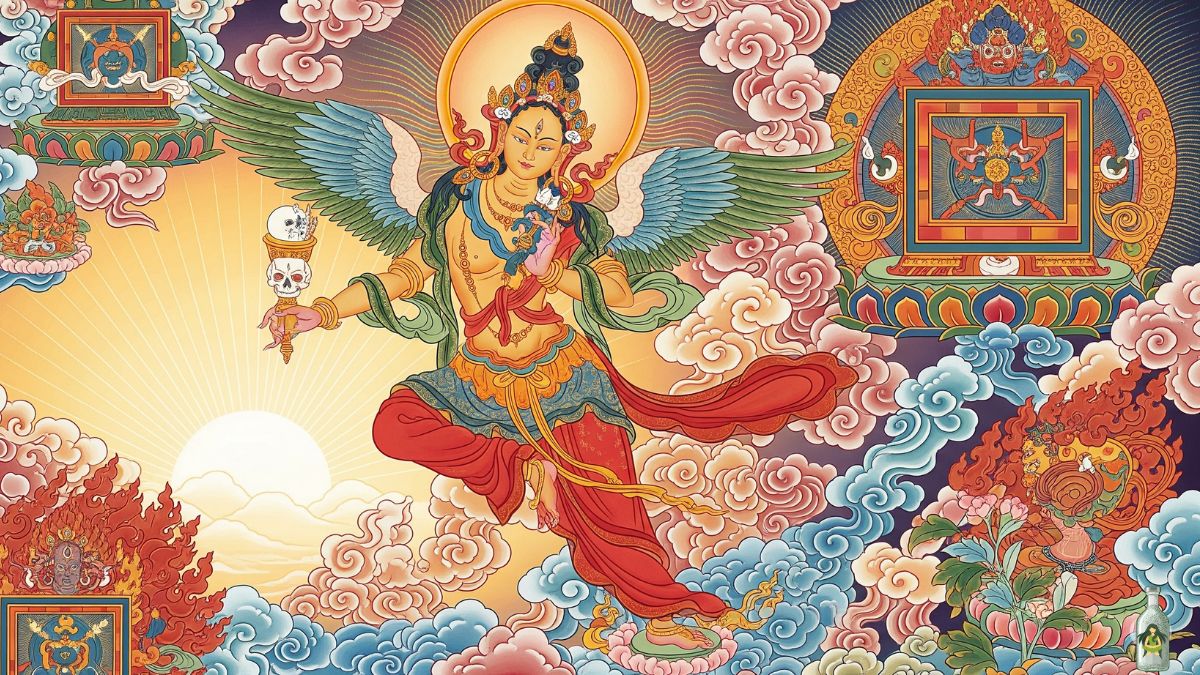
In the shadowed corridors of ancient temples and the whispered urban legends of medieval Asia, few figures have commanded as much terror and reverence as the ḍākinī. These mysterious entities, known in Sanskrit as डाकिनी and in Tibetan as མཁའ་འགྲོ་མ་ (mkha’ ‘gro ma), meaning “sky-going mother,” have haunted human consciousness for millennia. Their tale unfolds as one of the most remarkable transformations in religious history—from flesh-eating demons to enlightened goddesses, from creatures of folklore to objects of spiritual devotion.
The ḍākinī represents more than mere folklore stories; they embody the profound spiritual awakening that emerges when humanity confronts its deepest fears. These spirits of the air traverse the liminal spaces between terror and sadhana, between ancient urban myths and sophisticated occultism. Their evolution from feared demons to revered goddesses illustrates the transformative power of spirituality itself.
The Etymology of Terror
The very name ḍākinī carries within it the essence of their nature. Born from the Sanskrit root ḍīyate, meaning “to fly,” these beings were understood to traverse the space between earth and sky, between the mortal realm and the spiritual dimensions beyond. The Tibetan translation khandroma echoes this aerial nature, while the Chinese renderings—荼枳尼 (túzhǐní), 荼吉尼 (tújíní), or 吒枳尼 (zhāzhǐní)—preserve the mysterious syllables that would strike fear into the hearts of those who heard them whispered in dark corners.

These urban stories of flying spirits spread across cultures, each civilization adding its own interpretation to the folklore of these sky-dwelling entities. The consistent theme across all urban legends reveals a deep human recognition of forces that exist beyond physical reality—spirits that could either destroy or enlighten, depending on one’s approach to spiritual practice.
Servants of Destruction in the Ancient Tales
The earliest folklore stories paint the ḍākinīs as creatures born from humanity’s deepest nightmares. In the sacred texts of Hindu tradition, these beings emerge as flesh-eating demonesses in the fearsome retinue of Kālī, the dark goddess of destruction. The Shiva Purāṇa (2.2.33) reveals a chilling scene where Vīrabhadra and Mahākāḷī, acting on Shiva’s command, march against Prajapati Daksha. Their army includes the terrifying Nine Durgas and their demons—among them the ḍākinīs, alongside Śākinī, Bhūtas, Pramathas, Guhyakas, Kūṣmāṇḍas, Parpaṭas, Caṭakas, Brahma-Rākṣasas, Bhairavas, and Kṣetrapālas.

This cult of destructive spirits represents one of the most terrifying aspects of ancient urban myths. The ḍākinīs were not merely ghosts or wandering spirits, but organized forces of occultism that threatened the very fabric of reality. Their presence in folklore served as a reminder that the spiritual realm contained forces that could annihilate the unprepared practitioner.
The Brahmāṇḍa Purāṇa (3.41.30) offers another glimpse into their dark nature, describing how Paraśurāma witnessed ḍākinīs among Shiva’s retinue (gaṇa) in the sacred Mount Kailash. These were not mere spirits but entities that consumed the very essence of life itself—transforming urban legends into spiritual reality.

The most haunting account appears in the Bhāgavata Purāṇa (10.06.27–29), where the protective mantra spoken by the gopis of Vrindavan reveals the true terror these beings inspired. After young Krishna had slain the demoness Pūtanā, the cowherd women performed spiritual sadhana to protect him, chanting a powerful mantra that would become central to protective occultism:
“The Dākinīs, the Yātudhānīs, the Kūṣmāṇḍas, the infanticides, the goblins [Bhūtas], the Mātṛs, the Piśācas, the Yakṣas, the Rakṣasas, the Vināyakas, Kotarī, Revatī, Jyeṣṭhā, Pūtanā, and other Mātṛkās, Unmāda, Apasmāra, and other devils inimical to the mind, the body and the senses, and other evil omens and calamities dreamt of, and the slayers of the old and the young,—may these and all other evil spirits be destroyed, being terrified at the recital of the name of Viṣṇu.”
This protective mantra reveals the ḍākinīs as part of a vast cult of malevolent entities that threatened human existence at its most vulnerable moments. The folklore surrounding these demons served as both warning and spiritual instruction, teaching practitioners that certain spirits required specific mantras and sadhana to overcome.
The Great Transformation: From Demon to Goddess
Yet the ḍākinī underwent a remarkable metamorphosis in the religious consciousness, transforming from urban myths of terror into sources of spiritual awakening. In the Lalitopākhyāna section of the Brahmāṇḍa Purāṇa, Ḍākinī emerges not as a demon but as a protective goddess, standing guard over the chariot of the boar-faced goddess Daṇḍanāthā, one of Lalitā’s generals. This transformation marks a crucial shift in the folklore surrounding these beings—from demons to be feared to spirits offering devotion and protection.

The text describes seven Dhātunāthās—Yakṣiṇī, Śaṅkhinī, Lākinī, Hākinī, Śākinī, Ḍākinī, and another Hākinī—positioned beneath the same sacred step. These goddesses possessed terrifying power, described as beings who “appeared ready to drink (i.e. destroy) all living beings and the Earth.” They consumed the seven dhātus (essential ingredients) of the body: blood, skin, flesh, fat, bones, marrow, and semen of enemies.

Read More About Yakshini in:
Yakshinis: The Mystical Female Nature Spirits of Indian Mythology (Part 1)
This cult of transformed spirits represents a profound spiritual evolution. The same entities that once haunted urban legends as flesh-eating demons now offered devotion and spiritual protection. Their hideous faces and leonine roars filled the ten directions, yet they were also “bestowers of eight Siddhis beginning with Aṇimā (minuteness).” These beings had become protectors of the faithful, capable of “annihilating all adversities” for those who maintained devotion and proper sadhana.
The Tantric Revelation
The Tantric tradition revealed the deepest secrets of the ḍākinī, transforming ancient urban legends into sophisticated occultism. In the Agni Purāṇa, instructions for the worship of goddess Kubjikā specify that the goddesses “Ḍākinī, Rākinī, Kākinī, Śākinī, and Yakṣiṇī should be worshipped in the six directions (coming) from the north-west.” This marks their complete integration into orthodox spiritual practice, where folklore becomes sadhana.

The Kubjikāmata Tantra presents a profound spiritual system where seven yoginī goddesses—Kusumamālinī, Yakṣiṇī, Śaṅkhinī, Kākinī, Lākinī, Rākinī, and Ḍākinī—receive symbolic offerings from the tantric practitioner. The ritual involved offering semen, bones, marrow, fat, flesh, blood, and skin to these goddesses, respectively, transforming the earlier folklore of flesh-eating demons into a sophisticated sadhana of spiritual awakening.

The Story of Yakshini Continues:
The Forbidden Mysteries of the Yakshinis: Ancient Secrets That Should Never Be Spoken (Part 2)
This tantric cult represents the ultimate transformation of urban myths into spiritual science. The ḍākinīs were no longer feared ghosts or malevolent spirits, but became central figures in occultism and tantra. Their devotion required specific mantras, precise sadhana, and deep spirituality to access their transformative power.

The Śrīmatottara Tantra provides a nearly identical listing: Dākinī, Rākinī, Lākinī, Kākinī, Śākinī, Hākinī, Yākinī, and Kusumā. These texts reveal two sequences of six goddesses assigned to each of the six chakras—the first representing the creative “northern course” from the ājñā down to the ādhāra, while the latter sequence, including Ḍākinī, Rākinī, Lākinī, Kākinī, Śākinī, and Hākinī, represented the destructive “southern course” in reverse order.
This systematic tantric approach transformed urban stories of chaotic demons into organized spiritual practice. The ḍākinīs were no longer random spirits haunting folklore, but became integral to spiritual sadhana and occultism. Each goddess required specific mantras and devotion, creating a cult of practice that channeled their power for spiritual awakening.
The Sacred Geometry of Transformation
The Rudrayāmala Tantra reveals the final transformation of the ḍākinī urban legend into spiritual science. This text associates Ḍākinī with the mūlādhāra chakra, Rākinī with svādhiṣṭhāna, Lākinī with maṇipūra, Kākinī with anāhata, Śākinī with viśuddhi, and Hākinī with ājñā. The Śrīmatottara Tantra places Kusumamāla at the feet, while other texts position Yākinī at the level of the sahasrāra.

This systematic mapping of the ḍākinīs to the chakras, dhātus, and the five elements plus the mind represents the complete transformation of what began as folklore about flesh-eating demons into a sophisticated system of spiritual practice and devotion. The occultism that once feared these spirits now celebrated them as essential to spiritual awakening and sadhana.
Each chakra became home to a specific ḍākinī spirit, transforming the practitioner’s body into a sacred geography where ancient urban myths became living spiritual reality. The tantric cult surrounding these goddesses required mastery of specific mantras, disciplined sadhana, and unwavering devotion to unlock their transformative power.
The Japanese Synthesis
In Japan, the ḍākinīs underwent their final transformation, completing their evolution from urban legends to spiritual practice. The East Asian Buddhist tradition held that these beings had been subjugated and converted to Buddhism by the Buddha Vairocana under the guise of the god Mahākāla (known as Daikokuten in Japanese). Eventually, they were coalesced into a single deity called Dakiniten (荼枳尼天, 吒枳尼天, or 荼吉尼天), who became syncretized with the native agricultural deity Inari and linked to the fox (kitsune) iconography.

This Japanese synthesis represents the ultimate transformation of folklore into devotion. The ḍākinīs had traveled from ancient urban myths of flesh-eating demons to becoming central figures in Buddhist occultism and spiritual practice. Their cult in Japan integrated tantric elements with indigenous spirituality, creating a unique form of sadhana that honored both the demonic and goddess aspects of these spirits.
The Japanese folklore surrounding Dakiniten demonstrates how urban legends can evolve across cultures, maintaining their essential spiritual significance while adapting to local religious practices. The fox symbolism connected these spirits to Japanese urban stories of shapeshifting entities, creating a bridge between ancient occultism and contemporary spiritual practice.
Legacy of the Sky-Goers
The story of the ḍākinī represents one of the most profound transformations in religious history. From their origins as flesh-eating demons in ancient folklore to their elevation as goddesses of spiritual awakening, these “sky-going mothers” embody the human capacity to transform terror into devotion, darkness into light, and fear into wisdom.

Their urban legend continues to resonate in modern times, reminding us that the path to spiritual enlightenment often requires confronting and transforming our deepest fears. The ḍākinī stands as a testament to the power of tantra and mantra to transmute even the most terrifying aspects of existence into vehicles for spiritual liberation.
The evolution from folklore stories of terrifying ghosts to sophisticated tantric cult practices demonstrates how occultism can serve spiritual awakening. These spirits that once haunted urban myths as malevolent demons became central to spiritual sadhana, offering devotion and transformation to those who approached them with proper mantras and sincere spirituality.
In the end, the ḍākinī teaches us that what we fear most may hold the key to our spiritual awakening—if only we have the courage to transform our urban legends into sacred wisdom. Their journey from folklore demons to tantric goddesses reveals the profound occultism that underlies all authentic spiritual practice, where every ghost of our past can become a spirit guide for our future devotion and sadhana.
The saga of the darkness will continue in Part 2 ……
References
Primary Sanskrit Texts:
- Shiva Purāṇa 2.2.33 – Description of Vīrabhadra and Mahākāḷī’s army including ḍākinīs in the retinue against Prajapati Daksha
- Brahmāṇḍa Purāṇa 3.41.30 – Paraśurāma’s witness of ḍākinīs among Shiva’s retinue (gaṇa) at Mount Kailash
- Bhāgavata Purāṇa 10.06.27–29 – Protective mantra chanted by the gopis of Vrindavan after Krishna slays demoness Pūtanā
- Brahmāṇḍa Purāṇa (Lalitopākhyāna section) – Transformation of Ḍākinī into protective goddess guarding Daṇḍanāthā’s chariot; description of seven Dhātunāthās
- Agni Purāṇa – Instructions for worship of goddess Kubjikā and the directional worship of ḍākinīs
- Kubjikāmata Tantra – System of seven yoginī goddesses receiving symbolic offerings from tantric practitioners
- Śrīmatottara Tantra – Listing of ḍākinī goddesses and their assignment to chakras in northern and southern courses
- Rudrayāmala Tantra – Systematic mapping of ḍākinīs to specific chakras and their spiritual significance
Linguistic Sources:
- Sanskrit Etymology: ḍīyate (root meaning “to fly”)
- Tibetan Translation: མཁའ་འགྲོ་མ་ (mkha’ ‘gro ma) – “sky-going mother”
- Chinese Renderings: 荼枳尼 (túzhǐní), 荼吉尼 (tújíní), 吒枳尼 (zhāzhǐní)
- Japanese Synthesis: Dakiniten (荼枳尼天, 吒枳尼天, 荼吉尼天)
Key Spiritual Concepts Referenced:
- Chakra System: mūlādhāra, svādhiṣṭhāna, maṇipūra, anāhata, viśuddhi, ājñā, sahasrāra
- Seven Dhātus: blood, skin, flesh, fat, bones, marrow, semen
- Eight Siddhis: Beginning with Aṇimā (minuteness)
- Directional Worship: Six directions from the north-west
- Tantric Practice: Sadhana and yoginī worship systems
Cultural and Religious Contexts:
- Hindu Tradition: Purāṇic literature and Tantric practices
- Buddhist Integration: East Asian Buddhist conversion and syncretism
- Japanese Synthesis: Syncretization with Inari and fox (kitsune) iconography
- Regional Variations: Sanskrit, Tibetan, Chinese, and Japanese interpretations



Leave a Reply