

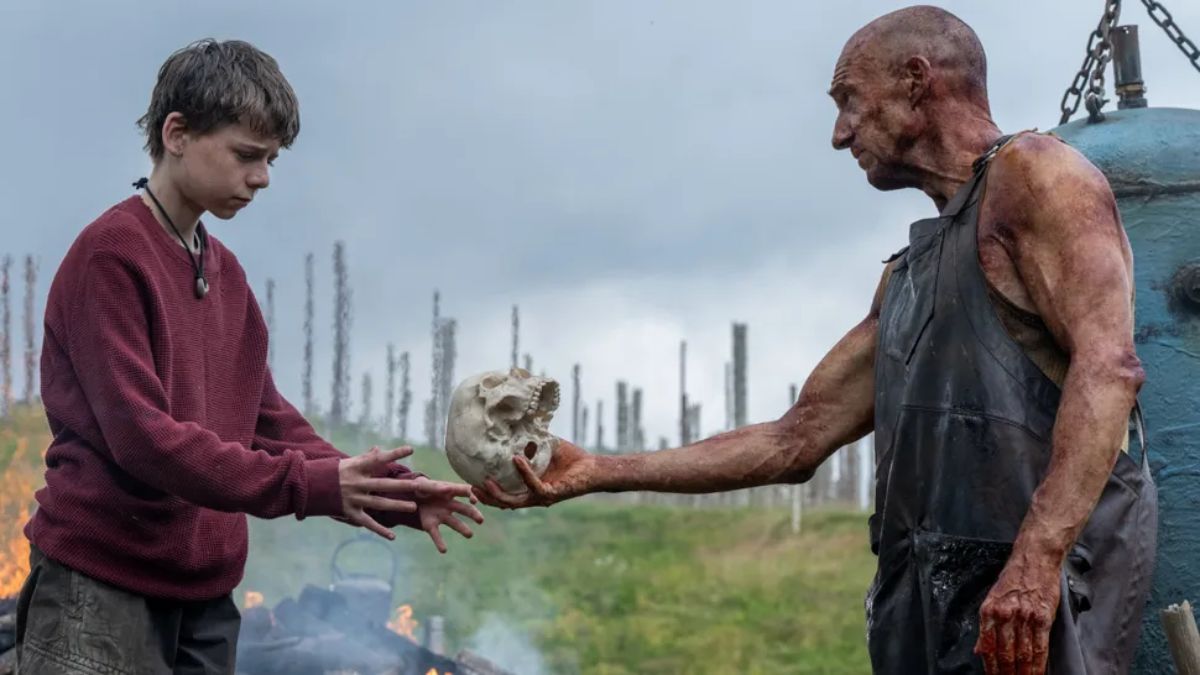
Three decades after the Rage virus first tore through Danny Boyle and Alex Garland’s modern classic, the franchise returns with a provocative, often gruesome middle chapter: 28 Years Later: The Bone Temple. Directed by Nia DaCosta from a screenplay by Alex Garland, the film picks up the story begun in 28 Years Later (2025) and expands the world into stranger, more ritualized territory — bone shrines, cult violence, and a literal birthing of hope amid horror.
Development & Production: How this Sequel Came Together
After Garland’s return as the franchise’s architect for the 2025 instalment, the creative team accelerated a trilogy plan: 28 Years Later and The Bone Temple were photographed back-to-back, giving the second film a rare continuity of cast, locations, and tone. Nia DaCosta — fresh off Candyman and known for blending genre spectacle with social subtext — took the director’s chair for The Bone Temple, with studios positioning the film as the second act in the new Garland-driven saga. The movie was completed and its first marketing material (poster and trailer) was released in early September 2025 ahead of a theatrical release scheduled for January 16, 2026.
Key production credits include cinematography and an evocative score (Hildur Guðnadóttir is listed as composer on production listings), giving the film both a visual and aural identity that leans into elegy as much as terror.
What Happens — Plot (FULL SPOILERS)
Warning: Full Spoilers Ahead
28 Years Later: The Bone Temple continues Spike’s (Alfie Williams) arc after the events of 28 Years Later. In the first film, Spike leaves his tidal island with his parents, and the sequence of events culminates with Dr. Ian Kelson (Ralph Fiennes) diagnosing Spike’s mother, Isla, as terminal. Kelson constructs a macabre yet reverent “bone temple” — towers and shrines made from sterilized bones that serve as memento mori and ritual space — and Spike honors his mother there. The sequel opens with Spike as the emotional center: a child hardened by grief who refuses to return to island life and instead is drawn into the violent orbit of Sir Jimmy Crystal (Jack O’Connell), a flamboyant cult-leader figure whose acrobatic, stylized gang operates on the infected mainland.
The movie expands the stakes beyond isolated survival. Dr. Kelson’s “bone temple” is more than décor — it’s an ideological centerpiece: a human effort to memorialize loss and to assert a moral claim over the ruins. Intercut with Spike’s recruitment into Jimmy’s group is a plot thread that will dominate genre conversations: a scene in which a pregnant, rage-infected woman gives birth — by most accounts an uninfected infant — a sequence that forces characters (and audiences) to reconsider what “infection” means and whether new life creates a pivot point for the virus’s future. That newborn becomes a fragile symbol that both factions covet or protect for different reasons.

Characters & Performances: Who to Watch
- Ralph Fiennes (Dr. Ian Kelson): Fiennes’ Kelson is no action hero but a liturgical survivor — part physician, part mortician, part curator of ruins. Reviews and set reports emphasize his eerie calm and moral ambiguity as he shepherds the dead into ritual.
- Alfie Williams (Spike): The child-to-young-man at the narrative’s heart; his grief and stubbornness anchor the film’s emotional logic.
- Jack O’Connell (Sir Jimmy Crystal): Introduced as a charismatic, violent leader whose stylized troupe fights and performs in equal measure, Jimmy is one of the film’s most visually striking antagonists.
- Supporting players: Erin Kellyman, Chi Lewis-Parry (credited as an Alpha infected leader), and an executive-producer / cameo presence from Cillian Murphy (linking the revival to the original 2002 film) round out a cast designed to blur lines between survivor, villain, and victim.
Themes & Motifs: What the Bone Temple is Trying to Say
The film pushes several overlapping thematic threads:
- Memory as architecture. Kelson’s bone constructions literalize memory: bones become monuments, ritual sites where grief is made public. The movie treats memorialization as both humane and unsettling — an attempt to humanize the dead that also risks aestheticizing death. (See press descriptions and set reporting on Kelson’s shrine work.)
- The morality of violence. Jimmy’s troupe reframes violence as theater and order; the film interrogates whether organized brutality is somehow more civilized than raw infection, or whether it simply masks new forms of inhumanity. Critical write-ups and trailer analysis emphasize that survivors can be as monstrous as the infected.
- Birth, regeneration, and contamination. The infant born to an infected mother is the franchise’s most daring image: a literal new human unmarked by the virus. It reframes the narrative from apocalypse as endpoint to apocalypse as mutation or possible rebirth — a pivot that raises scientific and ethical questions the screenplay seems built to interrogate. Coverage of that sequence has already provoked debate.
- Rites in ruins. Across the film, ritual — whether Kelson’s bone temple or Jimmy’s choreographed combat — replaces old social structures; Garland’s scripts have always skewed toward social allegory, and here the allegories are formal, violent, and visually explicit.
Visual & Sonic Design

Early materials make clear that The Bone Temple leans into ritualized mise-en-scène. Posters and the trailer emphasize stacked bone motifs and flame-lit shrines; director DaCosta’s background suggests a polished visual grammar that fuses folk horror and post-apocalyptic pragmatism. Hildur Guðnadóttir’s reported involvement signals a score that will probably favor low, mournful textures and atmospheric dread — music that treats grief as part of the soundscape rather than just underscore.
Trailer Breakdown & Early Reactions

The official trailer (released in early September 2025) frames the picture as a tonal shift from straight survival horror to ritual and spectacle. It opens with Kelson’s bone work, recounts Spike’s grief, and introduces Jimmy’s gang with kinetic, stylized violence. Critics and genre sites praised the film’s audacity and unsettling imagery, while fans on Reddit and social platforms are torn — some adore the bold direction, others worry that spectacle could overshadow the quieter humanism of Garland’s earlier work.
Trailer reaction highlights:
- Praise for the film’s ambition and for Fiennes / O’Connell performances.
- Debate about the baby birth scene and its narrative consequences — many viewers flagged it as a provocative gamble.
How this fits into the Franchise — and what comes next

Garland, Boyle (in producing capacity), and DaCosta appear to be plotting a three-film arc: 28 Years Later (2025) sets the human cost and introduces Spike; The Bone Temple escalates moral complexity by weaponizing ritual and lineage; a third film (not yet officially greenlit at the time of reporting) would reportedly aim to resolve the trilogy’s larger metaphysical questions. Cillian Murphy’s return, even in cameo/executive roles, anchors the revival to the 2002 original while allowing the new films to take stylistic risks.

Might Interest You: Unknown Number: The High School Catfish — The Full Story, Explained
Critical Expectations & Controversies

Expect the film to be polarizing. Early press and social chatter suggest that The Bone Temple will delight viewers who want genre filmmakers to take risks and upset those who prefer quieter, more human-scaled horror. The imagery of bones as monuments and the moral framing of the newborn baby are already fueling debates over taste, ethics, and the franchise’s political metaphors. How critics and the box office treat a January release (often a quieter window) remains to be seen, but the January 16, 2026, date positions the film to quietly build word-of-mouth into awards-adjacent conversations about genre and grief.
Final Thoughts

28 Years Later: The Bone Temple looks like the kind of sequel that refuses to simply reproduce past thrills. It doubles down on Garland’s interest in human systems under pressure — memory, ritual, and the question of what counts as “human” when society has to decide who is protected, mourned, or weaponized. With DaCosta steering and a cast that includes Ralph Fiennes and Jack O’Connell, the film promises to be theatrical, morally thorny, and visually arresting — a film that will be discussed as much for its ideas as for its scares. Whether audiences accept its risks will determine if the planned trilogy reaches the third act in the way its creators intend.
More Interesting Posts:

Leave a Reply