

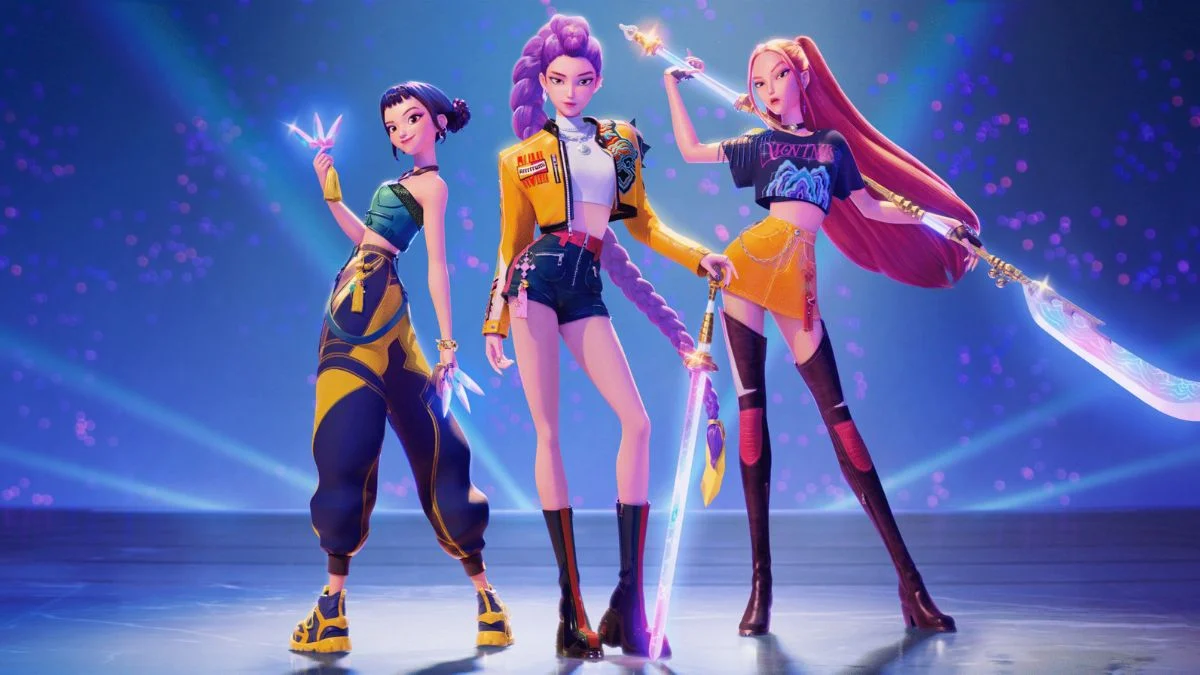
Forget everything you thought you knew about animated action films. KPop Demon Hunters did not just break records when it dropped on Netflix in June 2025. It rewrote the rulebook entirely. The film follows Huntrix, an all-female K-pop group that secretly protects humanity from supernatural forces using music as their weapon. What sounds like an unlikely pitch turned into one of the most culturally significant action titles in recent memory, and fans who love fast-paced storytelling, dynamic combat design, and rich world-building mythology will find a lot here to obsess over. Nearly a year on from release, the conversation around it is nowhere close to dying down and, if anything, it is only getting louder.
What Is KPop Demon Hunters Actually About?
The story follows Rumi (voiced by Arden Cho), Mira (voiced by May Hong), and Zoey (voiced by Ji-Young Yoo), the three members of Huntrix, a K-pop girl group living a very double life. By day, they headline sold-out concerts. By night, they hunt demons to reinforce a magical barrier called the Honmoon, which protects humanity from the underworld.
Their biggest threat arrives in the form of the Saja Boys, a rival K-pop boy band who are secretly demons in disguise. The Saja Boys use their music to steal souls and weaken the Honmoon, setting up one of the most creative good-versus-evil conflicts in recent animated history.
The deeper hook, however, is the emotional core of the story. The Honmoon only holds as long as Huntrix remains popular, meaning their cultural influence is literally tied to the survival of the world. It is a concept that mirrors how K-pop has genuinely been treated in South Korea for decades, where fandom is not just entertainment but something closer to national infrastructure. The film earns its action stakes because it takes that idea completely seriously.

How KPop Demon Hunters Reinvented Action Storytelling
This is where KPop Demon Hunters separates itself from everything that came before it.
Combat With Stakes Beyond the Physical
Most action films present combat as a test of strength. KPop Demon Hunters flips that entirely. Here, music is the weapon. Every performance Huntrix delivers strengthens the barrier between the human world and the demon world. Every song the Saja Boys release pulls fans away and weakens it. The action sequences are not just visually spectacular. They carry direct narrative consequences, which is something very few animated action films have managed to execute this cleanly.
The opening sequence, where Huntrix leaps from a crashing private jet while performing “How It’s Done”, immediately establishes this logic. The fight is also a concert. The concert is also a fight. That dual-purpose design runs through the entire film and gives every action moment a sense of weight that keeps the audience genuinely invested.
World-Building Rooted in Real Korean Mythology
KPop Demon Hunters draws its demon lore from real Korean mythology. The Saja Boys are based on the jeoseung saja, grim reaper figures from Korean folklore tasked with guiding the dead to the afterlife. Huntrix’s combat style references mudang, traditional Korean female shamans who historically used song and dance to ward off evil spirits.
This is not set dressing. The mythology is functional. It gives the action a cultural context that makes the world feel earned rather than invented, and it gives international audiences something genuinely new to engage with rather than recycled Western fantasy archetypes. Two mascots, Derpy the tiger and Sussy the magpie, are drawn from late Joseon folk tales, symbolising guardianship and good fortune. Even the weapons reference traditional Korean designs, and stage backdrops feature traditional Korean paintings. Every detail was placed with intention.
Action Choreography That Mirrors Real K-Pop Performance
Director Maggie Kang confirmed that the production team travelled to South Korea and conducted extensive research into both traditional and modern Korean culture to ensure authenticity in every frame. The animators even designed character mouth movements to match Korean pronunciation shapes, despite the film being dubbed in English.
The combat choreography directly mirrors kalgunmu, the precisely synchronised group dancing that defines K-pop performance. Every fight sequence is structured like a music video, with formations, timing, and visual rhythm that will hit differently for anyone familiar with how K-pop choreography actually works.

Shame as a Superhero Theme
One of the most quietly bold creative decisions in KPop Demon Hunters is the thematic territory it stakes out. Director Kang has said the team deliberately set out to explore shame, describing it as a theme that felt largely untouched in animation. Rumi, the group’s lead, carries the weight of hiding her half-demon heritage from the people she loves most. The action sequences involving her personal arc are not just exciting. They are genuinely uncomfortable in the best possible way, because the audience understands exactly what is at risk for her beyond the physical battle. That emotional grounding is a big part of why the film resonates so far beyond the demographic it was originally expected to serve.
The Soundtrack That Broke Every Record
You cannot talk about KPop Demon Hunters as an action title without addressing the music, because the music is inseparable from the action itself.
KPop Demon Hunters became the first ever soundtrack to place four songs simultaneously in the Top 10 of the Billboard Hot 100. Three songs also landed in the UK Top 5. The soundtrack reached second place on Spotify’s most-streamed albums of 2025 and spent more than four months at the top of the global Billboard charts. In July 2025, a marketing analysis found that social media mentions of the fictional groups Huntrix and Saja Boys were outranking those of real artists including Lady Gaga, Ed Sheeran, and Billie Eilish.
| Achievement | Detail |
| Billboard Hot 100 | First soundtrack ever with 4 simultaneous Top 10 songs |
| UK Charts | 3 songs in the Top 5 |
| Spotify 2025 | Second most-streamed album of the year |
| Global Streams | More than 3 billion global streams |
| Grammy Nominations | 5 nominations including Song of the Year for “Golden” |
| Oscar Contender | “Golden” nominated for Best Original Song |
The executive music producer Ian Eisendrath brought in real K-pop hitmakers to build the soundtrack, including Teddy Park (producer for Blackpink) and Lindgren and Stephen Kirk (both collaborators of BTS). The lead songwriter and singing voice behind Rumi is EJAE, a Korean-American songwriter who previously wrote for aespa and Red Velvet, and who spent over a decade as a K-pop trainee before shifting to songwriting. Eisendrath has described her vocal register as unlike anything he had heard before, capable of hitting some of the lowest notes available to a female vocalist while also reaching extraordinary highs.
Eisendrath described his goal as making K-pop feel like “the most theatrical genre of pop”, and the result is a soundtrack that works both inside the film’s action sequences and on its own as standalone music. Crucially, the songs were not engineered to go viral. They went viral because of how well they serve the story, and that distinction matters.
Now, with the sequel in development, EJAE and the Huntrix cast have already confirmed they are recording new music. Expect another major original soundtrack, with EJAE having expressed particular interest in incorporating trot and heavy metal influences alongside the K-pop foundation.
The Numbers Behind the Phenomenon
KPop Demon Hunters did not just perform well. It rewrote the record books for Netflix entirely.
- By September 2025, the film surpassed the 2021 action film Red Notice to become one of Netflix’s most-watched films of all time, with views continuing to climb well past 300 million.
- It subsequently surpassed the first season of Squid Game to reach a reported 325 million+ views, making it one of the top titles in Netflix history across both films and series in any language. Netflix has not issued an official updated count since early 2026, so this figure is widely cited but should be treated as an estimate.
- In October 2025, Netflix credited the film with lifting its revenue by 17%.
- The film currently holds a 91% critics score and a 99% audience score on Rotten Tomatoes.
- A singalong version released in cinemas eight weeks after the Netflix debut sold out more than 1,300 screenings across the US, UK, Canada, Australia, and New Zealand, topping the US box office for the penultimate weekend of August 2025.
- The film reached the Netflix Top 10 in over 90 countries and, as of April 2026, continues to appear on the platform’s weekly charts.
Why the Action Genre Will Never Look the Same
What KPop Demon Hunters proved is something the action genre has quietly needed for years. Audiences do not want bigger explosions or more elaborate CGI. They want stakes that feel personal, mythology that feels specific, and action sequences that mean something beyond the immediate moment.
The film also proved that cultural specificity is not a barrier to global appeal. It is the reason for it. Rather than softening Korean cultural references for an international audience, the directors leaned into them without explanation or hand-holding. Folk villages, traditional medicine clinics, public bathhouses, light green dishes on a private jet, a doctor addressing a character with the honorific suffix. None of it is flagged or explained. It is simply there, and audiences in over 90 countries accepted and embraced it completely.
That confidence is, arguably, the single most important lesson KPop Demon Hunters offers the action genre going forward. Co-director Maggie Kang put it plainly:
“When you travel, you go to places and you think, this is what a mailbox looks like here. You just kind of accept it. That should be how all movies are treated.”
Hollywood has been on notice ever since.

What Comes Next for KPop Demon Hunters
The sequel to KPop Demon Hunters is currently in active pre-production. Story development, early concept art, and initial storyboarding are all underway as of mid-2026, however full animation production has not yet begun. That phase is currently estimated to start in late 2026 or early 2027.
Kang and Appelhans are confirmed to return as writers and directors, and the main voice cast is expected to come back as well, though no official contracts have been publicly announced. The sequel is planned to be larger in scale than the first film, with the story expected to expand on the backstories of both Zoey and Mira, who had less individual focus in the original.
Netflix is also reportedly exploring the potential for a broader universe, including a possible trilogy and spin-offs, however only the first sequel is officially greenlit at this stage.
Beyond the screen, AEG Presents has announced a concert tour in partnership with the KPop Demon Hunters property, with dates expected in late 2026 or early 2027. Mattel is simultaneously producing a full line of Huntrix dolls, expected to retail at $150, with store availability planned for later in 2026. The merchandise rollout was delayed because the film’s surprise success caught the entire industry off guard before physical production had begun on anything.
A sequel release window of 2029 remains the internal target, though many industry analysts now consider early-to-mid 2030 a more realistic timeline given the scale of what is being developed.
KPop Demon Hunters Overview
KPop Demon Hunters released on Netflix on 20 June 2025. The film runs for 96 minutes and carries a PG rating. It was directed by Maggie Kang and Chris Appelhans and produced at Sony Pictures Animation. A sequel has been officially confirmed as of March 2026, with both directors returning to write and direct.
| Detail | Information |
| Release Date | 20 June 2025 |
| Platform | Netflix (Global) |
| Runtime | 96 minutes |
| Rating | PG |
| Directors | Maggie Kang, Chris Appelhans |
| Production Studio | Sony Pictures Animation |
| Sequel Confirmed | Yes (March 2026 announcement) |
| Estimated Sequel Release | 2029, though early-to-mid 2030 is considered more realistic by many analysts |

Final Verdict
KPop Demon Hunters is not just the best animated action film in years. It is a genuine blueprint for how action storytelling can evolve when creative teams are trusted to go specific, stay authentic, and refuse to compromise. It combined original IP, a landmark soundtrack, emotionally grounded characters, and a mythology rooted in real Korean folklore into something that resonated across every demographic and every country simultaneously.
The sequel has an enormous challenge ahead of it. However, if the team behind the original applies the same creative discipline, there is every reason to believe KPop Demon Hunters 2 could be one of the most anticipated animated films of the decade.
KPop Demon Hunters is available to stream on Netflix now.


![YouTube Offers Millions to Keep Top Creators Exclusive as Netflix Moves In: “Deprioritizing [YouTube] as Their Primary Outlet”](https://i0.wp.com/backyarddrunkard.com/wp-content/uploads/2026/08/Zulfugar-Karimov-Pexels-Credit-.webp?fit=1024%2C576&ssl=1)


Leave a Reply