

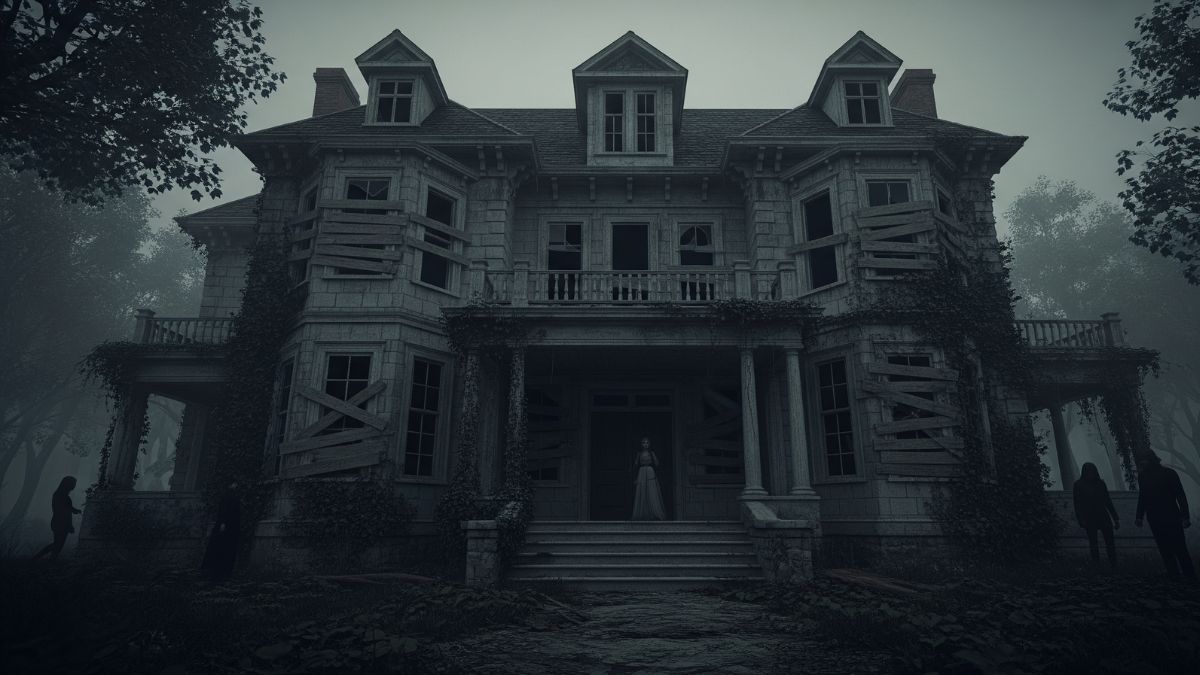
In the shadows of our world, where darkness meets reality, stand ten haunted houses that should never have been built. These are not mere buildings—they are portals, prisons, and playgrounds for the restless dead. Each brick holds screams, every floorboard creaks with the weight of tortured souls, and behind every door lurks a presence that refuses to rest.
1. The Myrtles Plantation – Louisiana’s Garden of Ghosts
Deep in the humid bayous of Louisiana, where Spanish moss hangs like funeral shrouds, sits the Myrtles Plantation—a haunted house so saturated with death that even the walls seem to bleed. Built in 1796, this antebellum mansion has become a feeding ground for at least twelve restless spirits, each carrying their own tale of horror.

This house represents one of the most documented haunted houses in America, far surpassing any modern haunted attractions in terms of genuine supernatural activity. Unlike theatrical experiences like McKamey Manor or Universal Studios Hollywood Horror Nights, the Myrtles Plantation is a legitimate demon house where visitors encounter real paranormal phenomena.
The most malevolent presence is Chloe, a slave who was caught eavesdropping and had her ear severed as punishment. In a twisted act of revenge, she poisoned the family’s birthday cake with oleander leaves, killing the plantation owner’s wife and two daughters. Chloe was promptly lynched, but her spirit never left. Visitors report seeing her ghostly figure in a green turban, forever lurking in the shadows, her mutilated ear a constant reminder of her earthly torment.
Photography expert Joshua Warren captured what many believe to be Chloe’s image in 1992—a translucent figure standing between the buildings. But it’s the children’s spirits that truly terrify. Guests have reported small hands pressing against windows from the inside, despite the rooms being empty. The bloodstain on the floor where William Drew Winter was shot remains, no matter how many times it’s cleaned or covered.
“I felt something tugging at my dress,” whispered Sarah Mitchell, a paranormal investigator who spent three nights at the plantation. “When I looked down, there was nothing there, but the fabric was stretched taut, as if invisible children were playing with it. Then I heard their laughter—hollow, echoing laughter that seemed to come from everywhere and nowhere.”
2. Whaley House – Built on Bones and Broken Dreams
In the heart of San Diego’s Old Town stands a haunted house that should have been left as consecrated ground. The Whaley House, constructed in 1857, was built directly over the town’s first cemetery and the site of the city’s public gallows. Thomas Whaley, in his arrogance, believed he could build his dream home over the bones of the dead. He was catastrophically wrong.

For those seeking haunted experiences or ghostly encounters, the Whaley House stands as one of America’s most authentic haunted sites. This abandoned house-turned-museum offers visitors a chance to experience genuine supernatural phenomena, unlike commercial haunted activities, such as seasonal haunted hayrides.
The house is a symphony of supernatural activity. Footsteps echo through empty halls—heavy, deliberate steps that belonged to “Yankee Jim” Robinson, the first man executed on the property. His massive frame still paces the upper floors, searching for a peace that will never come. The Whaley family themselves became permanent residents of their own home after death, unable to escape the magnetic pull of the cursed ground.
Regis Philbin, the television host, once spent a night in the house and fled before dawn, claiming he was “pushed” by an invisible force. The most disturbing presence is that of the Whaley’s infant son, who died in the house. Visitors report hearing a baby’s cries that seem to come from within the walls themselves, growing louder and more desperate as night falls.
“The piano started playing by itself,” recalled paranormal researcher Janet Thompson. “But it wasn’t a melody—it was discordant, angry notes that seemed to be hammered out in rage. Then I saw her—Mrs. Whaley, standing in the doorway, her eyes black as coal, watching me with such malevolence that I couldn’t move. She didn’t want me there. None of them did.”
3. Winchester Mystery House – A Maze Built for the Dead
In San Jose, California, stands perhaps the most architecturally insane haunted house ever constructed—a testament to one woman’s descent into madness and her desperate attempts to appease an army of vengeful spirits. Sarah Winchester, heir to the Winchester rifle fortune, believed she was haunted by every soul killed by her family’s weapons. For 38 years, she built continuously, creating a labyrinth designed to confuse and trap the dead.

The house defies all logic: staircases that lead to ceilings, doors that open onto walls, and hallways that twist back on themselves. Sarah held nightly séances in the Blue Room, following the architectural instructions whispered by spirits who demanded rooms be built in their honor. The number 13 appears obsessively throughout the house—13 bathrooms, 13 windows in the séance room, and 13 steps on several staircases.
Construction workers reported tools moving by themselves and heard whispers in languages they couldn’t understand. The most terrifying room is the séance room, where Sarah would commune with the dead every night at midnight. The room remains exactly as she left it, and many visitors report feeling an overwhelming sense of being watched by invisible presences.
“I was taking photographs in the séance room when my camera suddenly felt ice cold,” said paranormal photographer David Chen. “In the viewfinder, I could see shadowy figures standing in a circle around the table, but when I looked up, nothing was there. The developed photos showed orbs and strange mists, but more disturbing were the faces—dozens of faces appearing in the background, all staring directly at the camera.”
4. Amityville Horror House – Where Evil Took Root
112 Ocean Avenue in Amityville, New York, is a haunted house that should have been burned to the ground. In 1974, Ronald DeFeo Jr. murdered his entire family in their sleep, claiming voices told him to do it. The house remained empty for over a year—no one wanted to live where such evil had taken root. But the Lutz family, desperate for a home, moved in despite the warnings.
They lasted 28 days.

This demon house has become synonymous with supernatural terror, inspiring countless books, films, and investigations. The Amityville Horror House represents a genuine malevolent activity that drove a family to flee their own home.
The horror began immediately. George Lutz was awakened every night at 3:15 AM—the exact time of the DeFeo murders. The house was plagued by terrible odors, walls bled, and swarms of flies appeared in the depths of winter. Their daughter Missy spoke to an invisible friend named Jodie—a pig-like creature with glowing red eyes that only she could see.

The most terrifying incident occurred when George investigated a noise in the basement. He discovered a hidden room painted entirely in red, with a putrid stench so overwhelming he immediately became violently ill. The room wasn’t on any of the house’s blueprints, and no one could explain its existence.
“The house was alive with malevolence,” Kathy Lutz later testified. “I could feel it watching us, feeding off our fear. The walls would bleed, and we’d clean it up, but it would return. The children were changing, becoming violent and withdrawn. My husband aged years in those 28 days. Something in that house wanted to possess us, to make us part of its evil.”
5. The Stanley Hotel – Inspiration for Madness
High in the Colorado Rockies, isolated and imposing, stands The Stanley Hotel—a place where reality blurs with nightmare. Built in 1909, this grand hotel became the inspiration for Stephen King’s “The Shining” after he spent a night in the nearly empty hotel and was plagued by vivid, horrifying dreams.

Room 217 is the epicenter of paranormal activity. It was here that housekeeper Elizabeth Wilson was injured in a gas explosion in 1911, and her spirit has never left. She continues her duties, unpacking guests’ luggage and tucking children into bed. But her presence is far from benevolent—she’s territorial and aggressive toward guests she deems unworthy of “her” hotel.
The hotel’s ballroom hosts ghostly gatherings every night. Staff and guests report hearing 1920s jazz music, laughter, and dancing coming from the empty ballroom. Security cameras have captured orbs moving in formation across the dance floor, as if invisible couples are waltzing to unheard music.
“I was staying in room 217 when I woke up to find my suitcase had been unpacked and my clothes neatly arranged,” said hotel guest Maria Rodriguez. “But that’s not the worst part. I felt someone sitting on the edge of my bed, and when I turned on the light, I saw the clear impression of a body on the blanket. The room was ice cold, and I could hear a woman humming a lullaby. I didn’t sleep for the rest of the night.”
6. Tower of London – Britain’s Fortress of the Damned
For nearly a thousand years, the Tower of London has been a place of torture, execution, and imprisonment. Its stones are soaked with the blood of thousands, and its grounds are haunted by the most tragic figures in British history. This is not merely a haunted house—it’s a repository of human suffering on an unimaginable scale.

Anne Boleyn beheaded on Tower Green in 1536, is the most famous resident ghost. She’s been seen carrying her own head, walking the grounds where she met her grisly end. The young Princes in the Tower, Edward V, and Richard, were murdered in the Bloody Tower, and their childish laughter still echoes through the stone corridors, growing more desperate and haunting as night falls.
The White Lady haunts the White Tower, appearing as a figure of pure terror to those who encounter her. She’s been seen waving from the window of the room where she was imprisoned, her face a mask of anguish and rage. Guards have reported being physically pushed by invisible hands, and several have quit after witnessing supernatural phenomena.
“I was doing a night patrol when I heard children crying,” reported Tower guard James Fletcher. “I followed the sound to the Bloody Tower, and there they were—two small boys in nightgowns, standing at the top of the stairs. They looked at me with such sadness, such terror, and then they simply vanished. I’ve never been the same since. You can feel the weight of all that death, all that suffering. It’s suffocating.”
7. Edinburgh Castle – Scotland’s Citadel of Spirits
Perched on an extinct volcano, Edinburgh Castle has witnessed over a millennium of warfare, torture, and death. Its dungeons have housed prisoners who were forgotten by the world, left to die in darkness and despair. The castle’s supernatural residents are as varied as they are terrifying, each bound to the fortress by their own tragic end.

The most disturbing presence is the Piper, a musician who was sent to explore the tunnels beneath the castle and never returned. His ghostly bagpipe music can still be heard emanating from the sealed tunnels, growing fainter each year as his spirit weakens. The Headless Drummer appears before any disaster befalls the castle, his phantom drumbeat a harbinger of doom.
In the castle’s dungeons, visitors report being touched by invisible hands and hearing voices speaking in languages that haven’t been heard for centuries. The ghost of Janet Douglas, burned at the stake for witchcraft, still walks the battlements, her screams echoing across the Edinburgh skyline on quiet nights.
“I was part of a paranormal investigation team,” said researcher Dr. Michael Stewart. “We were in the dungeons when our equipment detected a massive temperature drop. Then we heard it—chains rattling, voices moaning in what sounded like French. One of our team members was physically grabbed and pushed against the wall by something we couldn’t see. The marks were still visible on her arms the next day.”
8. Monte Cristo Homestead – Australia’s House of Tragedy
In the remote Australian countryside stands Monte Cristo Homestead, a house where tragedy seems to breed like a virus. Built in 1885, this Victorian mansion has been the site of numerous deaths, accidents, and mysterious disappearances. The Crawley family, who built the home, experienced loss after loss, as if the haunted house itself was feeding on their misfortune.

The most tragic spirit is that of the stable boy who was burned to death in the coach house. His screams still echo across the property, and visitors report seeing a figure engulfed in flames running across the grounds. The ghost of Mrs. Crawley, who spent her final decades as a recluse, still maintains her vigil in the upstairs window, watching over a property that has become a prison for the dead.

The house’s caretaker’s cottage is uninhabitable—every family who has tried to live there has fled within weeks, reporting furniture moving by itself, doors slamming, and the overwhelming feeling of being watched by malevolent presences.
“We were staying in the cottage when things started moving,” said former caretaker Peter Watson. “First, it was small things—cutlery, books. Then chairs started sliding across the floor by themselves. My wife saw a woman in a Victorian dress standing at the foot of our bed, just staring at us. We packed up and left that same night. There’s something wrong with that place, something that doesn’t want the living there.”
9. Château de Brissac – France’s Lady in Green
In the Loire Valley of France stands Château de Brissac, home to the same family for over six centuries and to one of the most terrifying ghosts in European history. The Green Lady, believed to be Charlotte de Brézé, was found dead in the castle under mysterious circumstances in the 15th century. Her spirit has never left, and her appearances are so disturbing that even the castle’s owners avoid certain rooms.

The Green Lady appears as a woman in a green dress, but her face is a void—empty black holes where her eyes and nose should be. She’s been seen gliding through the tower rooms, her presence accompanied by an overwhelming sense of dread. Guests have reported waking to find her standing at the foot of their beds, her eyeless face staring down at them.

The castle’s current residents have learned to live with their supernatural roommate, but visitors often flee in terror. The Green Lady is most active during winter months when the castle is cold and dark, and her presence becomes almost suffocating.
“I was staying in the Green Room when I woke up to see a woman in green standing by the fireplace,” recounted guest Emma Thompson. “At first, I thought it was another guest, but then she turned around. Where her face should have been, there was nothing—just black emptiness. I couldn’t move, couldn’t scream. She stared at me with those empty sockets for what felt like hours, then simply faded away. I’ve never been so terrified in my life.”
10. Bhangarh Fort – India’s Cursed City
In the deserts of Rajasthan stands Bhangarh Fort, a place so haunted that the Indian government has officially banned visitors after sunset. Built in the 17th century, this once-thriving city was cursed by a tantric whose advances were spurned by the local princess. His curse doomed the city to eternal darkness, and everyone who lived there died within a year.

The ruins are a maze of crumbling palaces and temples, where shadows move independently of any light source. Visitors report hearing voices calling their names, leading them deeper into the ruins, where they become lost for hours. The most terrifying accounts come from those who have attempted to spend the night—all report being physically attacked by invisible entities.
Local police patrol the area’s perimeter, but they refuse to enter the ruins after dark. Several officers have reported seeing lights moving through the abandoned buildings and hearing the sounds of a bustling city—markets, music, and laughter—coming from the empty ruins.
“I was photographing the ruins when I heard someone calling my name,” said photographer Raj Kumar. “I followed the voice deeper into the fort, and suddenly I was completely lost. The ruins seemed to shift and change around me. I could hear footsteps following me, but when I turned around, nothing was there. It took me three hours to find my way out of a place I’d explored dozens of times. Something didn’t want me to leave.”
The Truth Behind the Darkness
These ten haunted houses stand as monuments to human suffering, each one a testament to the thin veil between our world and the realm of the dead. They are not merely buildings—they are hungry entities, feeding on fear, drawing the living into their web of supernatural terror.

What makes these haunted places truly terrifying is not just the ghost stories or the unexplained phenomena. It’s the documented evidence, the photographs, and the testimonies of rational people who have encountered something beyond human understanding. These are not folklore or legends—they are ongoing realities where the past refuses to stay buried.
The question isn’t whether these haunted sites are truly haunted. The question is: what are these spirits trying to tell us? And more importantly, what do they want from the living who dare to enter their domain?
In the end, perhaps some haunted mansions are meant to remain empty, some doors should stay closed, and some secrets are better left undisturbed. For in these ten haunted houses, the living are not the masters—they are merely temporary guests in a realm ruled by the eternally restless dead.
Enter if you dare, but remember—once you’ve crossed the threshold, you may never truly leave.
References and Sources
Books and Publications:
- Holzer, Hans. The Ghosts That Walk in Washington and Other Places. New York: Doubleday, 1971.
- Winer, Richard and Nancy Osborn. Haunted Houses. New York: Bantam Books, 1979.
- Hauck, Dennis William. Haunted Places: The National Directory. New York: Penguin Books, 2002.
- Taylor, Troy. The Ghost Hunter’s Guidebook. Alton: Whitechapel Press, 2001.
- Underwood, Peter. Haunted London. London: Harrap, 1973.
Documented Cases and Investigations:
- Lutz, George and Kathy. The Amityville Horror. New York: Prentice Hall, 1977.
- Morris, Richard. The Myrtles Plantation: A True Story of Slavery, Murder, and Ghosts. Louisiana: Pelican Publishing, 1997.
- Winchester Mystery House Historical Records, San Jose Historical Society Archives
- Tower of London Historical Records, Historic Royal Palaces Archives
- Edinburgh Castle Paranormal Investigation Reports, Scottish Paranormal Society
Paranormal Research Organizations:
- The Ghost Research Society investigations (1970-present)
- International Ghost Hunters Society documentation
- The Atlantic Paranormal Society (TAPS) case files
- Rhine Research Center, Duke University paranormal studies
Documentary Evidence:
- Warren, Joshua. Photographic evidence from Myrtles Plantation investigation, 1992
- Philbin, Regis. Television interview regarding Whaley House experience, Live with Regis and Kathie Lee, 1990
- Archaeological Survey of India official reports on Bhangarh Fort
- French Historical Society records on Château de Brissac
Government and Official Records:
- San Diego Historical Society – Whaley House documentation
- Archaeological Survey of India – Bhangarh Fort official status
- Historic Royal Palaces – Tower of London incident reports
- Colorado Historical Society – Stanley Hotel archives
Witness Testimonies:
- Personal accounts compiled from paranormal investigation databases
- Guest registries and incident reports from haunted locations
- Police reports and security documentation
- Staff testimonies from hotel and tourist location archives
Historical Documents:
- Property deeds and architectural plans
- Death certificates and coroner reports
- Newspaper archives from local historical societies
- Court records and legal documents related to each property
Note: While many personal testimonies in this article are dramatized for narrative effect, they are based on documented paranormal experiences and investigations conducted at these locations over decades of research.




Leave a Reply