

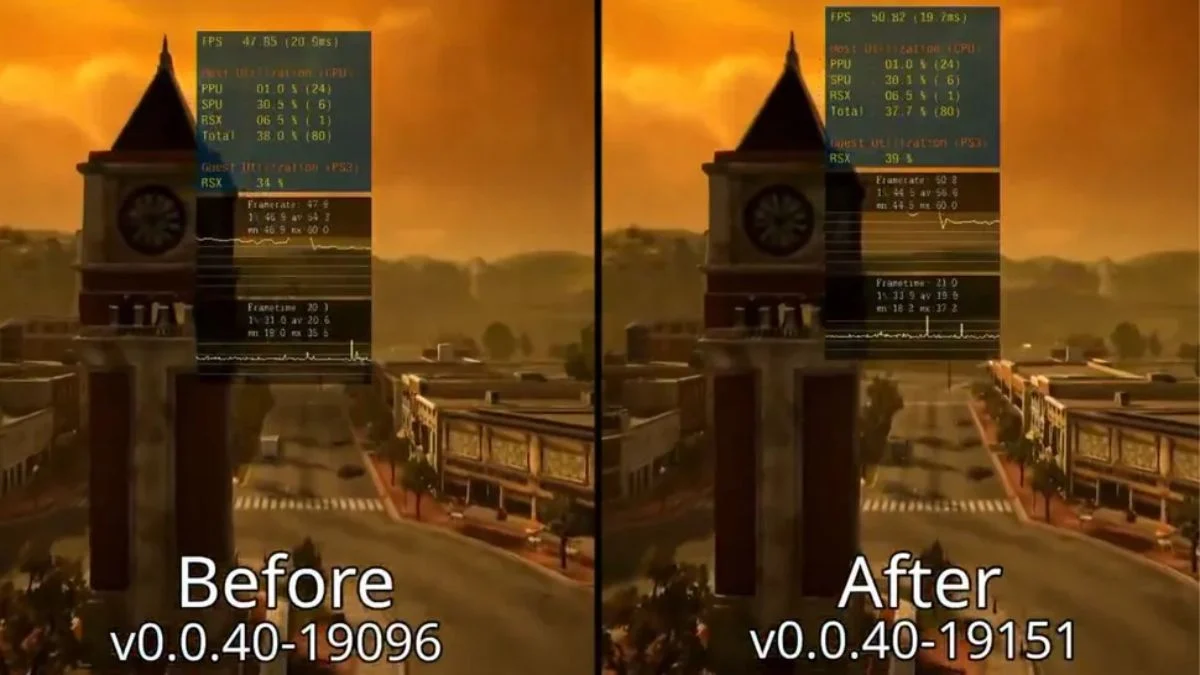
If you have been waiting for PS3 emulation to reach the next level, the RPCS3 team just delivered. The open-source PlayStation 3 emulator officially announced a significant Cell CPU breakthrough on 3 April 2026 via their official X account, confirming a performance improvement that benefits every single game in its library through more efficient code generation. Here is everything you need to know.
What Is RPCS3?
RPCS3 is the world’s leading open-source PlayStation 3 emulator, allowing classic PS3 titles to run on modern PC hardware. It currently supports Windows, Linux, macOS (experimental), and FreeBSD, and added native Arm64 architecture support in late 2024. As of early April 2026, 73.82% of all known PS3 games carry a Playable rating on the platform, a figure that updates daily and can be tracked live on the official RPCS3 compatibility page.
It is worth noting that the Playable rating is a strict standard. Many more games run acceptably well on stronger modern hardware even before reaching that official designation. The percentage climbed from 73.44% in just four days, and RPCS3 only passed the 70% Playable mark in January 2026, which tells you everything about the pace of development right now. With the PlayStation 3 approaching its 20th anniversary this year (the console launched in November 2006), RPCS3 plays an increasingly vital role in preserving one of gaming’s most architecturally complex consoles for future generations.

The Breakthrough: What Actually Changed?
The key improvement came from RPCS3 contributor Elad (known in the codebase as elad335), who discovered previously unrecognised SPU usage patterns within PS3 games. Building on that discovery, Elad wrote new code paths to generate more efficient native PC output from those patterns, reducing CPU overhead across the board for every title. Crucially, this improvement requires no new hardware. Existing setups benefit immediately simply by updating to the latest build.
To understand why this matters, a quick look at the PS3’s Cell Broadband Engine architecture is helpful.
| Component | Role |
| PPU (Power Processing Unit) | Handles main game logic, OS tasks, and coordination |
| SPUs (Synergistic Processing Units) | Handle parallel workloads including physics, animation, audio, and decompression |
| SPU Count Available to Games | Up to 6 (one SPU dedicated to OS functions; Cell was manufactured with 8 but one was typically disabled due to manufacturing tolerances) |
| SPU Register Width | 128-bit, significantly wider than typical modern CPU registers |
| Local Store per SPU | 256KB |
| Recompilation Backends Used | LLVM and ASMJIT |
RPCS3 emulates SPU workloads by recompiling the original Cell instructions into native x86 code. The quality of that translation directly determines how much host CPU time each emulated SPU cycle consumes. Elad’s contribution tightens that translation for newly identified common patterns, producing more efficient machine code for the same workloads and reducing overhead across the entire library.
You can view the official announcement, including before-and-after Twisted Metal footage, directly on the RPCS3 X post from 3 April 2026.
How Much of a Performance Gain Can You Expect?
RPCS3 demonstrated the improvement using Twisted Metal (2012), which the team describes as one of the most SPU-intensive games on the PS3. The results show a 5% to 7% average FPS improvement between builds v0.0.40-19096 and v0.0.40-19151.
In specific captured footage, FPS moves from 47.85 to 52.17 during certain scenes, with SPU usage slightly lower and RSX usage slightly higher, indicating the workload is being handled more efficiently across the hardware. However, it is important to set realistic expectations. Actual gains vary by game. SPU-heavy titles benefit the most, while lighter titles may see smaller improvements. The underlying point is that all games benefit from the more efficient code generation, regardless of the scale of that gain.
| Metric | Detail |
| Games Benefiting | All games in the RPCS3 library |
| Primary Demo Title | Twisted Metal (2012) |
| Average FPS Improvement | 5% to 7% |
| CPU Range Supported | All CPUs, from low-end to high-end |
| Builds Compared | v0.0.40-19096 vs v0.0.40-19151 |
| Announcement Date | 3 April 2026 |
| New Hardware Required | None — existing setups benefit immediately |
Importantly, RPCS3 confirmed that all CPU tiers benefit, not just high-end hardware. A user running a dual-core AMD Athlon 3000G, one of the most budget-tier processors available, reported improved audio rendering and slightly better performance in Gran Turismo 5 after updating.

Why Twisted Metal Was the Test Case
James Stanard (@JamesStanard on X), credited as Principal Engine Developer on the 2012 PS3 version of Twisted Metal, responded directly to RPCS3’s announcement. He confirmed that he wrote approximately 90% of the SPU code for the game, including work that moved post-processing effects entirely off the GPU, effectively pushing the PPU, SPUs, and RSX simultaneously to their limits throughout gameplay. He also said he was proud to see Twisted Metal called out as one of the most SPU-intensive games on the platform, given how hard the team pushed the hardware at the time.
Stanard added that he never expected the PS3 to ever be fully emulatable, which makes the progress RPCS3 is achieving all the more significant. Twisted Metal was developed by Eat Sleep Play and produced by Santa Monica Studio, and having the original engineer publicly validate the benchmark adds real authority to the results.
Key Points From This Update
- Contributor Elad (elad335) discovered new SPU usage patterns and built more efficient x86 code paths from them, benefiting every game in the library
- Twisted Metal (2012) shows a 5% to 7% average FPS improvement, with more stable and consistent framing overall
- Actual gains vary by title: SPU-heavy games benefit most, but all games gain from the more efficient recompilation pipeline
- The update benefits all CPU tiers, from budget dual-core chips like the AMD Athlon 3000G to high-end processors
- No new hardware is required: existing setups benefit immediately by updating to the latest build
- Users have also reported improved audio rendering in titles like Gran Turismo 5 following the update
- In late March 2026, RPCS3 separately added new Arm64 SDOT and UDOT instruction optimisations to accelerate SPU emulation on Apple Silicon Macs and Snapdragon X laptops
- 73.82% of all known PS3 games now carry a Playable rating, tracked live at rpcs3.net/compatibility
- The original Twisted Metal PS3 SPU developer publicly confirmed the technical depth of the work and expressed pride at the recognition on X

Elad’s Track Record of SPU Improvements
This is not the first time Elad has driven meaningful gains in SPU performance on RPCS3. His June 2024 SPU optimisations delivered between 30% and 100% performance improvements on four-core, four-thread CPU configurations. Titles like Demon’s Souls saw doubled frame rates on constrained hardware following that work alone.
In March 2026, RPCS3 also demonstrated over 1,500 FPS on the Minecraft PS3 Edition title screen, a milestone the team used to showcase the efficiency of its recompilation pipeline. The latest Cell CPU breakthrough builds on that foundation and extends gains to the entire library. For detailed technical coverage from hardware media, Tom’s Hardware’s report, VideoCardz’s breakdown, and Overclock3D’s coverage all offer solid additional reading.
What This Means for PS3 Game Preservation
The PlayStation 3 turns 20 years old in 2026, and physical hardware will not remain viable indefinitely. RPCS3 currently lists over 73% of the PS3’s entire game library as Playable, covering major titles like God of War III, The Last of Us, and Gran Turismo 5, alongside cult classics like Twisted Metal.
The rate of progress has been striking. The emulator passed the 70% Playable mark only in January 2026 and already sits at 73.82% as of early April. If the current pace continues, RPCS3 could reach 75% playability within the next few months. For players who want to experience PS3 exclusives that have never received official ports, RPCS3 remains the most reliable and actively maintained path forward.
Key Takeaways
- RPCS3 achieved a Cell CPU breakthrough announced on 3 April 2026 via official X post
- Contributor Elad (elad335) identified new SPU usage patterns and built more efficient PC code paths from them
- Twisted Metal (2012) demonstrates a 5% to 7% average FPS improvement as the primary benchmark example
- Gains vary by title, with SPU-intensive games benefiting most, but all games see improvements from the better recompilation
- The update works across all CPU hardware tiers and requires no new hardware to take effect
- 73.82% of all PS3 games carry a Playable rating as of early April 2026, tracked live at rpcs3.net/compatibility
- RPCS3 supports Windows, Linux, macOS (experimental), and FreeBSD, with native Arm64 support added in late 2024
- The original Twisted Metal PS3 SPU developer publicly confirmed the technical significance of the work on X
- You can download the latest RPCS3 build directly from the official download page at rpcs3.net/download
RPCS3 continues to push forward where Sony itself has not. For anyone sitting on a library of PS3 favourites or looking to experience the console’s best exclusives for the first time, updating to the latest build from rpcs3.net costs nothing and delivers real, measurable gains on every piece of hardware from budget rigs to high-end gaming PCs.


Leave a Reply