

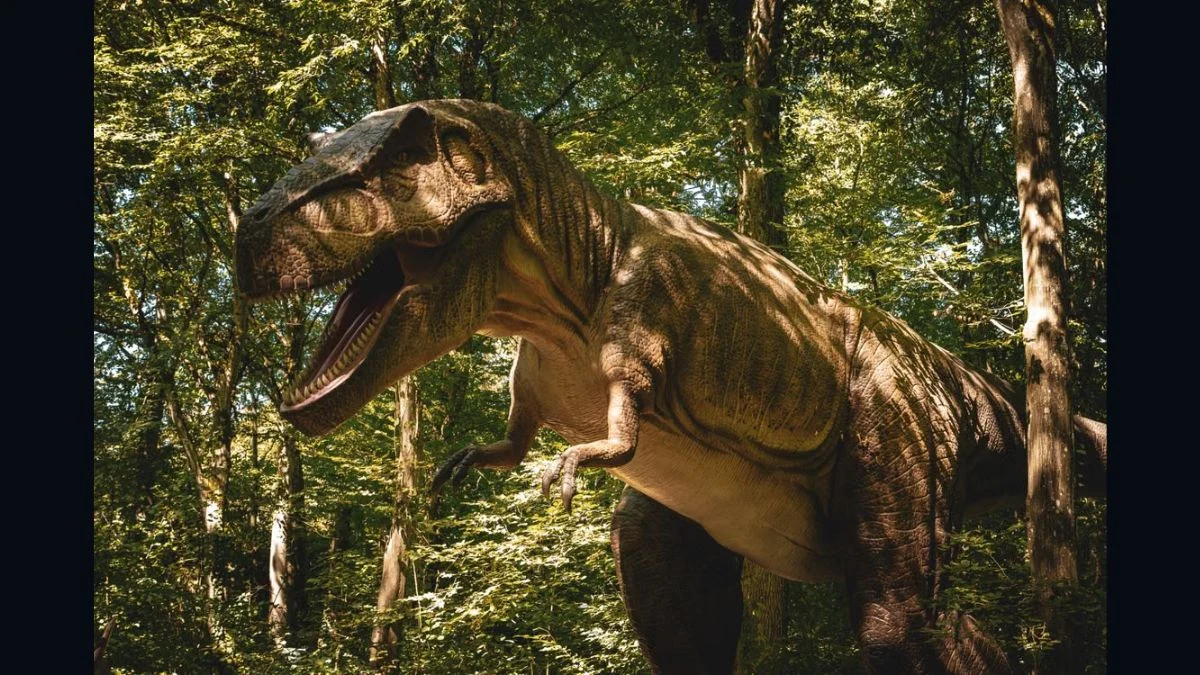
For decades, Alberta’s Late Cretaceous rocks have helped palaeontologists piece together the story of some of the most famous predators ever to walk North America. Now, a newly described tyrannosaur is adding an unexpected twist to that story.
Named Tromerosaurus solumons, the dinosaur comes from Alberta’s Oldman Formation and was formally described in a new study published online in the Journal of Vertebrate Paleontology on October 2, 2026. Its fossils contain an unusual combination of anatomical characteristics, and that combination is making its place on the tyrannosaur family tree surprisingly difficult to pin down.
Rather than providing a simple evolutionary step toward Tyrannosaurus rex, Tromerosaurus appears to highlight just how complicated tyrannosaurid evolution could be.
Meet Tromerosaurus solumons, Alberta’s newly described tyrannosaur
The formal name of the new dinosaur is Tromerosaurus solumons.
The genus name Tromerosaurus comes from Greek and means “frightful lizard” or “terrible lizard.” The species name solumons refers to “lonely mountain,” connecting the scientific name to the dinosaur’s locality and to the fictional Lonely Mountain associated with Smaug in J.R.R. Tolkien’s The Hobbit.
The result is a scientific name that combines the animal’s identity as a tyrannosaur with a literary reference.
Tromerosaurus lived during the Late Cretaceous, specifically during the Campanian portion of the period. According to the study’s stratigraphic interpretation, it dates to roughly 76.7 to 76.3 million years ago.
Its fossils were recovered from Alberta’s Oldman Formation, a fossil-rich geological unit that preserves an important record of Late Cretaceous life in what was then part of the ancient landmass of Laramidia.
Curious How DNA Is Redrawing the Animal Family Tree?
Whole-genome sequencing of 64 gentoo penguins split the gentoo group into four species, including the southeastern gentoo (Pygoscelis kerguelensis) from the Kerguelen Islands, the first penguin species named since 1921. See how the gentoo group was divided in our DNA Reveals a Penguin Hidden in Plain Sight as Scientists Name First New Species in More Than 100 Years report.
Key details at a glance
| Detail | Information |
| Dinosaur | Tromerosaurus solumons |
| Group | Tyrannosaurid |
| Identified lineage | Albertosaurine tyrannosaurid |
| Geological period | Late Cretaceous |
| Stage | Campanian |
| Approximate age | 76.7–76.3 million years ago |
| Formation | Oldman Formation |
| Location | Alberta, Canada |
| Study published online | October 2, 2026 |
| Journal | Journal of Vertebrate Paleontology |
Why Tromerosaurus is more than another Alberta tyrannosaur
At first glance, a new tyrannosaur from Alberta might seem like an addition to an already familiar cast of dinosaurs.
But Tromerosaurus does not fit neatly into that picture.
The researchers found similarities between the new genus and both Gorgosaurus and Daspletosaurus. At the same time, its anatomy includes a distinctive combination of features that separates it from previously named tyrannosaurs.
One particularly notable characteristic is found in the upper jaw, or maxilla. Tromerosaurus has an unusually long opening extending from front to back. The bony ridge toward the front of the maxilla is also narrower than the corresponding feature in Gorgosaurus libratus.
Those and other anatomical characteristics were used by the researchers to distinguish Tromerosaurus from Gorgosaurus and other known tyrannosaurs.
But the story becomes even more interesting when previously identified fossils enter the picture.
Love a Good Wildlife Mystery?
Genomes from 38 Leopardus cats, eight of them museum specimens, showed that South America’s tiger cats form five species, including Leopardus tilcayo, a small spotted cat from Bolivia’s Yungas cloud forest that was formally described in September. Trace the museum-DNA detective work in our Leopardus tilcayo: Scientists Discover a New Wild Cat Species in Bolivia After More Than 100 Years coverage.
Some fossils once called Gorgosaurus can now be reassigned
The discovery does not involve only newly interpreted anatomy.
The researchers’ diagnosis of Tromerosaurus allowed some specimens that had previously been attributed to Gorgosaurus to be reassigned to the new genus.
That is a significant part of palaeontological research. A new dinosaur does not always appear as a completely unknown skeleton discovered for the first time. Sometimes, fossils that have been sitting in collections or assigned to an existing species are examined again as researchers gain new anatomical evidence.
In this case, anatomical comparisons and stratigraphic information helped distinguish Tromerosaurus from Gorgosaurus.
That means the study potentially changes how some existing fossils from Alberta are interpreted, while also adding another layer to the known diversity of Late Cretaceous tyrannosaurs.
The biggest mystery is where Tromerosaurus belongs
The most intriguing part of the new study may not be the dinosaur’s name, its jaw, or even the reassignment of fossils.
It is the question of where Tromerosaurus actually sits on the tyrannosaur family tree.
Tyrannosauridae contains two major lineages commonly discussed in the Late Cretaceous of North America: Albertosaurinae and Tyrannosaurinae.
Albertosaurinae includes Albertosaurus and Gorgosaurus. Tyrannosaurinae includes more robust animals such as Daspletosaurus and, ultimately, Tyrannosaurus.
Tromerosaurus carries characteristics that make its position between these major evolutionary groupings less straightforward.
And different analytical methods produced different answers.
Two phylogenetic methods, two different placements
The study’s phylogenetic analysis using parsimony recovered Tromerosaurus as the earliest-diverging member of Albertosaurinae.
However, the Bayesian analysis produced a different result. It instead recovered the dinosaur near the base of Tyrannosaurinae.
That difference is central to the study.
Rather than presenting the exact placement of Tromerosaurus as settled, the researchers emphasize the uncertainty created by the different phylogenetic approaches.
The result suggests that the evolutionary split between the major tyrannosaurid lineages may have involved a relatively rapid acquisition of different anatomical features rather than a simple, clearly traceable progression from one group into another.
A mixture of albertosaurine and tyrannosaurine characteristics
The anatomy of Tromerosaurus helps explain why its position is so difficult to resolve.
The researchers describe the dinosaur as possessing an unusual mixture of characteristics. Some features resemble the more gracile albertosaurines, while others resemble characteristics associated with the more robust tyrannosaurines.
That combination is important because evolutionary relationships cannot always be determined from one anatomical feature or from a straightforward visual comparison.
The title of the scientific study captures the problem directly:
“A new albertosaurine from the Oldman Formation, Alberta, Canada, illuminates ambiguity between albertosaurine and tyrannosaurine characteristics.”
The researchers use Tromerosaurus to examine that ambiguity and what it may reveal about the early evolutionary history of tyrannosaurids.
Tromerosaurus and Gorgosaurus may have lived at the same time
There is another detail that makes the discovery especially relevant to the history of tyrannosaurs in Alberta.
The researchers identified stratigraphic overlap between Tromerosaurus and Gorgosaurus libratus.
In practical terms, the geological evidence indicates that the two animals existed during overlapping periods rather than representing a simple sequence in which one species completely replaced the other.
That matters because tyrannosaur evolution has sometimes been discussed through the idea of chronospecies or relatively straightforward replacement through time.
The evidence surrounding Tromerosaurus instead contributes to a more complicated picture.
Several tyrannosaur species could coexist within the broader ecosystems of ancient Laramidia, potentially occupying different ecological roles or niches despite living in the same general region.
The study therefore adds to evidence that the evolution of these predators was not necessarily a clean succession of one dominant species followed by another.
What Alberta’s Oldman Formation reveals about ancient Laramidia
The Oldman Formation is part of an exceptionally important fossil record from the Late Cretaceous.
During this period, the western part of North America formed the landmass known as Laramidia, while the Western Interior Seaway divided much of North America.
The Oldman Formation preserves remains from a wide range of dinosaurs and other organisms, giving palaeontologists an unusually detailed window into the ecosystems that existed during the Campanian stage.
The discovery of Tromerosaurus adds another predator to that fossil record.
More importantly, it demonstrates that even familiar dinosaur groups can still produce new species and unexpected evolutionary relationships.
The new tyrannosaur therefore contributes not only to the list of dinosaurs known from Alberta, but also to the broader effort to understand how tyrannosaur diversity developed during the Late Cretaceous.
Tromerosaurus is not simply a “missing link”
It would be tempting to describe the new dinosaur as a straightforward missing link between familiar tyrannosaurs such as Gorgosaurus and Daspletosaurus.
But that would go beyond what the study establishes.
The researchers do not present Tromerosaurus as a definitive missing link between those animals.
Instead, its significance comes from the combination of traits it possesses and the uncertainty produced by different phylogenetic methods.
Its position appears important near the early divergence of major tyrannosaurid lineages, but the precise placement remains sensitive to the analytical method used.
That distinction is crucial.
Rather than solving the tyrannosaur family tree with one definitive branch, Tromerosaurus provides evidence that the evolutionary history may have been considerably more complicated.
A new dinosaur that raises a much bigger evolutionary question
Taken together, the findings surrounding Tromerosaurus solumons point toward a dynamic period in tyrannosaur evolution.
The dinosaur lived approximately 76.7 to 76.3 million years ago in what is now Alberta. Its fossils come from the Oldman Formation and show an unusual combination of anatomical characteristics.
Its upper jaw includes an unusually long opening extending from front to back, while the bony ridge toward the front of the maxilla is narrower than in Gorgosaurus libratus. These and other features helped distinguish the new genus.
Some fossils previously attributed to Gorgosaurus can also now be referred to Tromerosaurus.
At the same time, the new dinosaur’s relationship to the two major tyrannosaurid lineages remains uncertain. Parsimony analysis recovered it as the earliest-diverging member of Albertosaurinae, while Bayesian analysis placed it near the base of Tyrannosaurinae.
That difference is not a minor technical detail. It is part of what makes the discovery scientifically important.
Conclusion: Another piece of the tyrannosaur puzzle
Tromerosaurus solumons may have a new name, but its biggest contribution is the evolutionary question it raises.
Its combination of albertosaurine and tyrannosaurine characteristics, its stratigraphic overlap with Gorgosaurus libratus, and the reassignment of some fossils previously identified as Gorgosaurus all add complexity to the Late Cretaceous tyrannosaur record of Alberta.
The study does not establish a simple evolutionary bridge toward Tyrannosaurus rex. Instead, it provides another piece of evidence that major tyrannosaurid characteristics may have emerged and changed relatively quickly, making the early history of these famous predators harder to reconstruct than a simple march from one species to another.
For palaeontologists investigating how the tyrannosaur family eventually produced animals such as Tyrannosaurus rex, Tromerosaurus solumons offers another valuable piece of the puzzle.
Following Rare Primate Discoveries?
Formally described in July, the Likweli (Colobus congoensis) is a black-furred monkey from the Democratic Republic of the Congo, identified through years of field observations, DNA and knowledge from 52 villages, with scientists proposing an Endangered listing. Meet the primate and the communities who knew it in our New African Monkey Species Hid in Plain Sight for Years? Meet Colobus congoensis (Likweli), the Rare Primate Just Discovered in the Congo post.
Source and research disclaimer
This article has been prepared based on thorough research of the sources provided with the original material, including the Journal of Vertebrate Paleontology study, its DOI record, and the cited reporting and dinosaur reference sources. It reflects the information available from those sources as provided and should not be understood as independent verification beyond that material. Tromerosaurus solumons is a newly described dinosaur, and its exact position within Tyrannosauridae remains subject to interpretation because different phylogenetic methods produced different placements.
Sources
- Journal of Vertebrate Paleontology: “A new albertosaurine from the Oldman Formation, Alberta, Canada, illuminates ambiguity between albertosaurine and tyrannosaurine characteristics”
- DOI record for the scientific paper
- Dexerto: New tyrannosaur species identified by palaeontologists in Canada
- RTP: Tromerosaurus solumons and the new Canadian tyrannosaur discovery
- Total Dino: Tromerosaurus
Featured Image Credit: Antonio Mistretta via Pexels


Leave a Reply