

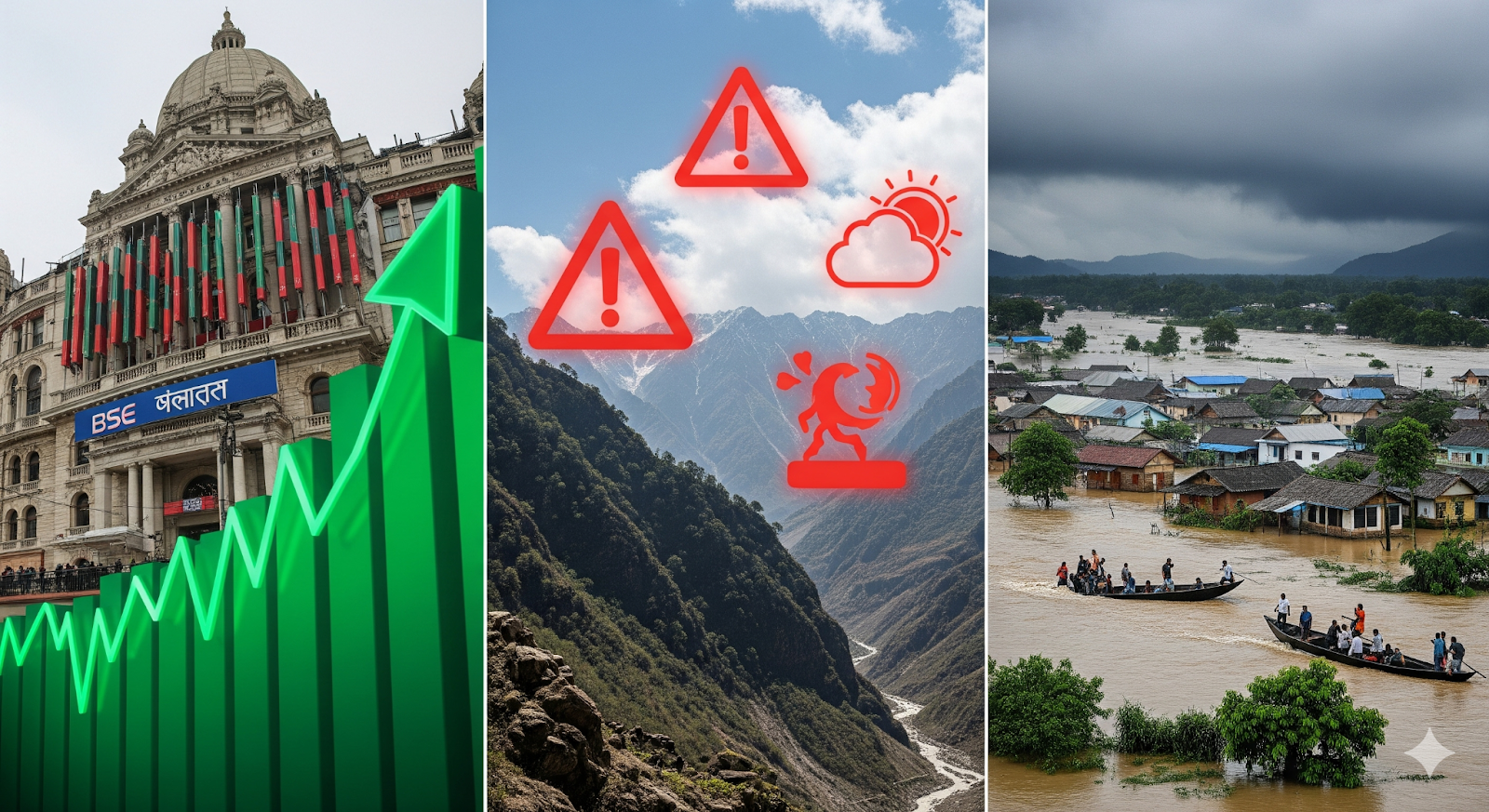
Highlights:
1. Dehradun & Uttarakhand — Red Alert, Cloudburst, Flooding
a) Rainfall and Weather Data
- Dehradun experienced a cloudburst on the night of Sep 15–16, which triggered flash floods and landslides, particularly affecting the Sahastradhara area.
- Sahastradhara recorded 264 mm of rain within 24 hours, surpassing the previous September record of 212.6 mm (set in 1924).
- Other rainfall figures in the region:
- Thal: ~130 mm
- Kathgodam: ~134 mm
- Nainital: ~123 mm
- Mussoorie: ~95 mm
- Rishikesh: ~66.4 mm
- Uttarkashi: ~66.2 mm
- IMD’s warning for Dehradun predicted very heavy rain, with downpours exceeding 15 mm per hour, accompanied by thunderstorms and gusty winds (62–87 km/h).
- According to IMD’s local forecast for Dehradun, the risk included overflow of rivulets and streams, inundation in low-lying areas, and isolated damage due to lightning or flooding.
b) Human and Infrastructure Impacts
- As many as 13 deaths have been confirmed in Dehradun alone, and 15 across Uttarakhand in connection with the cloudburst and landslides during this event.
- At least two major bridges collapsed — one on the Dehradun–Vikasnagar National Highway and another at Nanda Ki Chowki / Prem Nagar — cutting off transport links and isolating areas.
- The Tamsa river swelled dramatically, inundating areas such as Tapkeshwar Mahadev temple, causing damage to the temple’s premises and prompting warnings against going near riverbanks.
- Local authorities ordered the closure of all schools and Anganwadi centres up to Class 12 in Dehradun (and some adjoining districts) as a precaution.
c) Forecast and Warnings
- The red alert was issued for Dehradun, Tehri Garhwal, Champawat, and Udham Singh Nagar, with warnings that extremely heavy rainfall, landslides, and infrastructure collapse could continue through September 20.
- IMD also flagged a flash flood risk in several Uttarakhand districts (Almora, Bageshwar, Chamoli, Champawat, Dehradun, Nainital, Pauri Garhwal, Pithoragarh, Rudraprayag, Tehri, and Uttarkashi).
2. Flooding in Manipur and Assam
While detailed rainfall figures for September 17 are less readily available, here are the key developments:
a) Manipur
- Torrential rains in the Imphal Valley have caused rivers to breach banks, flash floods, and landslides, isolating several villages.
- The Jawaharlal Nehru Institute of Medical Sciences (JNIMS) in Imphal was evacuated due to rising water levels and flood risk, affecting patient care.
- Relief operations are active, though the floods have aggravated existing humanitarian challenges, especially in light of ethnic tensions in the area.
b) Assam
- In the second wave of flooding, 2 deaths were reported and roughly 22,000 people were directly affected by inundation, displacement, or loss of livelihood.
- Rescue efforts and relief camps are underway in affected districts, as water levels remain high in many areas.
2. Markets & Economy
a. Stock markets rally on trade optimism and Fed hopes
Indian stock indexes opened higher on September 17, with the Nifty 50 and BSE Sensex posting gains driven by positive sentiment from U.S.–India trade talks and expectations of a Fed rate cut.
Sectoral gains were broad-based: eleven of the sixteen major sectors rose, with small-cap and mid-cap stocks gaining 0.5% and 0.2%, respectively.
Notable movers included Mahindra Lifespaces (up ~4.4%), Premier Explosives (up ~7.1%), and Bharat Electronics (up ~2%), which saw gains on company updates and order announcements.
b. Rupee gains ground on dollar weakness and trade deal hopes
The Indian rupee strengthened to ₹87.73 per U.S. dollar, its best in over two weeks, buoyed by a weaker U.S. dollar and optimism around progress in trade negotiations with the U.S.
Earlier in the day, it had opened around ₹87.82, rising approximately 23 paise, reflecting investor repositioning ahead of the Fed’s policy decision.
Analysts are watching closely whether the Fed will deliver a 25 basis point cut, or possibly a larger 50 bps move, and how that might affect the dollar’s trajectory and currency markets.
3. Politics & Governance
Rajasthan SEC change sparks debate
Retired IAS officer Rajeshwar Singh has been appointed as Rajasthan’s new Chief State Election Commissioner by Governor Haribhau Bagde, succeeding Madhukar Gupta whose term ended upon reaching age 65.
The appointment comes amidst controversy over Gupta’s term and earlier disputes related to municipal election timelines. Gupta’s resignation (or completion of term) took place against a backdrop of disagreement with the state government—particularly over the scheduling of local polls—leading to public friction between him and the Urban Development minister. Some BJP leaders reportedly viewed Gupta’s proposals as challenging the state’s political timetable.
4. Prime Minister Modi’s 75th Birthday and Public Outreach
Sewa Pakhwada & welfare push
Prime Minister Narendra Modi turns 75 on September 17, and the BJP has launched a large-scale outreach campaign titled “Sewa Pakhwada” (service fortnight), running from
September 19 to October 2. The initiative will include health camps, cleanliness drives, public fairs, Indigenous product exhibitions, and awareness programs aimed at grassroots engagement.
In Madhya Pradesh’s Dhar, Modi is expected to inaugurate the “Swasth Nari Sashakt Parivar” initiative and launch the eighth National Nutrition Month.
Uttar Pradesh’s planting spree
As part of Modi’s birthday, Uttar Pradesh has rolled out a tree-planting campaign titled “Seva Parv”, which will run from September 17 to October 2. On the first day, 100 saplings are set to be planted in each of the 34 Nagar Van (urban forest) sites. The total target for the state is 15 lakh saplings, with allocations for planting in degraded forest areas and river rejuvenation zones.
These efforts are geo-tagged and documented via the MeriLIFE portal.
5. Security & Counter-terrorism
ISIS module busts in India
Indian investigative agencies have uncovered two pan-India ISIS modules allegedly planning attacks on religious sites and targeted killings. The investigations revealed digital evidence pointing to links with Pakistani terrorist operatives, and plans connected to the “Khilafat” model and Ghazwa-e-Hind.
Authorities say both modules were working toward ideological models involving territorial occupation followed by militant “jihadi” campaigns, with one module allegedly involved in plot material procurement, including chemical bomb-making materials.
6. Urban Challenges & Public Infrastructure
Bengaluru’s growing pains: civic concerns
Biocon chairperson Kiran Mazumdar-Shaw has sounded the alarm over Bengaluru’s infrastructure, writing in a social media post that the city’s growth as an IT hub is bringing mounting civic challenges, including crumbling roads, traffic congestion, and sanitation issues. She has called on state authorities, including Karnataka’s Chief Minister D.K. Shivakumar, to institute “emergency measures” to address these problems.
More Trending News:

Leave a Reply