
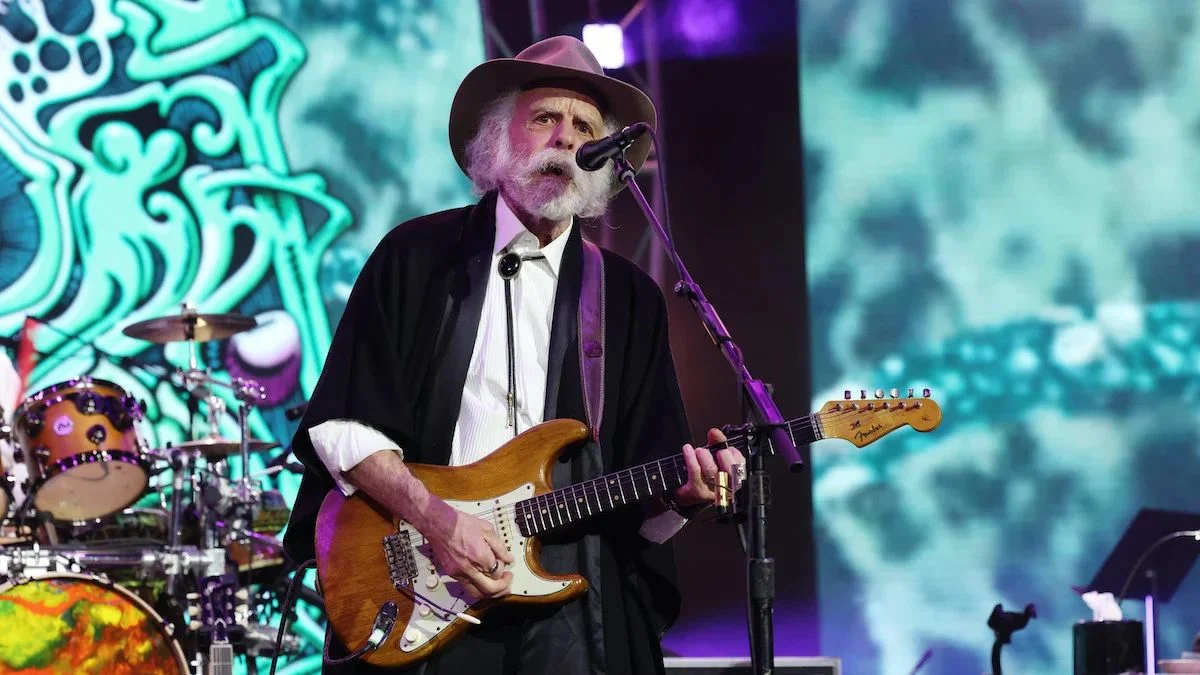
Bob Weir, the legendary guitarist, singer, and co-founder of the Grateful Dead, passed away on January 10, 2026, at the age of 78. Revered as one of the most influential figures in American rock history, Weir’s death marked the end of a monumental chapter in music defined by improvisation, counterculture, and an unbreakable bond with generations of fans known as Deadheads.
His family confirmed that Weir died peacefully, surrounded by loved ones, after succumbing to underlying lung issues following a recent battle with cancer. The announcement was shared via his official website and social media platforms, including Instagram, prompting an immediate outpouring of tributes from across the music world.
Bob Weir Early Life and Childhood in California
Born Robert Hall Weir on October 16, 1947, in San Francisco, California, Bob Weir was adopted as an infant by affluent parents Frederic Utter Weir and Eleanor Cramer Weir. He was raised in the suburban community of Atherton, California, a setting far removed from the psychedelic revolution he would later help define.
Weir struggled throughout his youth with undiagnosed dyslexia, which led to academic difficulties and expulsions from several schools, including Menlo School in Atherton and Fountain Valley School in Colorado. Despite these challenges, his time at Fountain Valley proved pivotal, as he befriended John Perry Barlow, who would later become one of the Grateful Dead’s most influential lyricists.
Music became Weir’s refuge. Although he initially experimented with piano and trumpet, he found his true calling in string instruments, beginning guitar at the age of 13.

Meeting Jerry Garcia and the Birth of the Grateful Dead

Weir’s life changed forever on New Year’s Eve 1964, when the 16-year-old met Jerry Garcia at a music store in Palo Alto, California. The encounter sparked a creative partnership that would alter the course of rock music.
The duo formed Mother McCree’s Uptown Jug Champions, which soon evolved into the Warlocks, and by 1965, became the Grateful Dead. As the band’s rhythm guitarist and co-lead vocalist, Weir played a crucial role in shaping their genre-defying sound, blending rock, folk, country, jazz, and psychedelia.
Bob Weir’s Musical Evolution and Signature Sound
Weir became known for handling many of the band’s rock & roll and country-western covers, as well as co-writing iconic originals such as “Sugar Magnolia,” “Playing in the Band,” and “Truckin’.”
In 1968, the band briefly sidelined Weir and keyboardist Ron “Pigpen” McKernan, citing perceived musical limitations. Rather than falter, Weir returned reinvigorated, immersing himself in influences ranging from McCoy Tyner and John Coltrane to Rev. Gary Davis and Igor Stravinsky. By the late 1970s, he further expanded his sound by incorporating slide guitar techniques, cementing his reputation as one of rock’s most innovative rhythm guitarists.
Grateful Dead Legacy, Deadheads, and Major Honors
The Grateful Dead became synonymous with the American counterculture movement, celebrated for their extended improvisational jams and fiercely loyal fanbase, the Deadheads. In recognition of their cultural impact, the band was inducted into the Rock and Roll Hall of Fame in 1994.
Decades later, Weir received one of the highest honors of his life: a Kennedy Center Honor in 2024, acknowledging his profound contributions to American music and culture.
Life After Jerry Garcia and Post-Grateful Dead Projects
Following Jerry Garcia’s death in 1995, the Grateful Dead disbanded, but Weir’s musical journey was far from over. He continued performing with various offshoots and bands, including Kingfish, The Other Ones (later The Dead), the Bob Weir Band, and Bobby and the Midnites.
In the mid-1990s, Weir formed RatDog, which toured extensively until 2014. He later co-led Furthur with bassist Phil Lesh from 2009 to 2014.
Dead & Company, Sphere Residency, and Final Performances
In 2015, Weir joined Dead & Company alongside Mickey Hart, Bill Kreutzmann, John Mayer, Oteil Burbridge, and Jeff Chimenti. The group toured extensively through their “final” tour in 2023, followed by a groundbreaking residency at the Sphere in Las Vegas, beginning in May 2024 and extended through August 2024.
Additional projects included Weir, Wasserman, and Lane, the Weir, Robinson, & Greene Acoustic Trio, and Bob Weir and Wolf Bros, who collaborated with symphonies from 2022 to 2025. He also curated the Dead Ahead Festival in Cancún, Mexico, in 2024 and 2025.

Solo Career, Awards, and Creative Ventures
Weir’s solo discography included Ace (1972), Heaven Help the Fool (1978), Weir Here – The Best of Bob Weir (2004), and Blue Mountain (2016). Blue Mountain marked his first solo album in over 30 years and peaked at No. 14 on the Billboard Folk Albums chart.
In 2016, Weir received both the Les Paul Spirit Award and a Lifetime Achievement Award at the Americana Honors & Awards. Earlier, in 2011, he founded TRI Studios in San Rafael, California, pioneering high-definition livestreaming of concerts.
Bob Weir Personal Life, Activism, and Health Struggles
Weir was in a long-term relationship with Frankie Hart (Frances Azzara) from 1969 to 1975, widely believed to have inspired “Sugar Magnolia.” He later married dancer Natascha Münter in 1999, and they had two daughters, Shala Monet Weir and Chloe Kaelia Weir.
A committed vegetarian and animal-rights advocate, Weir co-founded Farm Sanctuary in 1986 and supported numerous philanthropic organizations. Despite facing health challenges and onstage collapses during Furthur tours in 2013, he returned to performing.
In July 2025, Weir was diagnosed with cancer, which he reportedly overcame before ultimately passing due to underlying lung complications.
Bob Weir Death and Lasting Legacy
Bob Weir’s death on January 10, 2026, prompted tributes from figures such as Andy Cohen and Don Felder, celebrating a life that reshaped live music and improvisational rock.
As a pioneer of psychedelic rock, a fearless innovator, and a cultural icon, Bob Weir’s influence continues to resonate. His music, spirit, and commitment to artistic freedom ensure that his legacy will endure for generations to come.
More Latest Stories:


Leave a Reply