

हिंदी में पढ़ें: रोनाल्ड डो की भूत-निकासी: वह भयानक सच्ची कहानी जिसने “द एक्सॉर्सिस्ट” को प्रेरित किया
In the winter of 1949, a quiet residential street in St. Louis, Missouri, would become the epicenter of one of America’s most documented and controversial cases of demonic possession. What began as unexplained disturbances in a Maryland home would evolve into a months-long battle between good and evil that would eventually inspire one of the most terrifying films ever made.
The Innocent Beginning
Ronald Edwin Hunkeler, born in 1935 in Cottage City, Maryland, seemed like any ordinary child growing up in a devout German Lutheran household. An only child in a world of adults, young Ronald often found himself seeking companionship and entertainment from his elders. Little did anyone know that this longing for connection would lead him down a path that would forever change his life—and challenge the very foundations of faith and reason.

The boy’s Aunt Harriet (also known as Aunt Tillie) was a woman fascinated by the supernatural. A practitioner of spiritualism, she introduced her impressionable nephew to the mysterious world of Ouija boards and spirit communication. What began as innocent curiosity would soon unleash forces that defied explanation.

Might Interest You:
The Impossible Files: When Children Remember Lives They Never Lived
When Death Opened Dark Doors
The first signs of trouble emerged following Aunt Harriet’s death in early 1949. It was as if her passing had torn open a veil between worlds, allowing something malevolent to seep through. The Hunkeler family home in Cottage City began experiencing phenomena that would make even the most skeptical observer question the nature of reality.

Scratching sounds echoed through the walls at night, as if invisible claws were desperately trying to break free from within the house itself. Objects moved without explanation, defying the laws of physics. Most disturbing of all, Ronald’s bed would shake violently, sometimes throwing the terrified boy across the room.
“The scratching sounds were so real, so persistent, that the family searched every inch of the house for rodents or other explanations,” one witness later recalled.
The Manifestations Intensify
As days turned into weeks, the paranormal activity escalated with frightening intensity. Ronald’s body began bearing the marks of an unseen tormentor—mysterious scratches appeared on his skin, forming patterns that seemed almost deliberate, almost intelligent. The 14-year-old boy would slip into trance-like states, his personality completely transforming.

During these episodes, Ronald would exhibit violent outbursts that were completely out of character. His voice would change, becoming deep and guttural, speaking words that no child should know. He displayed an inexplicable aversion to religious objects, recoiling from crosses and holy water as if they caused him physical pain.
Seeking Help from the Divine
Desperate and terrified, the Hunkeler family first sought help from medical professionals and psychiatrists, but no earthly explanation could account for what they were witnessing. In their desperation, they turned to their Lutheran minister, Reverend Luther Miles Schulze.

Reverend Schulze was a man of faith, but what he witnessed in the Hunkeler home challenged everything he believed about the natural world. According to newspaper reports from 1949, a total of “forty-eight people witnessed this exorcism”, suggesting that the events were far from private family matters.
Recognizing that this case required expertise beyond his denomination, Reverend Schulze made the difficult decision to refer the family to the Catholic Church. He contacted Jesuit priests, knowing that the Catholic tradition had more experience with such supernatural phenomena.
The Battle in St. Louis
The family’s journey led them to St. Louis, Missouri, where they would encounter Father William S. Bowdern of Saint Louis University. Father Bowdern was assisted in the exorcism by fellow Jesuit priest Walter Halloran, and together they would wage a spiritual battle that would last for months.

The exorcists witnessed scratching on the boy’s body and the mattress moving violently at the residence on Roanoke Drive in early March of 1949. These were the same terrifying phenomena that had plagued the family in Maryland, but now they seemed to intensify in the presence of the holy men.
The exorcism rituals were grueling affairs that tested the limits of human endurance. Prayers were recited for hours, holy relics were employed, and the priests attempted to expel what they believed to be a demonic entity from the boy’s body. Ronald would thrash violently, his strength seemingly superhuman, requiring multiple adults to restrain him.

The Climactic Confrontation
On April 18, 1949, a St. Louis University priest completed an exorcism after hearing a diabolical laugh that froze his blood. This final confrontation would mark the turning point in the case.
According to witnesses, Ronald experienced a vision of St. Michael the Archangel, the warrior saint who battles demons. In this vision, the archangel appeared to drive away the malevolent entity that had tormented the boy for months. Ronald reportedly declared that the entity was gone, and the supernatural phenomena that had plagued him ceased immediately.
The Aftermath and Questions
Following the successful exorcism, Ronald Hunkeler returned to what appeared to be a normal life. He eventually married, had children, and lived quietly away from the public eye. The boy at the centre of the story was later revealed to be Ronald Edwin Hunkeler, a 13-year-old from Cottage City, Maryland, though his identity remained protected for decades.
The case would later inspire William Peter Blatty to write his novel “The Exorcist” in 1971, which was adapted into the terrifying film in 1973. Author William Peter Blatty contacted Bowdern as part of his research for his novel The Exorcist, ensuring that the story would reach a worldwide audience.
The Skeptical Perspective
Not everyone accepts the supernatural explanation for the events surrounding Roland Doe. Some researchers and skeptics have proposed alternative theories:
- Mental health issues: Some experts believe Ronald may have been suffering from undiagnosed psychological conditions
- Elaborate hoax: Others suggest that the boy may have been a disturbed child who enjoyed manipulating the adults around him
- Suggestive influence: The power of suggestion and group hysteria may have played a role in escalating the reported phenomena
The Ouija board connection has also been questioned, with some investigators suggesting that this element may have been added later to provide a convenient explanation for the events.
The Legacy of Terror
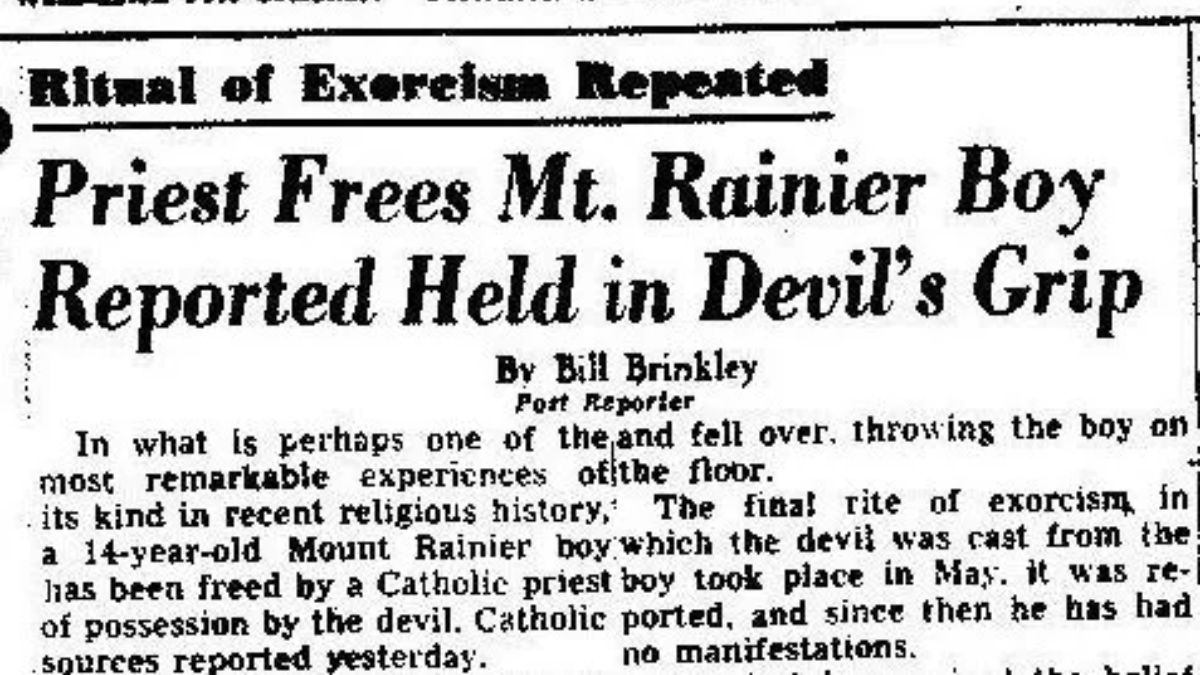
Whether one believes in the supernatural aspects of the case or not, the Exorcism of Roland Doe remains one of the most thoroughly documented cases of alleged demonic possession in American history. In 1949, several newspapers across America, including The Washington Post, released an unsettling, anonymous report that detailed the alleged demonic possession of a 14-year-old boy.
The case continues to fascinate and terrify people more than seven decades later. It raises profound questions about the nature of evil, the power of faith, and the mysteries that still lurk in the shadows of our understanding.
What truly happened to Ronald Edwin Hunkeler in those dark months of 1949? Was he the victim of genuine supernatural forces, or was there a more earthly explanation for the terror that gripped his family and the witnesses who observed the exorcism?
The answer may forever remain in the realm of the unknown, leaving us to wonder what other dark secrets might be hiding in the quiet suburban homes around us, waiting for the right moment to reveal themselves.
References
- Wikipedia Contributors. “Exorcism of Roland Doe.” Wikipedia, May 24, 2025. https://en.wikipedia.org/wiki/Exorcism_of_Roland_Doe
- “Inside The Harrowing Exorcism Of Roland Doe, The True Story Behind ‘The Exorcist’.” All That’s Interesting, December 12, 2024. https://allthatsinteresting.com/roland-doe-the-exorcist-true-story
- “Boy Whose Case Inspired ‘The Exorcist’ Is Identified After 72 Years.” Inside Edition, December 21, 2021. https://www.insideedition.com/boy-whose-case-inspired-the-exorcist-is-identified-over-70-years-later-72075
- Wikipedia Contributors. “William S. Bowdern.” Wikipedia, September 26, 2024. https://en.wikipedia.org/wiki/William_S._Bowdern
- “The St. Louis exorcism of 1949: the real-life inspiration for ‘The Exorcist’.” St. Louis Post-Dispatch, October 14, 2023. https://www.stltoday.com/news/archives/the-st-louis-exorcism-of-1949-the-real-life-inspiration-for-the-exorcist/article_fbdecb6a-9d3c-5903-a12c-effd4f7a7713.html
- “The Real Story Behind The Exorcist: The Strange Case of Ronald Hunkeler.” Danny Dutch, June 1, 2025. https://www.dannydutch.com/post/the-real-story-behind-the-exorcist-the-strange-case-of-ronald-hunkeler
- “History Uncovered: Roland Doe And The True Story Of ‘The Exorcist’.” All That’s Interesting, November 16, 2023. https://allthatsinteresting.com/history-uncovered/roland-doe
- “SLU Legends and Lore: The 1949 St. Louis Exorcism.” Saint Louis University. https://www.slu.edu/news/legends-and-lore/st-louis-exorcism.php




Leave a Reply