
In a world where justice is a performance and peace is painted in blood, some words never stop echoing…
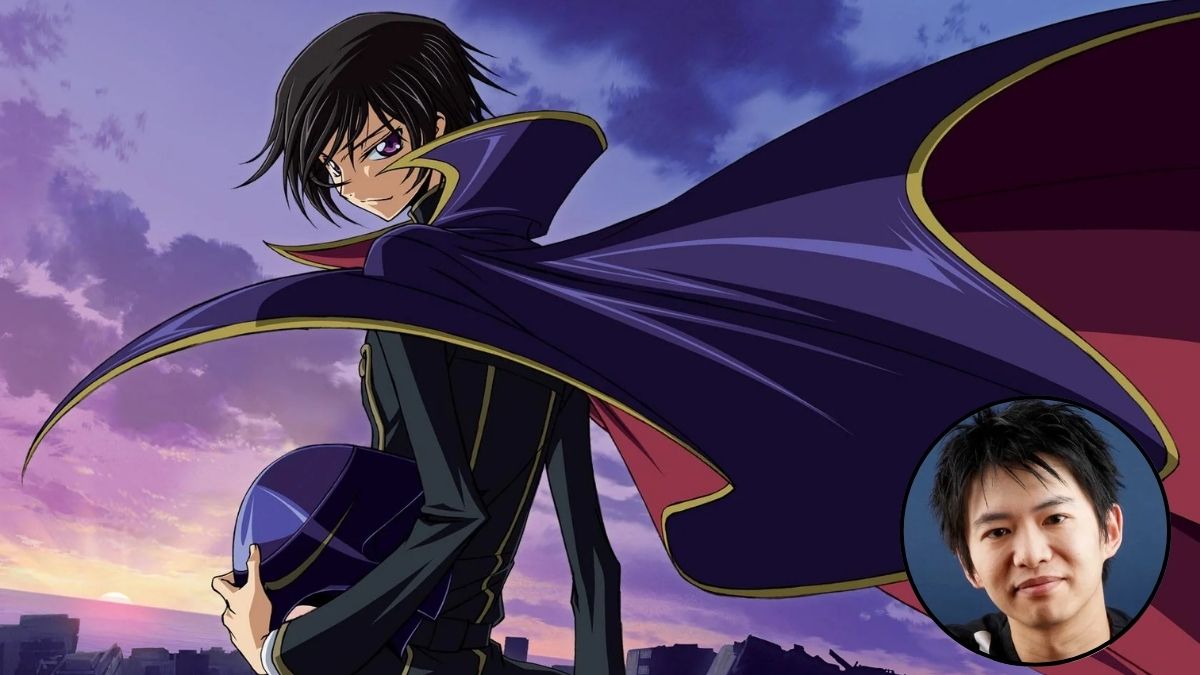
We’ve all felt it, haven’t we? That moment when we realize the world isn’t as simple as heroes and villains. When we discover that sometimes, the people fighting for justice must become the very thing they hate. Ichirō Ōkouchi (Writer, Code Geass) understood this human paradox. The way hope and despair dance together, how love can drive us to unthinkable cruelty, how the price of change is often paid with pieces of our own soul.
When Ōkouchi penned the story of Code Geass, he didn’t just craft a tale of war, rebellion, and masked revolutions; he imprinted layers of philosophy, justice, grief, and moral complexity into its core. Known for his powerful writing in series like Guilty Crown, Devilman Crybaby, and Mobile Suit Gundam: The Witch from Mercury, Ōkouchi has long been a weaver of emotionally charged narratives and ideological clashes. But in Code Geass, he did something extraordinary.
He gave birth to a world where the lines between good and evil blur dangerously. Where every decision bleeds consequence. Where a chessboard of empires and emotions is dominated not by a savior but by a flawed anti-hero whose darkness mirrors the very real shadows of our own society.
And perhaps that’s why Code Geass still endures. It speaks not to fantasy, but to reality—through the cries of war, the silence of sacrifice, and the unrelenting pursuit of change.
Code Geass: More Than Just a Mecha Show
Over a decade later, Code Geass remains more than a cult classic. It is a cultural philosophy cloaked in anime. While many shows glorify heroism, Code Geass introduced us to Lelouch vi Britannia, a young man with noble ideals and monstrous methods. He wasn’t just a character; he was a question:
What would you be willing to sacrifice to change the world?
In Lelouch’s journey, the anime community found an icon. A symbol of rebellion against oppressive systems. A face of flawed hope. His words crafted with poetic precision still ignite debates, reflections, and even real-world parallels.
In this same spirit, let’s revisit 8 quotes from Code Geass that continue to echo in our hearts and minds even today…
1. The Color of Snow

“Do you know why snow is white? Because it has forgotten what color it once was.”
– C.C
There is a quiet sadness in this line, like the hush that falls just before snowfall. It’s not only about memory. It’s about losing the very shape of who we once were. When C.C. speaks these words, it’s not from bitterness but from a place of stillness, from having lived long enough to watch her identity fade into myth and silence.
And somehow, we understand it too. We wear different faces for different rooms. We bend ourselves to meet expectations, to survive, and to be loved. Over time, we begin to forget the sound of our own voice, the color of our own truth. Bit by bit, the person we were becomes distant, like a childhood photo we barely recognize.
2. If Happiness Had a Physical Form

“We wondered what happiness would look like if we could give it a physical form. If I’m not mistray, it was Suzaku who said that the shape of happiness might resemble glass. His reasoning made sense, he said that even though you don’t usually notice it, it’s still definitely there, you merely have to change your point of view slightly and then that glass will sparkle when it reflects the light. I doubt that anything can argue its own existence more elegantly.”
– Lelouch
This quote is not just a reflection on happiness; it is a memory. A quiet echo from a time when things were simpler when Lelouch and Suzaku were still boys dreaming of a kinder world. At this moment, Lelouch is not strategizing. He is not hiding behind Zero’s mask.
He is remembering.
And not just anyone. He is remembering Suzaku, his childhood friend, his rival, his mirror. Someone who once stood beside him when the world still felt full of possibilities. Before betrayal. Before war. Before their ideals pushed them to opposite ends of the same battlefield.
And perhaps, in remembering Suzaku’s words, Lelouch is also trying to remember who he used to be. Someone who could still see happiness. Someone who believed it existed, even if only as a glimmer.
The Brutal Reality: We often spend so much time chasing happiness that we step right through it, shattering the very thing we’re trying to grasp.
3. The Weight of Hollow Existence

“Ever since that day, I have lived a lie, the lie of living.”
– Lelouch
This line cuts to the bone because it speaks to a kind of death that doesn’t involve stopping breathing, but the death of authentic existence. It’s about going through the motions of life while feeling completely disconnected from it, playing a role you no longer believe in.
How many of us wake up each day and perform the routine of living without feeling truly alive? We smile when we’re supposed to smile, achieve what we’re supposed to achieve—all while feeling like we’re watching someone else’s life unfold.
4. The Moral Paradox of Power

“If strength is justice, then is powerlessness a crime?”
– Lelouch
This question by Lelouch forces us to confront the uncomfortable truth that in a world that worships power, being weak isn’t just unfortunate—it’s often treated as a moral failing. We see this everywhere: blaming victims for not fighting back, shaming the poor for their poverty, ignoring the vulnerable because helping them might cost us something.
If we truly believe that might makes right, then we must also accept that being powerless is a form of guilt. This quote challenges us to examine our own relationship with power and weakness.
5. The Heartbreaking Truth About Justice

“To defeat evil, I must become a greater evil.
– Lelouch
This quote captures the tragic heart of Code Geass. It speaks about how sometimes, saving the world requires damning yourself. It’s not about becoming evil for its own sake, but about the terrible calculation that sometimes, the only way to stop a greater harm is to become a lesser one.
We see this dilemma play out in smaller ways every day. The parent who lies to protect their child’s innocence. The whistleblower who breaks laws to expose corruption. The doctor who bends rules to save a patient. These aren’t evil acts, but they require us to compromise our principles for a higher purpose.
6. The Stain of Necessary Action

“You can’t change the world without getting your hands dirty.”
– Lelouch
This line by Lelouch speaks the fundamental truth about transformation—that it’s messy, morally complex, and often requires us to do things that make us uncomfortable. Real change isn’t achieved through pure intentions and clean methods but it’s forged in the gray areas where idealism meets reality.
In our age of performative activism and sanitized virtue, this quote is a slap of truth. Change makers throughout history have understood this. The underground railroad broke laws. Civil rights activists disrupted the peace. Sometimes, creating justice requires breaking unjust systems, even when it means getting your hands dirty.
This isn’t about abandoning morality, but about recognizing that moral purity is often a luxury that those fighting for change can’t afford. It’s about being willing to bear the weight of imperfect choices in service of a better world.
7. The Asymmetry of Deception

“False tears hurt others. False smiles hurt oneself.”
– C.C.
Throughout the Code Geass’ narrative, C.C. never failed to amuse us with her stoic expressions and stable emotional clarity. This quote in itself reveals something so profound about the different ways we lie to the world and to ourselves. When we fake our pain, we manipulate others and create false connections. When we fake our joy, we slowly poison our own well of authentic emotion.
There’s a cruel irony here—we often fake happiness to avoid burdening others, not realizing that we’re the ones who pay the highest price. Every false smile we wear creates a small crack in our authentic self, while every false tear we shed creates a barrier between us and the people we claim to love.
8. The Binding Nature of Our Choices

“I am sorry, but I cannot be friends with a goddess, because I have signed a contract with a devil.”
– Lelouch
This quote speaks to the way our past decisions create chains that bind us to certain paths. When Lelouch uttered these words he had completely accepted the consequences of the vigilante path he took. And in a moment of this mental clarity, he taught us a brutal life lesson. That once we make a deal with our darker impulses, once we choose power over innocence, we can’t simply walk away from the consequences. The contract with the devil isn’t just about Geass, it’s about the pact we all make when we choose to compromise our ideals for the sake of necessity.
Some choices change us so fundamentally that we can never go back to who we were before, no matter how much we might want to.
Similar Post: 10 Anime Heroes with Tragic Backstories
The Echoes That Remain
What makes these quotes so timeless is not just their poetic essence, but their emotional honesty. Ōkouchi didn’t write to impress—he wrote to disturb, to provoke, to reflect. Through Code Geass, he gave us more than a tragic anti-hero. He gave us a mirror to our own chaos.
And perhaps that’s why these words still cut so deep.
Because from behind the show’s narrative
—they speak of us!


Leave a Reply