

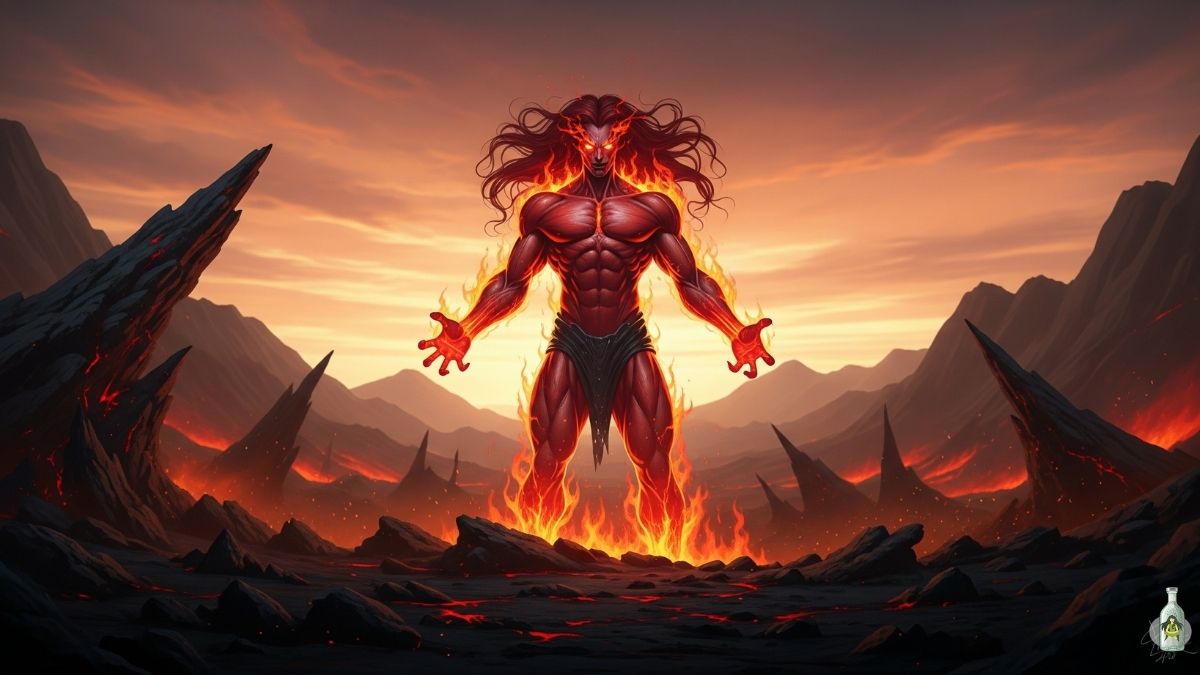
Listen carefully… do you hear that? The whispered warnings carried on desert winds, the ancient voices that speak of things that should not be named in the light of day…
In the suffocating darkness of ancient deserts, where the wind carries whispers of forgotten terrors and shadows dance with malevolent purpose, there exists a class of beings so unnaturally powerful, so devastatingly malevolent, that even the bravest souls dare not speak their name when darkness falls. These are the ifrits — the most dreaded among the Islamic demons, creatures born from a smokeless fire whose very existence sends ice-cold shivers down the spine of anyone who truly comprehends their horrifying nature.
What Lurks in the Shadows: Understanding the Ifrit Meaning
What is an ifrit in Islamic mythology? The word ifrit itself seems to crawl from the depths of hell, slithering off the tongue like a curse. Derived from the Arabic root ʿ-f-r, meaning “to rub” or “to become dusty,” this innocent etymology masks a far more sinister truth that will make your blood run cold.

In the realm of Islamic demons, an ifrit in Islam represents the most rebellious, most powerful, and most terrifyingly intelligent class of jinn — supernatural beings forged from smokeless fire who possess abilities that would make your soul tremble. They are not mere spirits. They are predators of the supernatural realm.
The difference between jinn and ifrit in Islam is like comparing a whisper to a scream, a shadow to a consuming darkness that devours light itself. Unlike their lesser jinn brethren, ifrits are not mere mischievous spirits playing pranks in the night. They are entities of pure malevolence, beings whose very essence pulses with rebellion against the divine order.

Related:
The Quranic Horror: Solomon and Ifrit — When Divine Authority Meets Demonic Power
Close your eyes and imagine the scene. Can you feel the supernatural tension crackling in the air?
The most bone-chilling account of ifrit encounters emerges from the sacred text itself. Stories of ifrits in the Quran and Hadith paint a picture so terrifying that even seasoned scholars of Islamic jinn stories find themselves trembling at the implications, their scholarly composure cracking like ice under hellfire.
In Surah An-Naml (27:38-40), we witness a scene that would make even the most hardened horror enthusiast’s skin crawl and their heart skip beats of pure terror.
How did Prophet Solomon control ifrits? The answer lies in divine authority so absolute that it could command the very forces of hell itself. Prophet Solomon (Sulaiman), blessed with dominion over the supernatural realm, sits in his court surrounded by an assembly that defies human comprehension — humans, birds, and the dreaded jinn.
When Solomon demands that someone bring him the Queen of Sheba’s throne, an ifrit steps forward from the shadows like a nightmare made manifest. Imagine: a being of pure terror, its form shifting between fire and smoke, its eyes burning with the intensity of hellfire itself, declaring with bone-chilling confidence that penetrates the very soul:
“I will bring it to you before you rise from your place, and verily, I am indeed strong, and trustworthy for such work.”
– (Quran 27:39)

The very fact that this ifrit could address Solomon directly speaks to its terrifying intelligence and power. These are not mindless demons stumbling through darkness — they are calculating, strategic entities whose ifrit supernatural powers can bend reality itself to their will. The ifrit’s boast reveals the horrifying truth: they possess strength that transcends human understanding, intelligence that mocks our limitations.
Yet even more disturbing is what happens next. Another being, one with knowledge of the divine Book, brings the throne even faster, demonstrating that while ifrits are terrifyingly powerful, they are not omnipotent. This hierarchy of supernatural power should offer no comfort — it merely reveals that there are forces in the universe so dark and complex that even demons have their place in a cosmic order we can barely comprehend.
The chess game between light and darkness continues, and we are merely pawns.
The Prophet’s Nightmarish Encounter: Who is the ifrit that tried to disrupt Prophet Muhammad’s prayer?
If you thought the Quranic account was disturbing, steel yourself for an even more harrowing tale that will haunt your dreams.
Prophet Muhammad himself faced the malevolent fury of an ifrit in what can only be described as a supernatural assault that would have utterly destroyed any ordinary mortal. This was not a chance encounter — it was a calculated attack from the realm of nightmares.

According to Hadith collections including Sahih Muslim and Musnad Ahmad, the Prophet revealed with chilling clarity:
“An ifrit from the jinn came to me last night to interrupt my prayer, but Allah gave me power over him…”
Let the scene unfold in your mind like a horror beyond imagination:
The Prophet, deep in prayer,suddenly confronted by a being of pure evil attempting to shatter his connection to the divine. The ifrit didn’t simply appear — it actively sought to disrupt the most sacred act of worship. This wasn’t a random encounter; it was a calculated attack by an entity that understood the spiritual significance of what it was trying to destroy.
Can you feel the malevolent presence? The way the air itself would have turned cold?
The Prophet’s account becomes even more chilling when he reveals that he considered tying the ifrit to a pillar in the mosque so people could see it in the morning light. Can you fathom the horror of such a sight? A demon, bound and writhing in the holy space, its supernatural form barely contained by divine power, its eyes burning with hatred that could melt steel.
The fact that the Prophet refrained out of respect for Solomon’s unique kingdom only emphasizes the terrifying reality that these encounters were not unique — they were part of an ongoing supernatural war between light and darkness that rages still.
The war continues. The battles are fought in shadows. And sometimes, the darkness wins.
The Literary Nightmare: Famous ifrit stories from Arabian Nights
The transition from sacred text to folklore did nothing to diminish the ifrit’s terrifying nature. If anything, it made them more insidious, more personally threatening.
Ifrit Arabian Nights tales, and ifrit folklore transformed these demons into characters of such disturbing complexity that they continue to haunt readers centuries later, their stories passed down like infectious nightmares.
The Bride Stealer: A Wedding Night Horror
This story will make your skin crawl and your heart race with primal terror.
In “The Porter and the Three Ladies of Baghdad,” we encounter an ifrit whose actions would make even the most twisted horror filmmaker shudder and lose sleep. This demon doesn’t simply kill or possess — it kidnaps a beautiful woman on her wedding night, the moment that should represent the pinnacle of human joy and love.
Imagine the scene: joy transformed to terror in an instant.

The ifrit drags her to the depths of the ocean, imprisoning her in a locked chest that becomes her underwater tomb. For years, she remains trapped in this hellish prison, her only companion the very demon who destroyed her life. The psychological horror of this scenario — the isolation, the helplessness, the constant presence of malevolent intelligence — represents a fate worse than death itself.
What conversations did they have in that underwater hell? What did the ifrit whisper to her in the endless darkness?
The Fisherman’s Curse: Tales of Solomon trapping ifrits in bottles
Some discoveries are too dangerous to make. Some bottles should never be opened.
The story of “The Fisherman and the Jinni” presents perhaps the most iconic ifrit encounter in all of literature. When the poor fisherman pulls up his nets and finds a brass bottle sealed with Solomon’s seal, he unknowingly holds in his hands a container of pure malevolence.
He should have thrown it back into the depths. He should have run.
The ifrit that emerges is not grateful for its freedom. Instead, it declares with bone-chilling certainty its intention to murder its liberator. The demon’s logic is terrifyingly simple: centuries of imprisonment have driven it to a level of rage that can only be satisfied by killing whoever frees it. This is not justice or even revenge — it is pure, concentrated evil seeking expression.

Can you imagine the fury? The madness? The accumulated hatred of centuries?
The fisherman’s escape through trickery might seem like a victory, but consider the implications that will make your blood freeze: the ifrit is now free in the world, and there are likely countless other bottles, other seals, other prisons waiting to be opened by unsuspecting humans. Jinn Solomon controlled have left a legacy of supernatural landmines scattered throughout our reality.
How many bottles remain? How many seals are weakening with time?
The Modern Horror: Can ifrits possess humans in Islam?
The terror of ifrits is not confined to ancient texts and folklore. They walk among us still.
Are ifrits good or evil in Islamic texts? The answer is unequivocally chilling — they are entities of pure malevolence that continue to wage war against humanity through ifrit possession, sorcery, and shape-shifting that would make your blood freeze in your veins.
The Invasion of the Human Soul: Signs of ifrit possession and Islamic exorcism
Ifrit possession represents one of the most harrowing experiences imaginable. Unlike Hollywood depictions of demonic possession, Islamic accounts describe a process of systematic invasion where the ifrit doesn’t simply control the body — it corrupts the very essence of the person, poisoning them from within.
The possessed individual becomes a battleground between human will and supernatural malevolence.
The signs of ifrit possession are as terrifying as they are varied: unnatural strength that can bend steel, knowledge of hidden information they should never possess, speaking in voices not their own that chill the blood, and displaying personalities that are fundamentally alien to their nature.

But perhaps most disturbing is the intelligence behind these manifestations. Ifrits don’t simply rage and destroy — they manipulate, deceive, and corrupt with surgical precision. They know exactly which buttons to push, which fears to exploit, which hopes to crush.
They study us. They learn us. They become us.

Might Interest You:
The Terrifying True Story That Inspired “The Exorcist”
The Ancient Art of Spiritual Warfare: Ruqyah for ifrit
This is humanity’s last line of defense against the supernatural storm.
Ruqyah for ifrit represents humanity’s primary defense against these supernatural attacks. This is not the dramatic, cinematic ifrit exorcism of popular culture, but a methodical spiritual warfare that acknowledges the very real danger these entities pose.
The battle is not just against the demon, but against the fear and despair it seeks to instill.
The ruqyah process involves reciting specific Quranic verses, particularly those that emphasize divine protection and the limitations of jinn power. The practitioner must have unwavering faith, as ifrits are known to exploit any weakness or doubt in their opponents like predators sensing wounded prey.

Real exorcism prayers for ifrit possession include verses like Ayat al-Kursi (Quran 2:255), which serves as a spiritual shield against supernatural attacks. The power of these divine words can force even the most powerful ifrit to retreat, but only when wielded by someone with absolute faith and proper spiritual preparation.
The words have power. But only if you truly believe.
Divine Protection: Islamic ways to protect against ifrits and jinn
Knowledge is protection. Ignorance is vulnerability.
Ifrit prayer protection is not merely a concept from ancient texts — it is a living practice that provides real spiritual armor against supernatural threats. The Islamic ways to protect against ifrits and jinn form a comprehensive system of spiritual defense that has been refined over centuries of supernatural warfare.

Regular prayer, remembrance of Allah, and maintaining ritual purity are considered the primary protective measures. The recitation of Surah Al-Falaq and Surah An-Nas creates a spiritual barrier that ifrits cannot penetrate. These verses specifically mention seeking refuge from “the evil of that which He created” and “the evil of the whisperer who whispers in the hearts of mankind.”
The protection is real. But it requires discipline, faith, and constant vigilance.
The Islamic view on black magic and ifrits reveals another layer of horror that will make your soul tremble. Some humans actively seek out ifrits for sorcery purposes, believing they can harness demonic power for their own ends. But Islamic scholars warn that such practices inevitably lead to the magician’s destruction.
The ifrit doesn’t serve — it corrupts. It grants power only to create dependency, and provides abilities only to ensure the sorcerer’s eventual damnation.
The Shapeshifter’s Deception: Ifrit Supernatural Powers Beyond Comprehension
The most terrifying truth: they could be anyone, anywhere, anytime.
Ifrit’s supernatural powers extend far beyond simple possession. These entities possess the ability to shape-shift, taking on human or animal forms with such perfection that detection becomes nearly impossible. This is not mere illusion — it is a fundamental alteration of their being that allows them to walk among us undetected.
Imagine the person sitting next to you…
The animal you pet…
The stranger you pass on the street…
Any of them could be an ifrit in disguise, studying you, learning your weaknesses, waiting for the perfect moment to strike. The shape-shifting ability means that ifrits are not distant threats confined to ancient stories — they could be active participants in our daily lives.
How would you know? How could you tell? What signs would betray their true nature?
The Cultural Legacy: Ancient ifrit myths and modern pop culture
The fear transcends time, culture, and belief. It is universal because it is true.
Ancient ifrit myths and modern pop culture have created a fascinating yet disturbing evolution of these entities. While contemporary media often dilutes their terrifying nature, the core truth remains: ifrits represent humanity’s deepest fears about the supernatural realm and our vulnerability to forces beyond our understanding.
Ifrit stories Quran continue to influence modern horror precisely because they tap into something fundamental about the human psyche — our fear of intelligent evil, our terror of beings that understand us better than we understand ourselves, and our helplessness against forces that operate according to rules we cannot comprehend.
The stories persist because the threat is real.
FAQ: Confronting the Ifrit Mystery
Are ifrits mentioned in the Quran?
Yes, ifrits are directly mentioned in the Quran, most notably in Surah An-Naml (27:38-40) where an ifrit offers to bring the Queen of Sheba’s throne to Prophet Solomon. This passage demonstrates their supernatural abilities and their place in the cosmic hierarchy of power.
How did Prophet Solomon control ifrits?
Prophet Solomon was granted unique divine authority over jinn and ifrits by Allah. He could command them to perform tasks, imprison them, and bind them with supernatural seals. His control was absolute and represented a prophetic miracle that no other human has possessed.
What is the difference between an ifrit and other jinn?
Ifrits are a specific class of jinn characterized by their exceptional power, rebellious nature, and malevolent intelligence. While not all jinn are evil, ifrits are consistently portrayed as hostile to humans and divine order. They possess greater supernatural abilities than ordinary jinn.
Can ifrits possess people in real life?
According to Islamic belief, ifrit possession is a real phenomenon that can cause physical and mental illness. Islamic tradition provides specific remedies through ruqyah (spiritual healing) and emphasizes the importance of divine protection against such supernatural attacks.
What Islamic prayers protect against ifrits?
Islamic protection against ifrits includes reciting specific Quranic verses, particularly Ayat al-Kursi (Quran 2:255), the last two verses of Surah Al-Baqarah, and Surah Al-Falaq and Surah An-Nas. Regular prayer, remembrance of Allah, and maintaining ritual purity are also considered protective measures.
References and Sources
- The Holy Quran – Surah An-Naml (27:38-40) – The encounter between Solomon and the ifrit
- Sahih Muslim – Hadith collections containing Prophet Muhammad’s accounts of ifrit encounters
- Musnad Ahmad – Additional Hadith sources on jinn and ifrit interactions
- Alf Layla wa-Layla (The Arabian Nights) – Classical Arabic folklore collection featuring ifrit stories
- Islamic scholarly works on jinn and supernatural entities by classical and contemporary scholars
- Ruqyah manuals and Islamic spiritual healing texts
- Quranic commentaries (Tafsir) explaining references to jinn and ifrits
- Islamic jurisprudence (Fiqh) texts addressing supernatural encounters and spiritual protection

Leave a Reply